Portrait of a child
- Date de création
- AD 240s
- Material
- Göktepe marble, district 4 (Turkey)
- Dimensions
- H. 28 x l. 21 x P. 15 (cm)
- Inventory number
- Ra 167
- Photo credits
- Daniel Martin
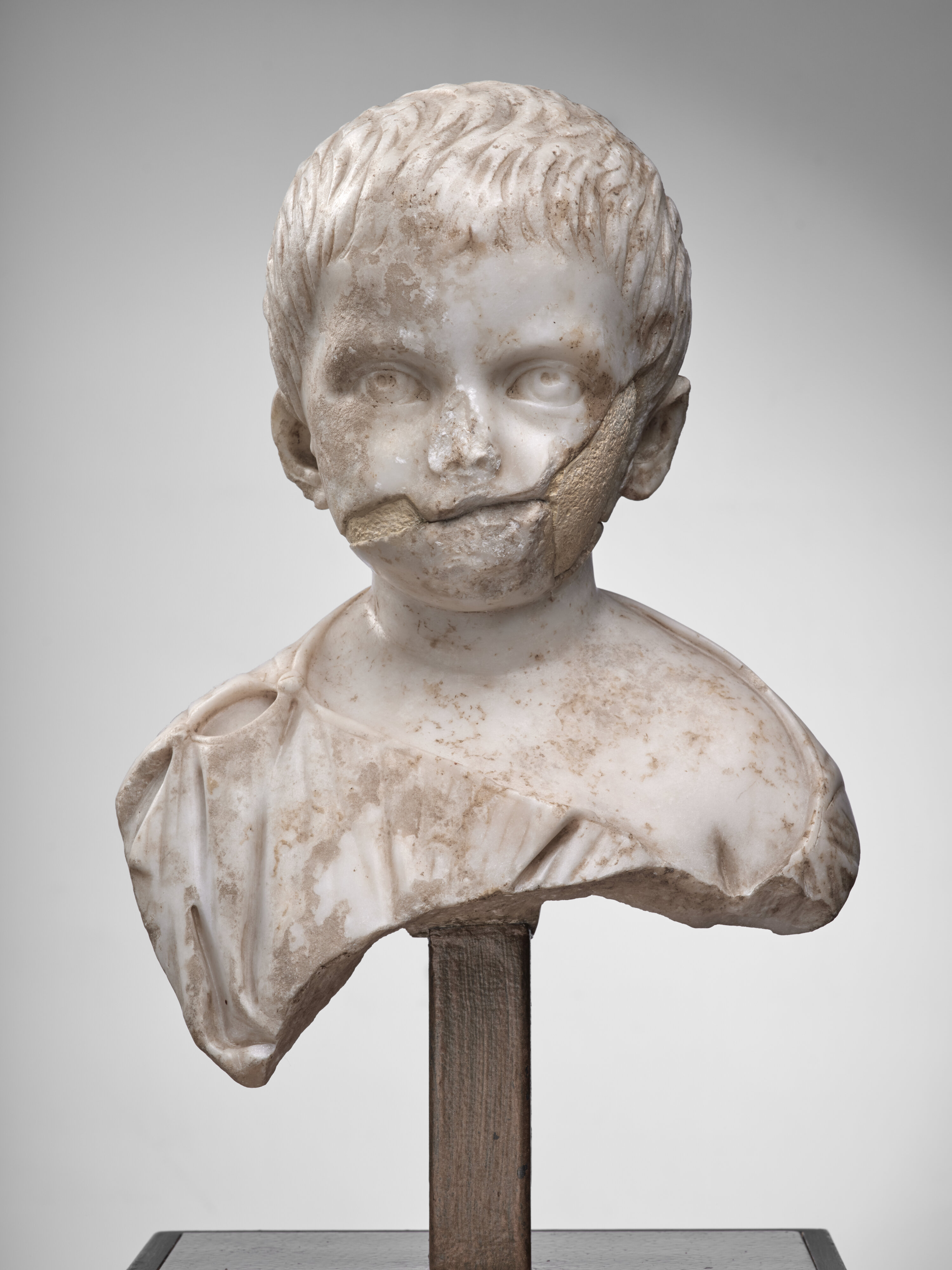
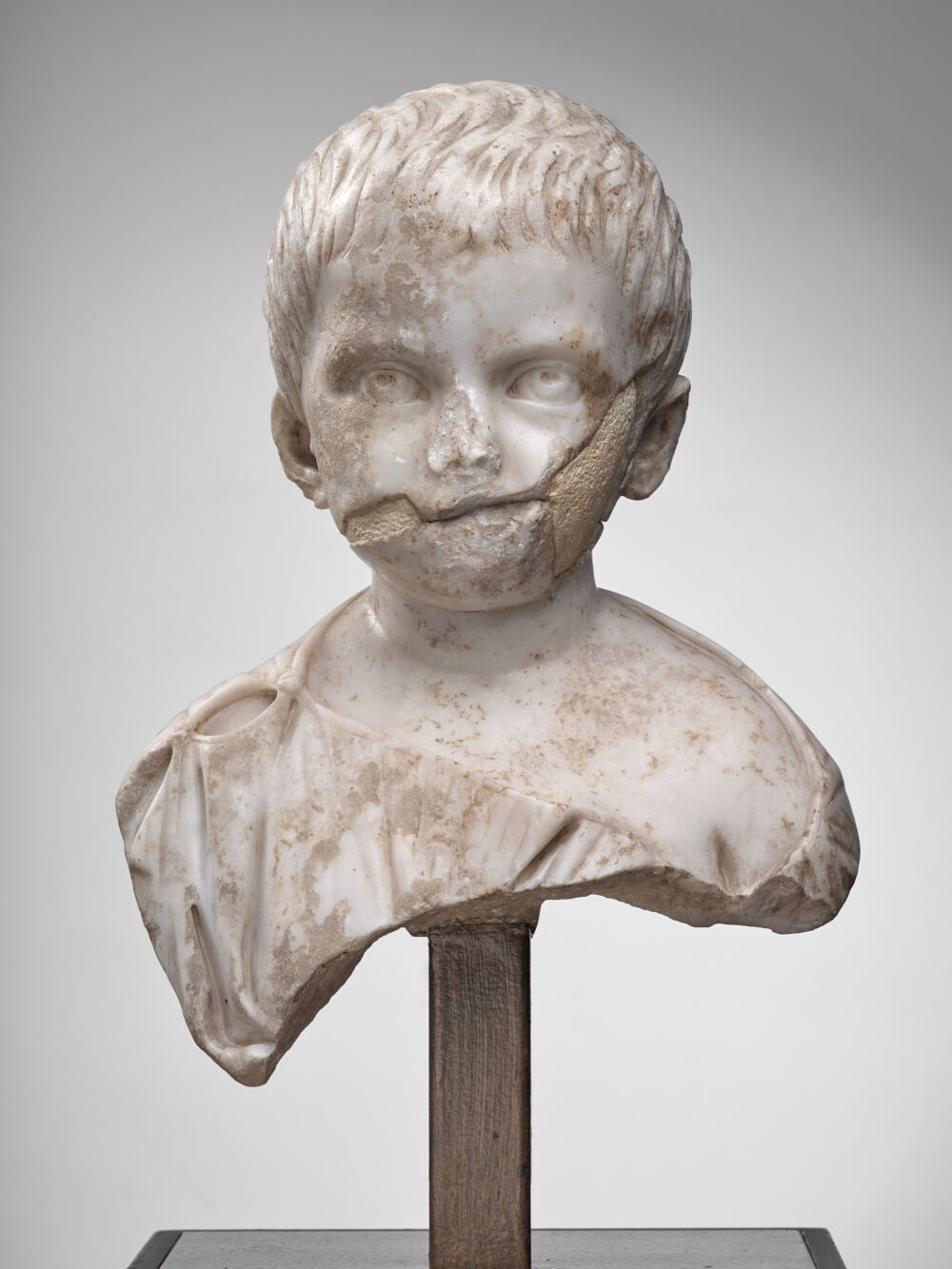
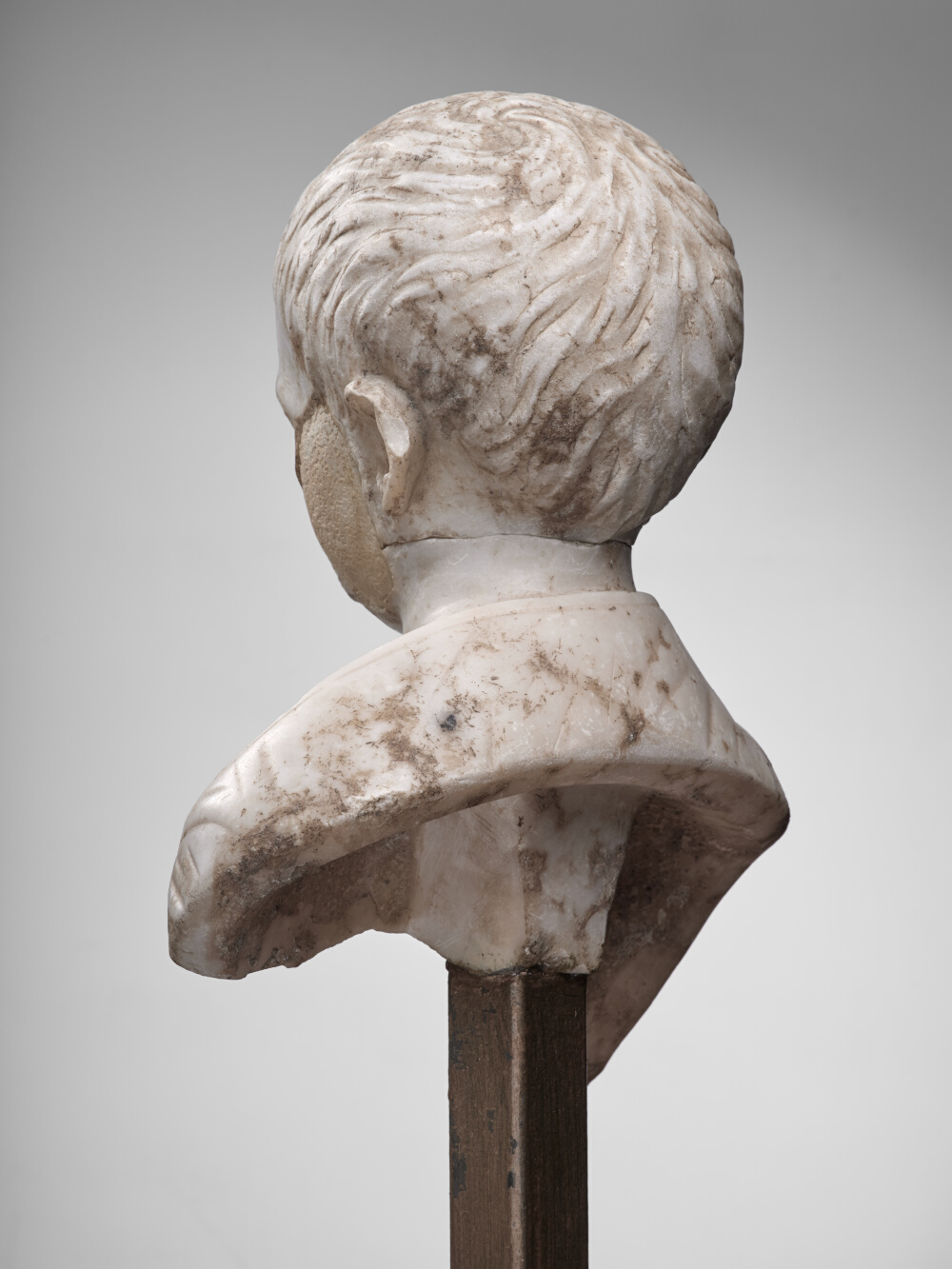
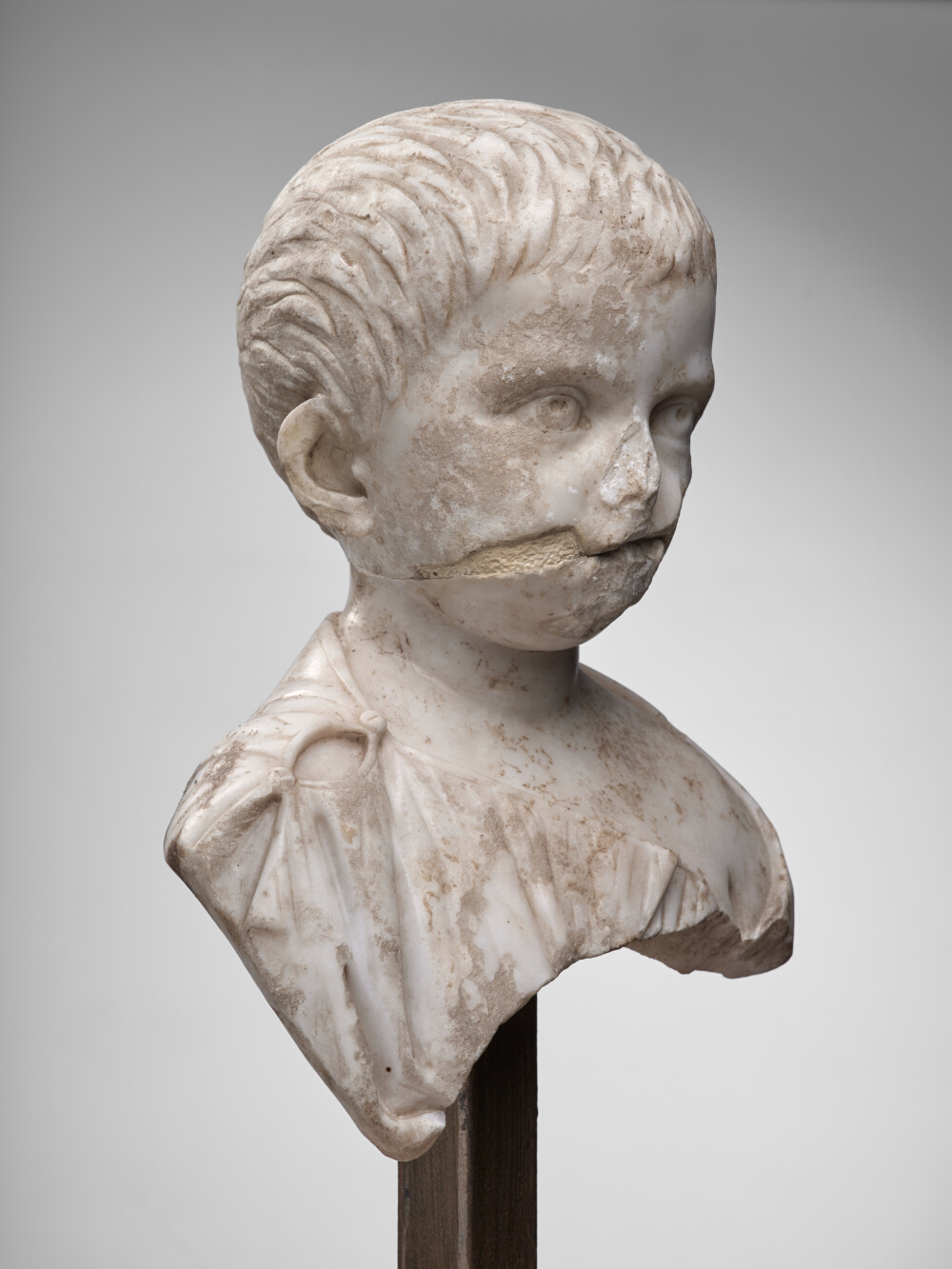
Long displayed at the Musée Saint-Raymond alongside the bust of Tranquillina (Ra 166), this portrait was interpreted as that of a child of the empress and Gordian III, due to general similarities in proportions, clothing, and material. This association is no longer accepted. Several arguments speak against this hypothesis: the differences in craftsmanship between the two sculptures, the lack of any documented children for the imperial couple, the distinct origins of the Göktepe marble blocks used to create them, as well as the incompatibility of their spatial presentation—the bust of Tranquillina is turned slightly to the side, while that of the child faces strictly forward. The portrait is therefore now considered an independent work.
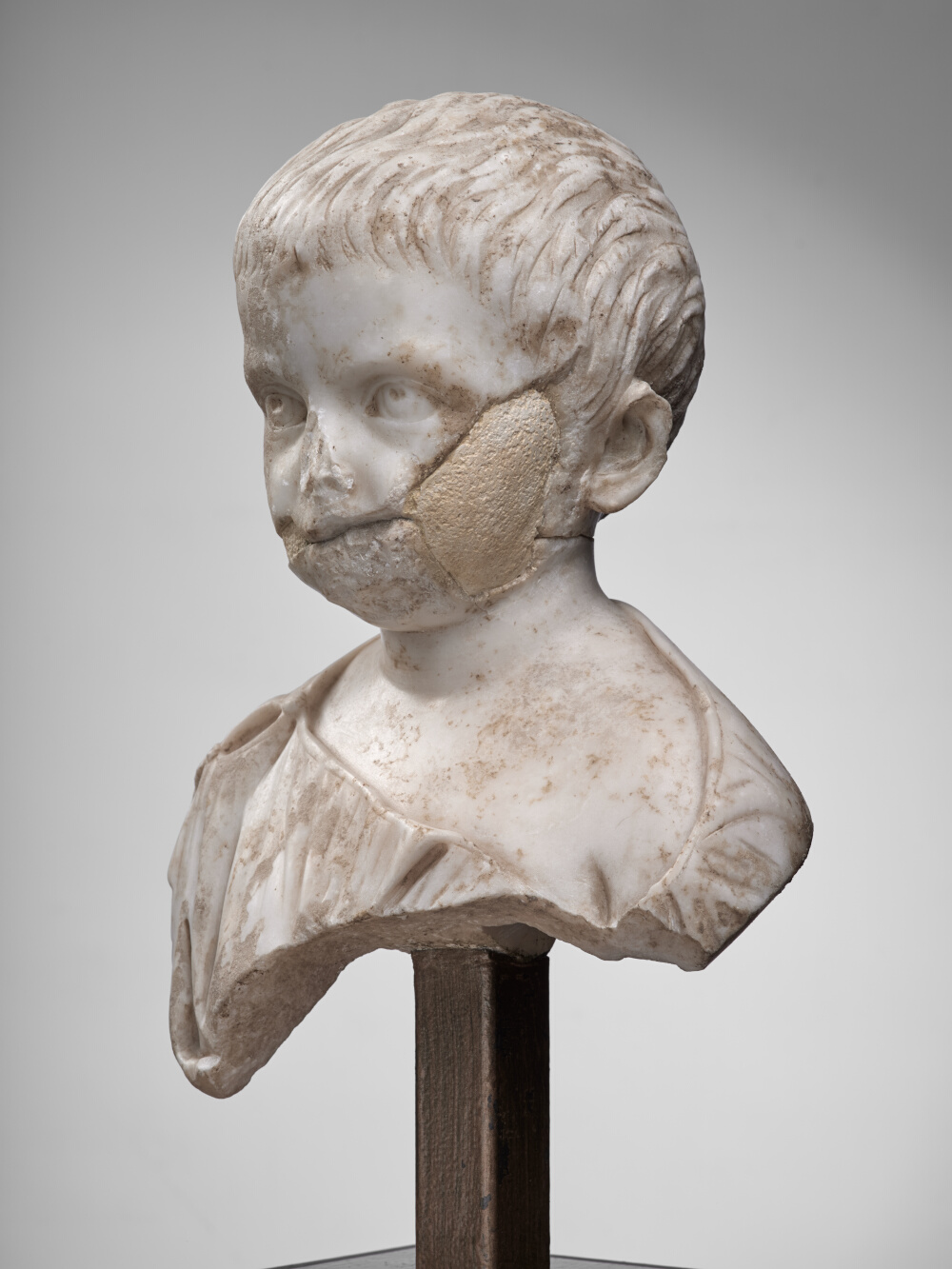
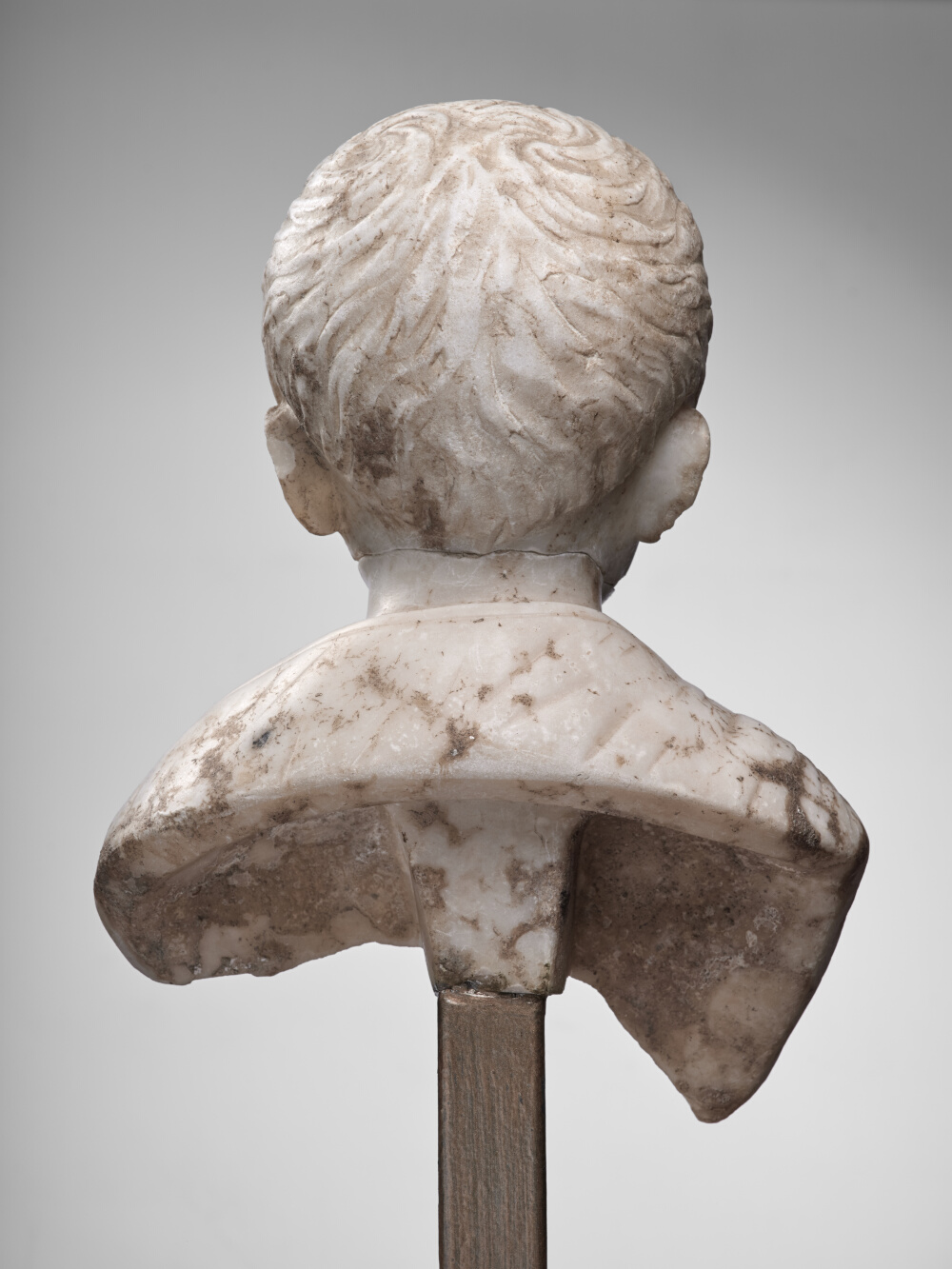
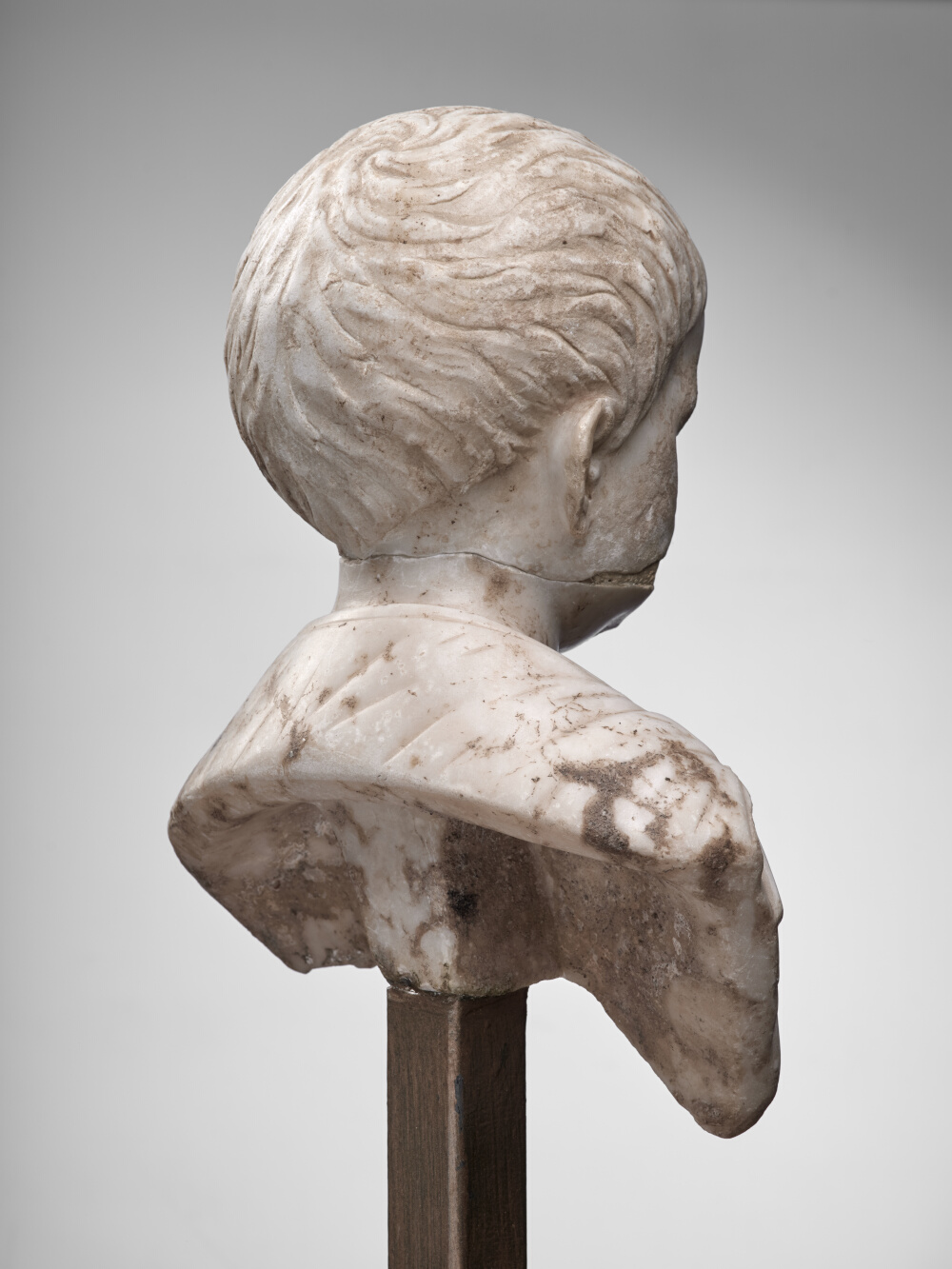
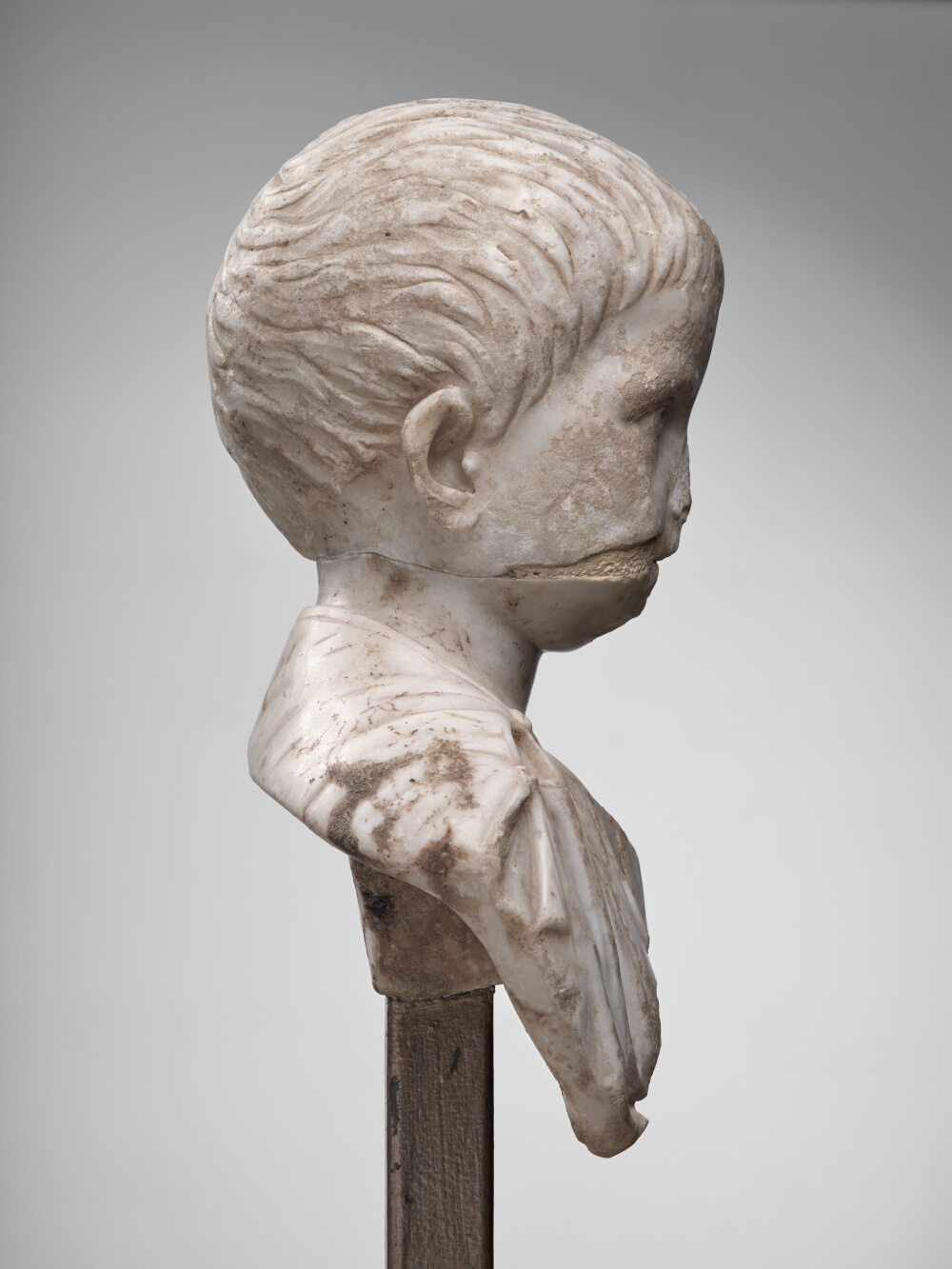
The bust depicts a very young child, approximately one year to eighteen months old. The child wears the tunic characteristic of early childhood, fastened on the right shoulder with small buttons and slipping off the left shoulder. This garment, common to both boys and girls in antiquity, provides no basis for linking this work to Tranquillina. Its sculptural treatment also differs: the folds are rendered as broad surfaces separated by deep trepan grooves, with a simpler and more austere execution than in the female portrait. The bust’s small dimensions correspond perfectly to the subject’s age and are not unusual when compared to other portraits of children from Chiragan.
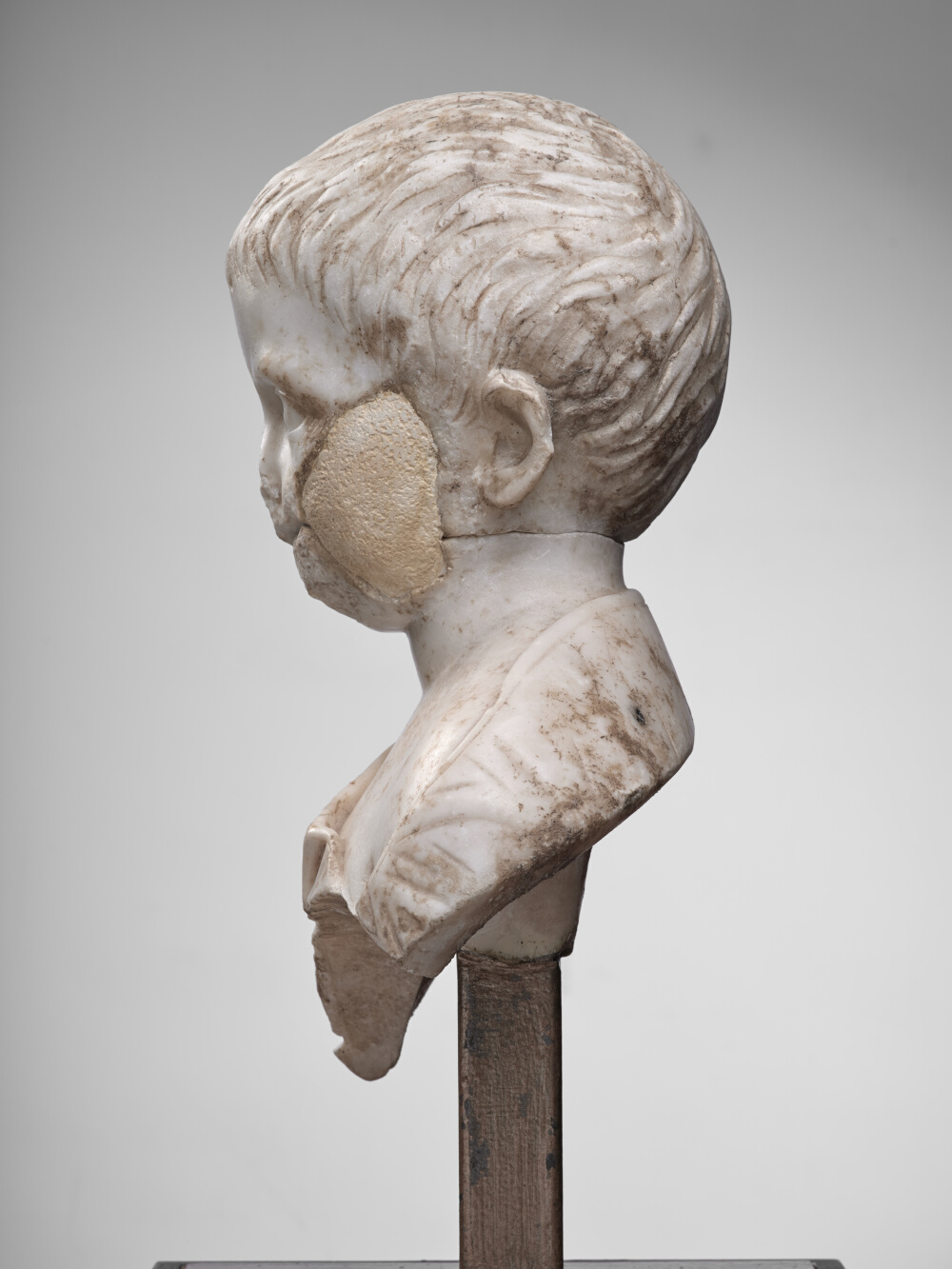
The shape of the bust provides an initial clue for dating. Despite the loss of its lower portion, it belongs to the morphological group defined by Adolf Hekler as a transitional phase between Flavian-era works and those from Trajan’s reign. The depiction of the torso becomes more naturalistic, with the shoulders better defined by subtle grooves. Several comparisons with portraits preserved in Göttingen, at the Capitoline Museums, and at the Museum of Naples place this style around the year 100. Certain more archaic details, notably the thickness of the breastplate or the structure of the lapel, are reminiscent of older models, while the quality of the workmanship rules out an overly early date.
The hairstyle provides more precise chronological clues. The hair is arranged from the crown of the head toward the forehead in long, fine, slightly wavy strands. This arrangement directly evokes the men’s hairstyles that appeared under Trajan, with a subtle central parting of the frontal strands. However, the strands remain more supple and less geometric than in imperial portraits. Parallels are drawn with several Trajanic portraits as well as with depictions of children dating from the early 2nd century. However, certain characteristics suggest extending this chronology slightly into the reign of Hadrian.
The decisive criterion lies in the treatment of the eye. The iris is engraved and the pupil drilled, a technique that appeared in Roman portraiture around 130. This innovation lends the gaze a new depth and expressiveness that had previously been achieved primarily through polychromy. The child’s gaze, particularly gentle and slightly dreamy, finds its closest parallels in the early portraits of Antoninus Pius and in certain works from the end of Hadrian’s reign. The finesse of the execution rules out the possibility of later retouching.
Portraits of children often follow a different evolutionary path than those of adults. Hairstyles inspired by models from the Trajan era thus continued to be used for several decades among young children, even as adult fashion had evolved. This continuity explains why the portrait combines a Trajan-inspired hairstyle with a technique for rendering the eyes characteristic of the 130s.
Thus, a combined analysis of the bust’s morphology, the hairstyle, and especially the rendering of the eyes leads to a proposed dating in the 130s–140s, likely during the final years of Hadrian’s reign or the beginning of Antoninus Pius’s reign. The work illustrates both the persistence of certain iconographic models inherited from Trajan and the technical innovations introduced into Roman portraiture during the second quarter of the 2nd century.
Based on J.-C. Balty and E. Rosso 2024, Sculptures antiques de Chiragan (Martres-Tolosane) I. Les portraits romains I.4 Des Sévères à la Tétrarchie, Toulouse, Musée Saint-Raymond, 2024, p. 169-185.
Bibliography
- Attanasio, Bruno, Prochaska 2021 D. Attanasio, M. Bruno, W. Prochaska, Göktepe Marbles. White, Black and Two-Tone, L’Erma di Bretschneider, Roma, Bristol.
- Cazes et al. 1999 D. Cazes, E. Ugaglia, V. Geneviève, L. Mouysset, J.-C. Arramond, Q. Cazes, Le Musée Saint-Raymond : musée des Antiques de Toulouse, Toulouse-Paris. p. 141
- Espérandieu 1908 É. Espérandieu, Recueil général des bas-reliefs de la Gaule romaine, 2. Aquitaine, Paris. p. 88, no 997
- Joulin 1901 L. Joulin, Les établissements gallo-romains de la plaine de Martres-Tolosane (Mémoires présentés par divers savants à l’Académie des inscriptions et belles-lettres",), Paris.
- Rachou 1912 H. Rachou, Catalogue des collections de sculpture et d’épigraphie du musée de Toulouse, Toulouse. no 167
To cite this notice
Capus P., "Portrait of a child", in The sculptures of the roman villa of Chiragan, Toulouse, 2019, online <https://villachiragan.saintraymond.toulouse.fr/en/ark:/87276/a_ra_167>.