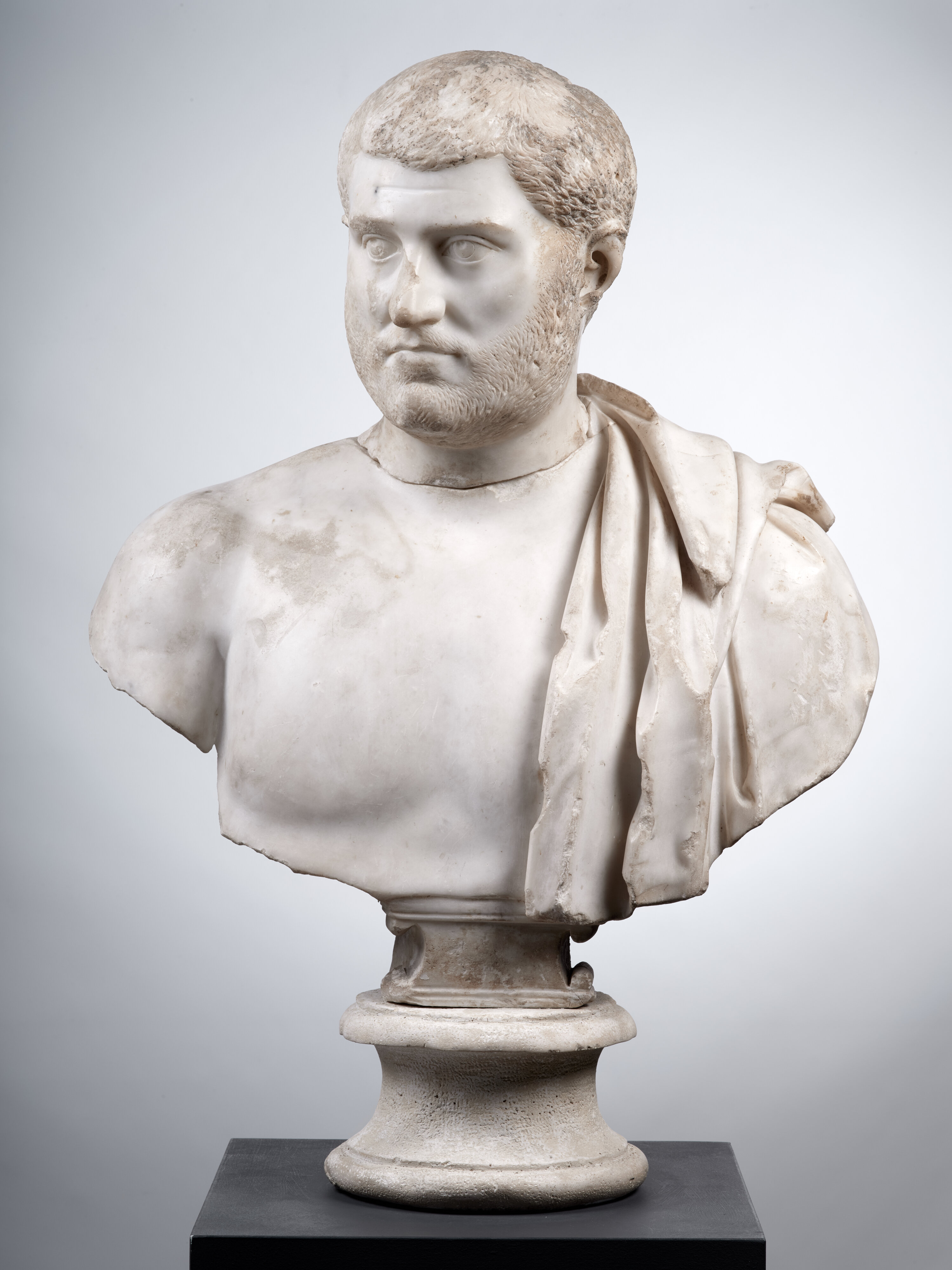
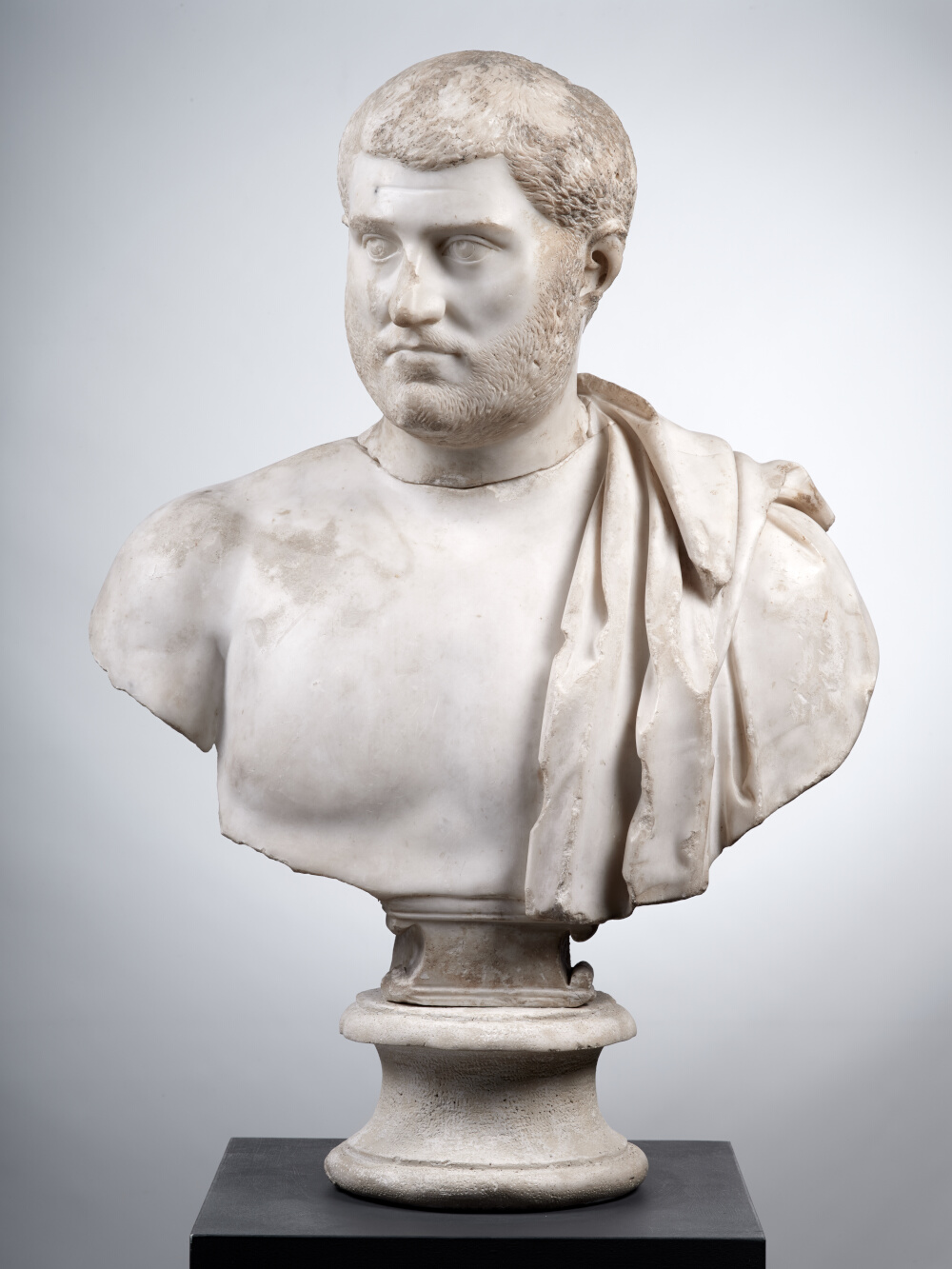
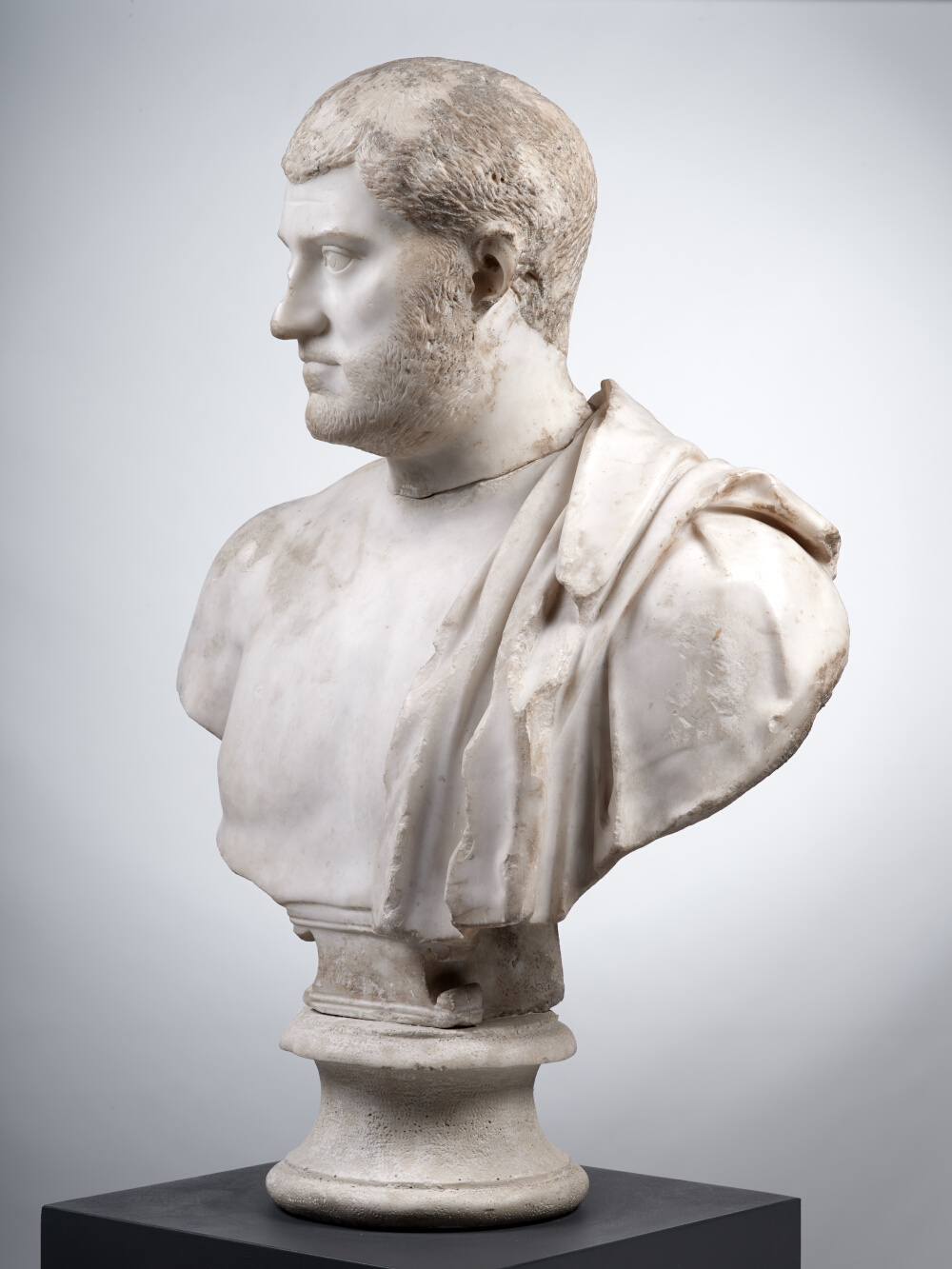
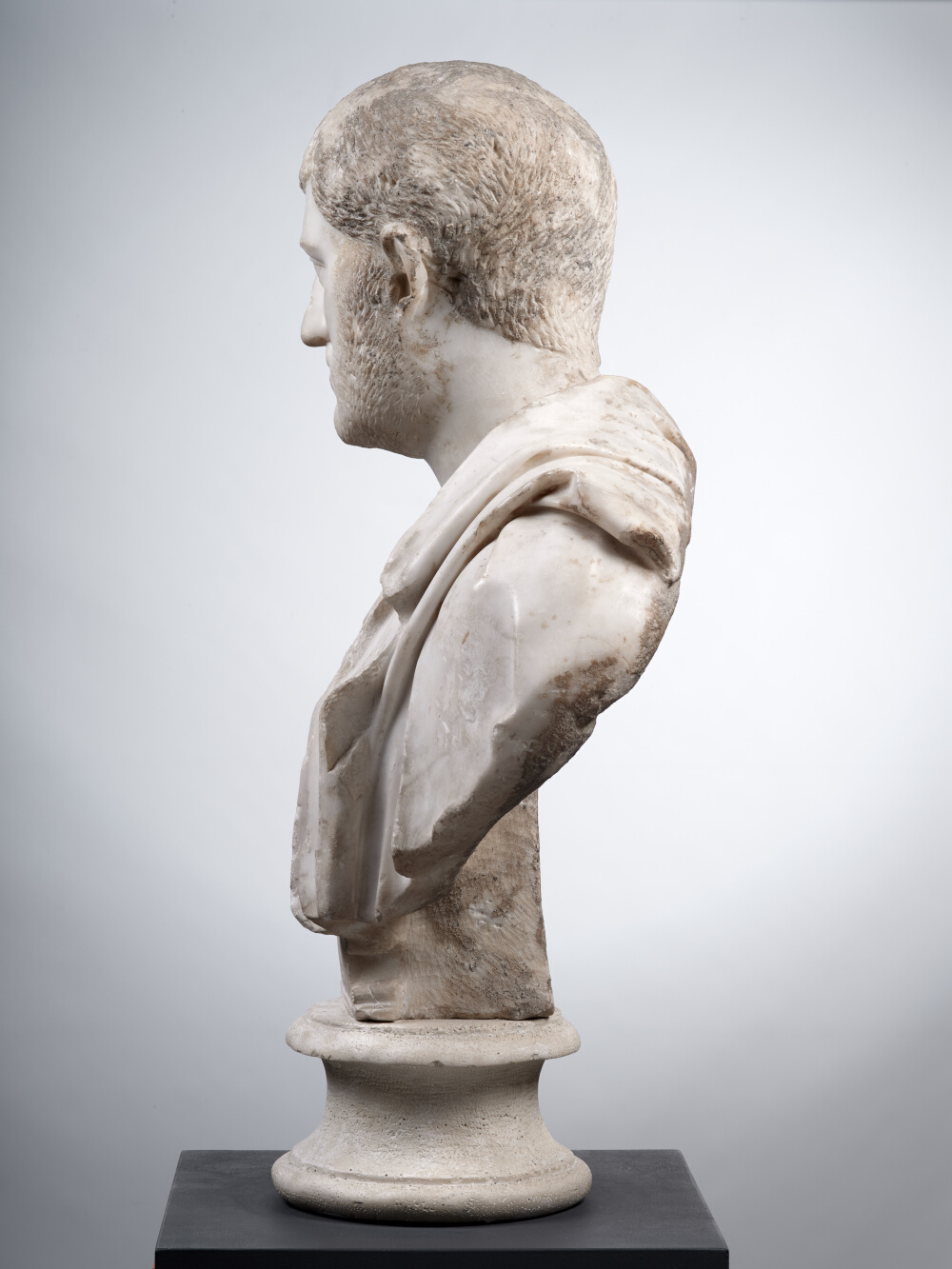
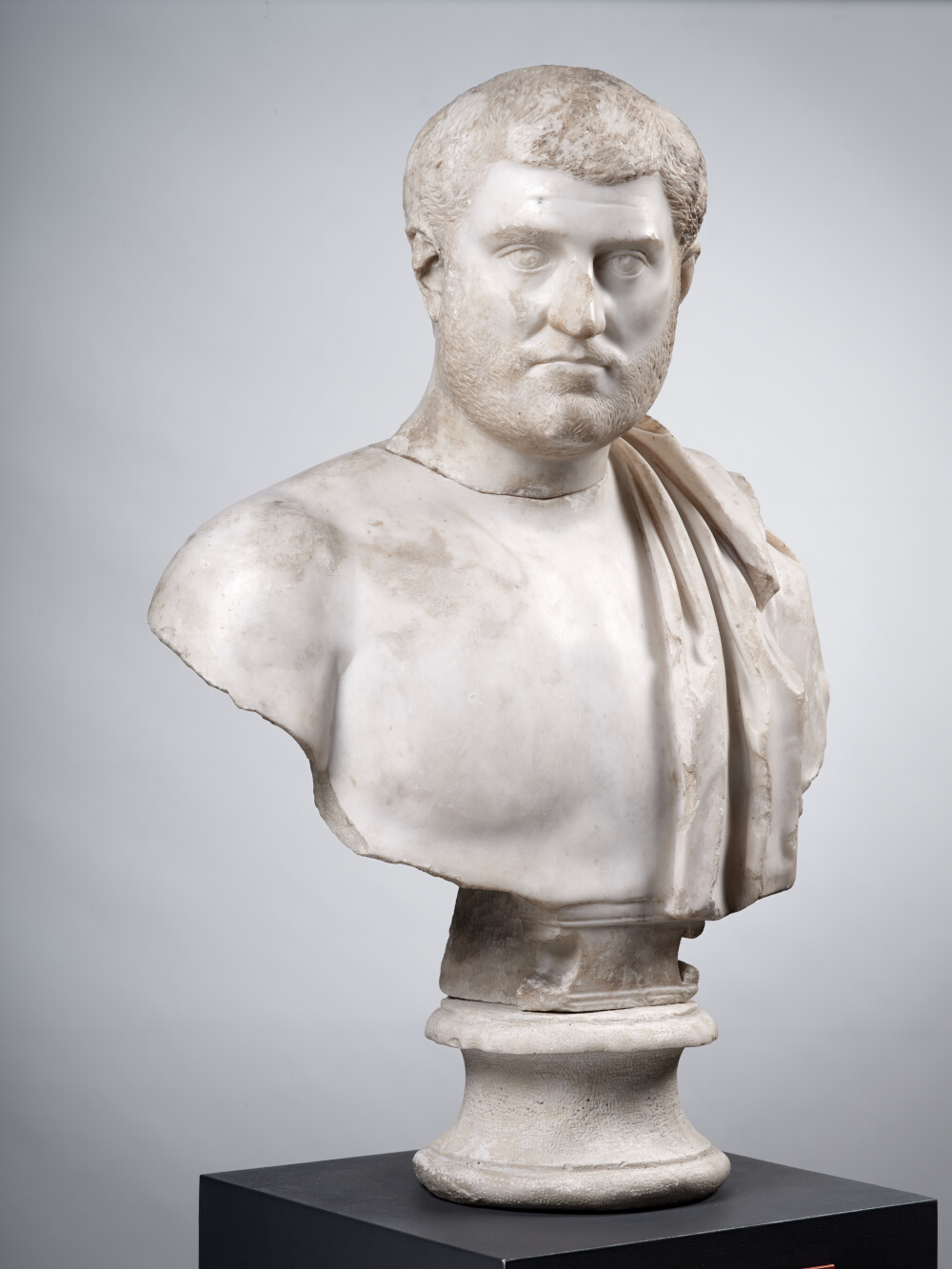
Heroic bust of a man
- Date de création
- Approximately 230 - 240
- Material
- Göktepe marble, district 3 (Turkey)
- Dimensions
- H. 615 x l. 53 x P. 29 (cm)
- Inventory number
- Ra 123
- Photo credits
- Daniel Martin
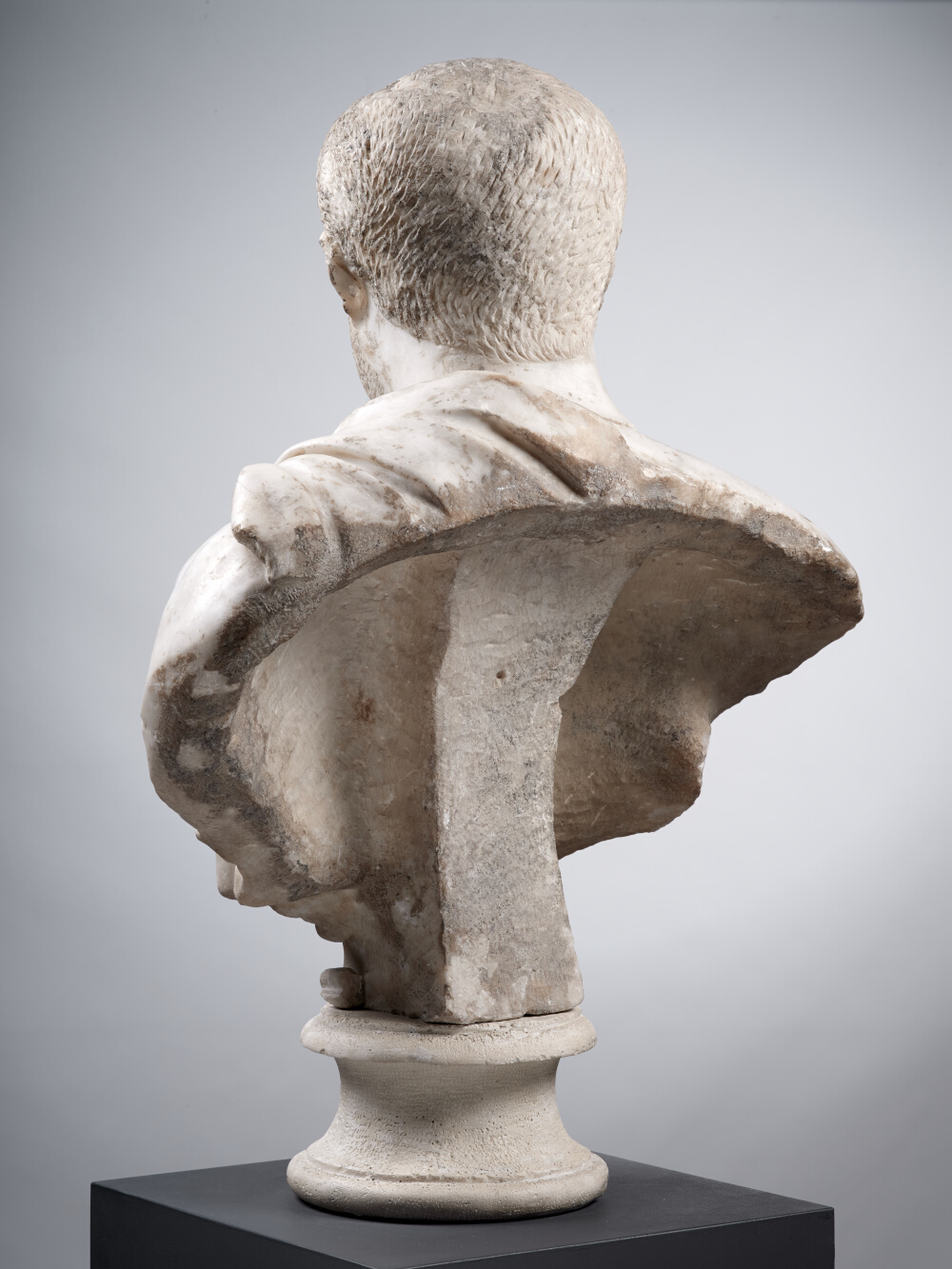
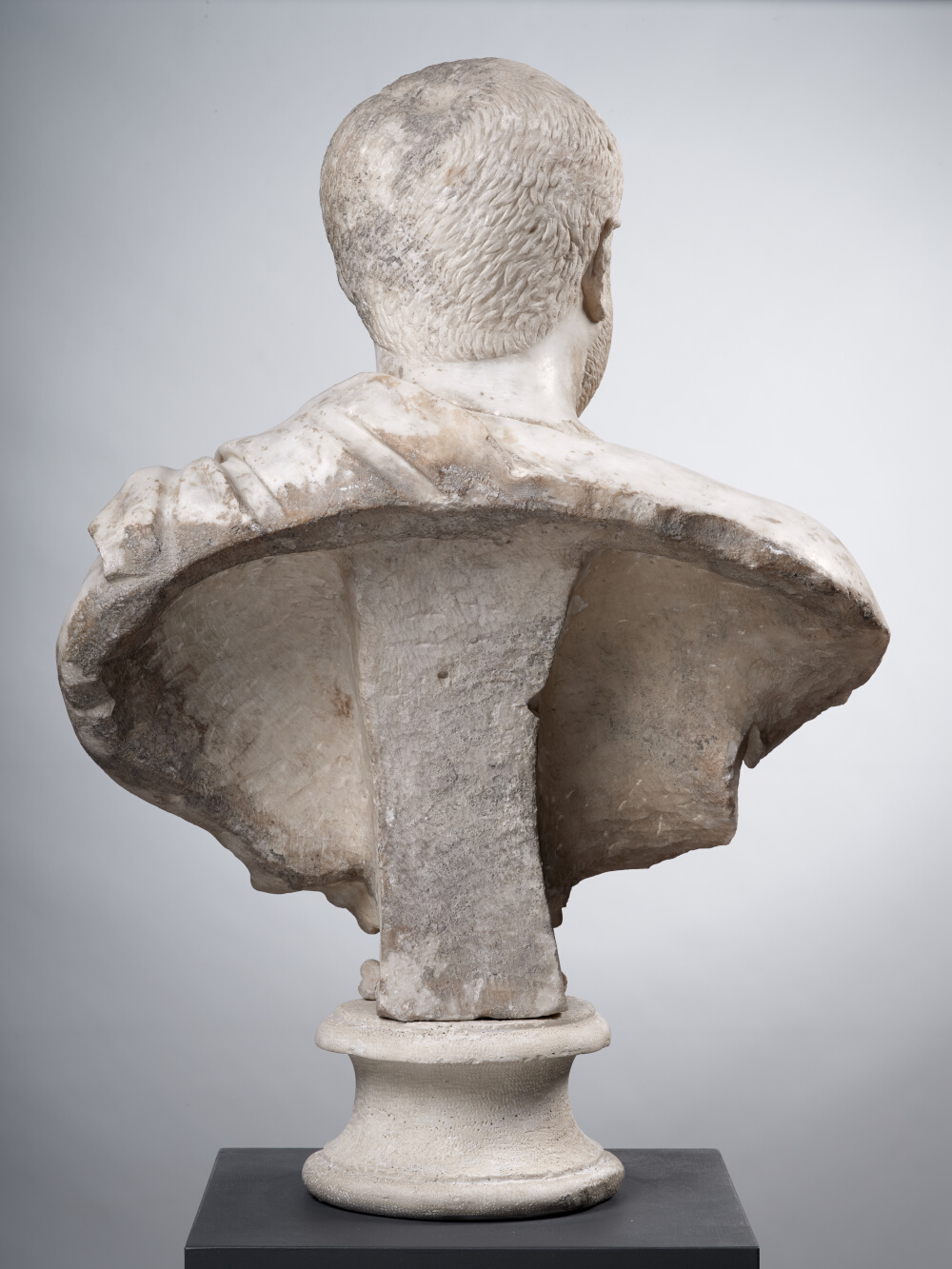
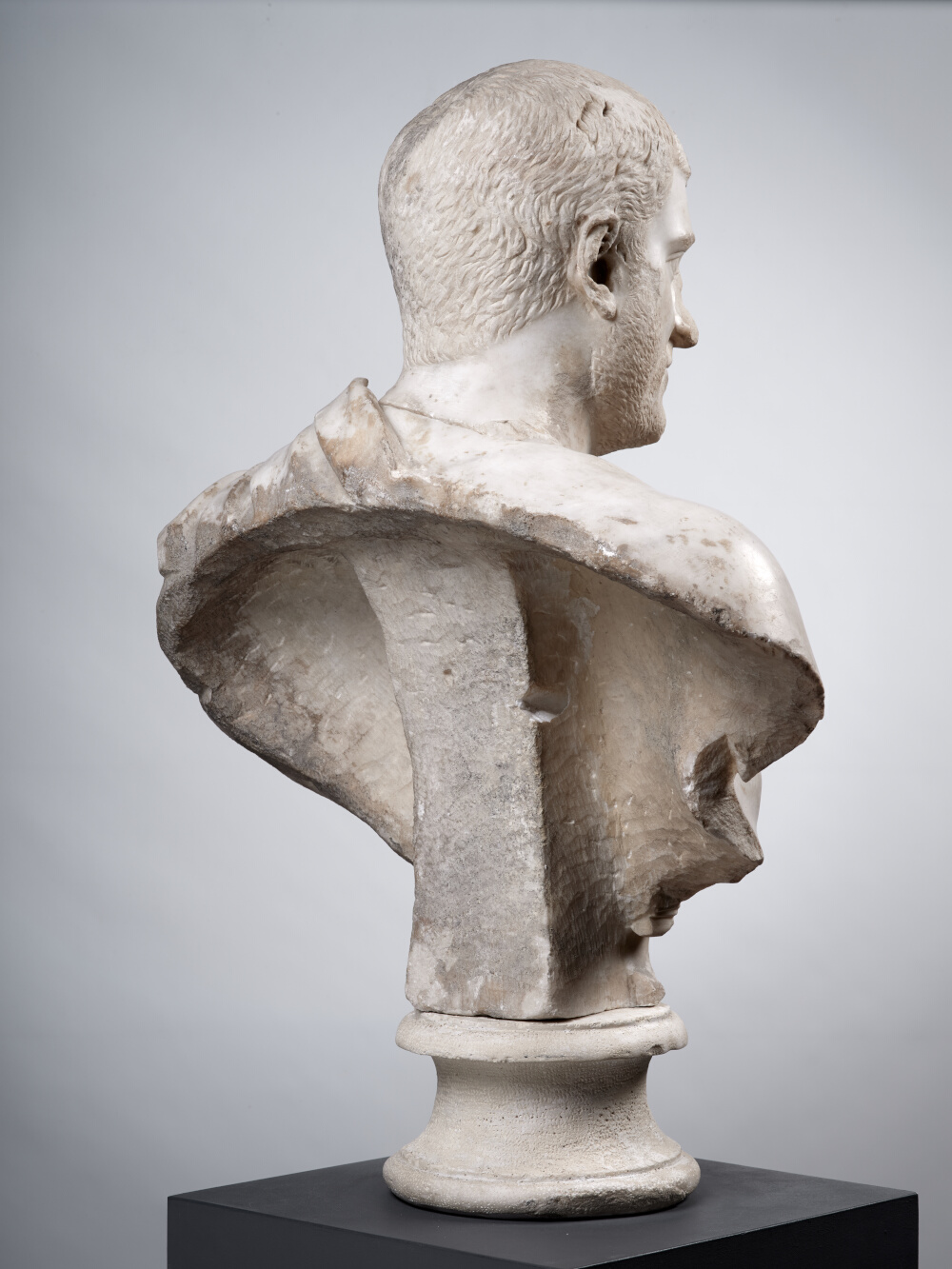
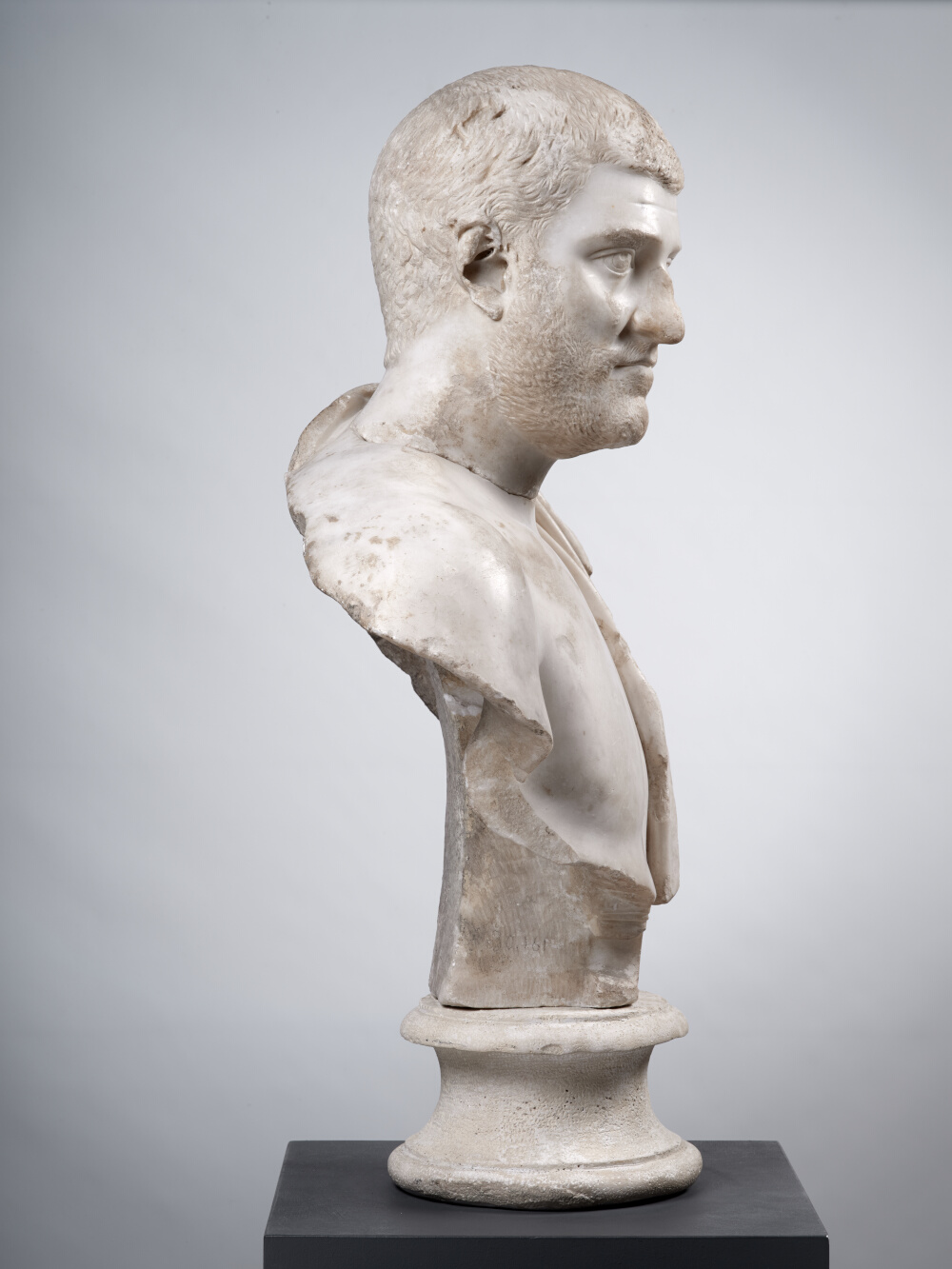
The work appears to be the result of a profound transformation of an earlier bust (Umarbeitung). Several consistent clues point to this intervention: remnants of an original hairstyle preserved above the ears, differences in the modelling of the hair, traces of drilling corresponding to the earlier treatment of the locks, as well as a clear reduction in the volume of the beard. The irregularities observed on the surface of the skull are not the result of later damage but stem directly from this reworking. The craftsman must have had to work with the volumes inherited from the original portrait, adapting the design of the new hairstyle to conceal, as far as possible, the old hollows left by the curled locks of the earlier version.
The transformation mainly concerns elements likely to bring the image up to date in accordance with the tastes of the 3rd century, whilst the face itself remains almost intact. The general proportions, the contour of the cheeks, the bone structure and the main physiognomic features show no significant alterations. This remarkable minimal intervention suggests that the figure depicted in the first phase already belonged to the same social class as that to which the portrait was subsequently assimilated. The transformation therefore consists less of a complete recreation than of a stylistic adaptation intended to modernise an earlier effigy.
An analysis of the hairstyle allows this second phase to be dated to around 235–240. The small, tightly gathered locks, pressed close to the skull in a variation of the a penna style, bear a closer resemblance to portraits from the reign of Gordian III than to the earlier models of Severus Alexander. This dating confirms that the alteration belongs to a relatively late phase of the Severan dynasty or to the beginning of the crisis of the third century.
Conversely, several features of the original bust clearly point to the early 2nd century. The particularly voluminous rendering of the pallium, concentrated in thick, overlapping folds on the left shoulder, the shape of the plinth connecting the bust to the pedestal, and the overall proportions of the piece correspond to works from the end of Hadrian’s reign or the early years of Antoninus Pius. The original portrait could therefore date back to the years 130–140, nearly a century before its alteration.
This chronology sheds light on the practice of reusing portraits in imperial workshops. Around the middle of the 3rd century, an old portrait of an intellectual was selected and then adapted to depict a new figure, probably from the same social circle. The fact that the pallium—a traditional attribute of philosophers, rhetoricians and jurists—was retained in its entirety shows that the portrait’s symbolic function remained unchanged despite the transformation. The process therefore reflects less a desire for material reuse than a wish to preserve the prestige associated with an ancient image whilst updating it in accordance with contemporary aesthetic conventions.
A comparison with a bust held at the Palazzo Massimo alle Terme in Rome (inv. 152) provides further evidence. The two works display striking similarities in the treatment of the drapery, the tilt of the head, the general structure of the face, the modelling of the ears and the arrangement of the volumes. These similarities suggest that the Chiragan portrait derives from a replica belonging to the same series as the Roman example. The craftsman would essentially have limited himself to reducing the thickness of the hair and beard before carefully repolishing the entire surface to erase any traces of his intervention.
The choice of Göktepe marble—a material favoured for official portraits in the 2nd and 3rd centuries—reinforces the hypothesis that it was produced in a Roman workshop close to the imperial court. Like several other portraits from Chiragan, this work appears to have been reworked in Rome before being dispatched to the aristocratic residence in Gaul. The precise identification of the subject remains impossible, but the historical context suggests that this is the effigy of a member of the imperial entourage, probably one of the leading jurists who held a key position within the consilium principis under Hadrian and Antoninus Pius. The portrait thus provides exceptional evidence of the practice of reusing official statuary and of the continuity of iconographic models in the depiction of the Roman elite between the 2nd and 3rd centuries.
Based on J.-C. Balty 2024, Sculptures antiques de Chiragan (Martres-Tolosane). I. Les portraits romains I.4 Des Sévères à la Tétrarchie, Toulouse. Musée Saint-Raymond, Musée d’archéologie de Toulouse, 2024, p. 41-55.
Bibliography
- Attanasio, Bruno, Prochaska 2021 D. Attanasio, M. Bruno, W. Prochaska, Göktepe Marbles. White, Black and Two-Tone, L’Erma di Bretschneider, Roma, Bristol.
- Balty, Cazes, Rosso 2012 J.-C. Balty, D. Cazes, E. Rosso, Les portraits romains, 1 : Le siècle des Antonins, 1.2 (Sculptures antiques de Chiragan (Martres-Tolosane), Toulouse. p. 66, fig. 61, p. 269, fig. 205
- Cazes et al. 1999 D. Cazes, E. Ugaglia, V. Geneviève, L. Mouysset, J.-C. Arramond, Q. Cazes, Le Musée Saint-Raymond : musée des Antiques de Toulouse, Toulouse-Paris. p. 138
- De Lachenal et al. 1986 L. De Lachenal, B. Palma Venetucci, M.E. Micheli, Soprintendenza archeologica di Roma, Museo nazionale romano : I, Le sculture. 6, I marmi Ludovisi dispersi, Rome. p. 48-53
- Espérandieu 1908 É. Espérandieu, Recueil général des bas-reliefs de la Gaule romaine, 2. Aquitaine, Paris. no 972
- Joulin 1901 L. Joulin, Les établissements gallo-romains de la plaine de Martres-Tolosane (Mémoires présentés par divers savants à l’Académie des inscriptions et belles-lettres",), Paris.
- Massendari 2006 J. Massendari, La Haute-Garonne : hormis le Comminges et Toulouse 31/1 (Carte archéologique de la Gaule), Paris. p. 249, fig. 117
- Perrot 1891 G. Perrot, « Rapport sur les fouilles de Martres, » Revue Archéologique, 18, pp. 56–73.
- Rachou 1912 H. Rachou, Catalogue des collections de sculpture et d’épigraphie du musée de Toulouse, Toulouse. no 123
- Musée Saint-Raymond 1995 Musée Saint-Raymond, Le regard de Rome : portraits romains des musées de Mérida, Toulouse et Tarragona. Exhibition, Mérida, Museo nacional de arte romano ; Toulouse, Musée Saint-Raymond ; Tarragone, Museu nacional arqueològic de Tarragona, 1995, Toulouse. p. 159, no 114
To cite this notice
Capus P., "Heroic bust of a man", in The sculptures of the roman villa of Chiragan, Toulouse, 2019, online <https://villachiragan.saintraymond.toulouse.fr/en/ark:/87276/a_ra_123>.