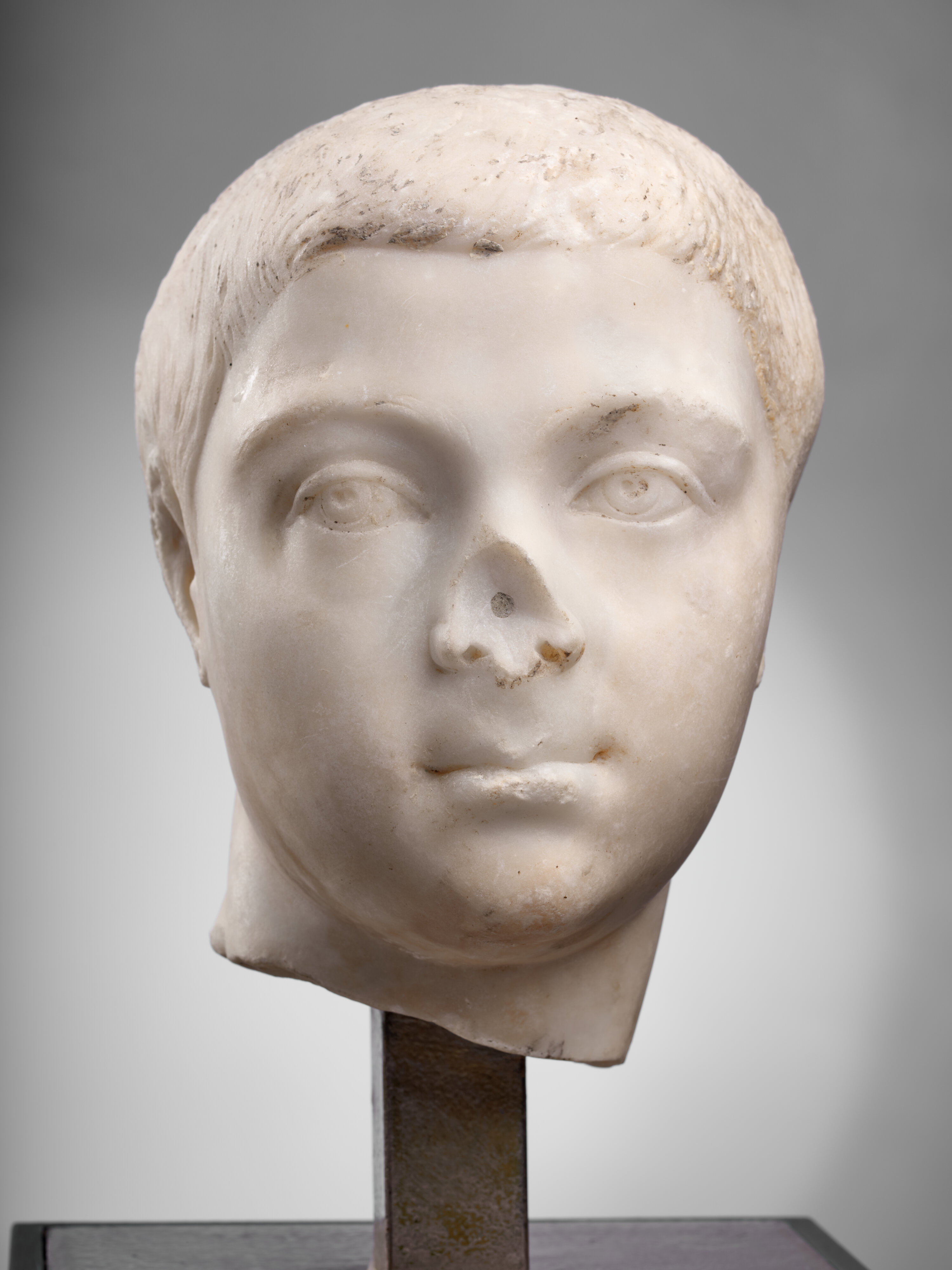
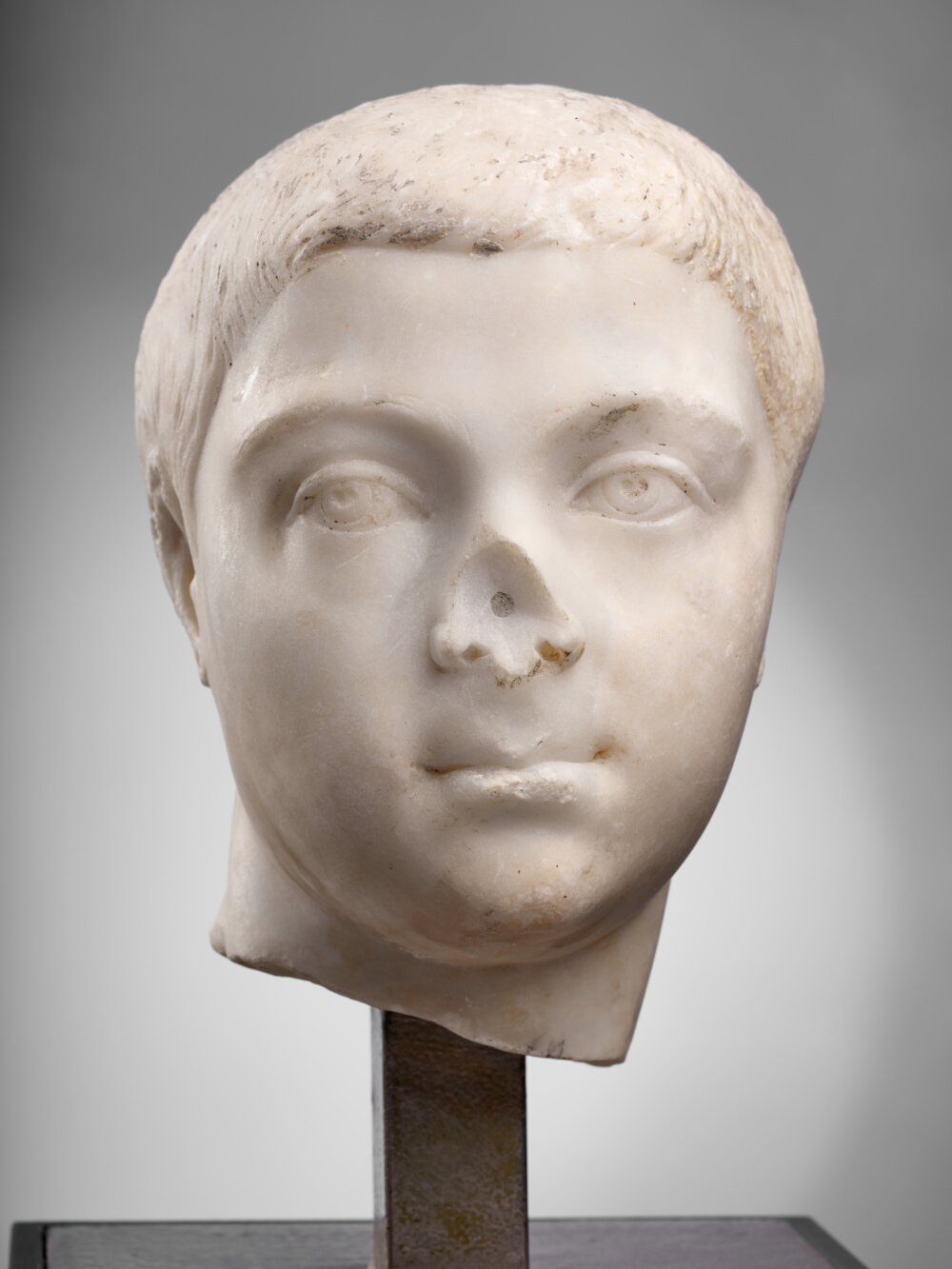
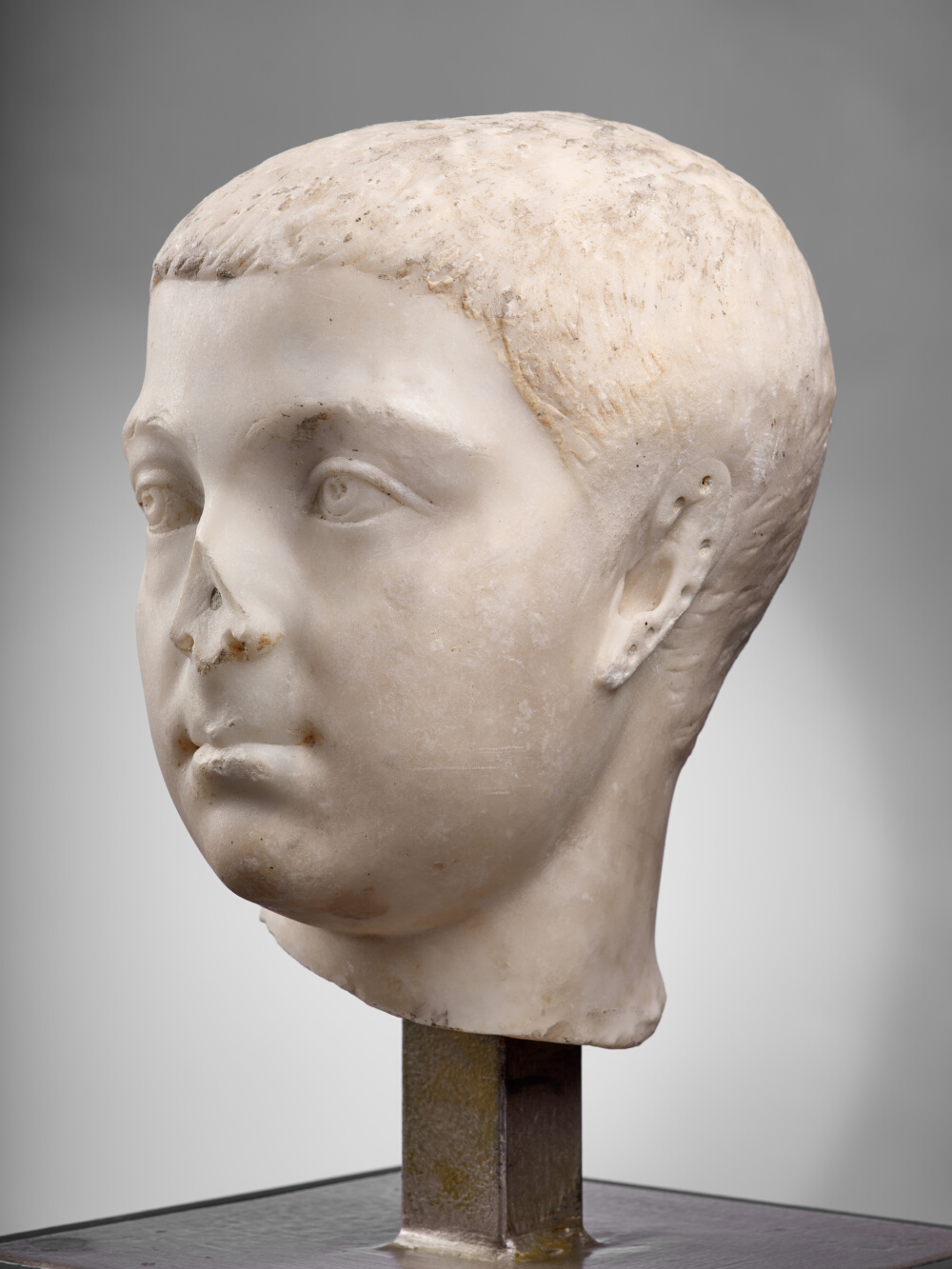
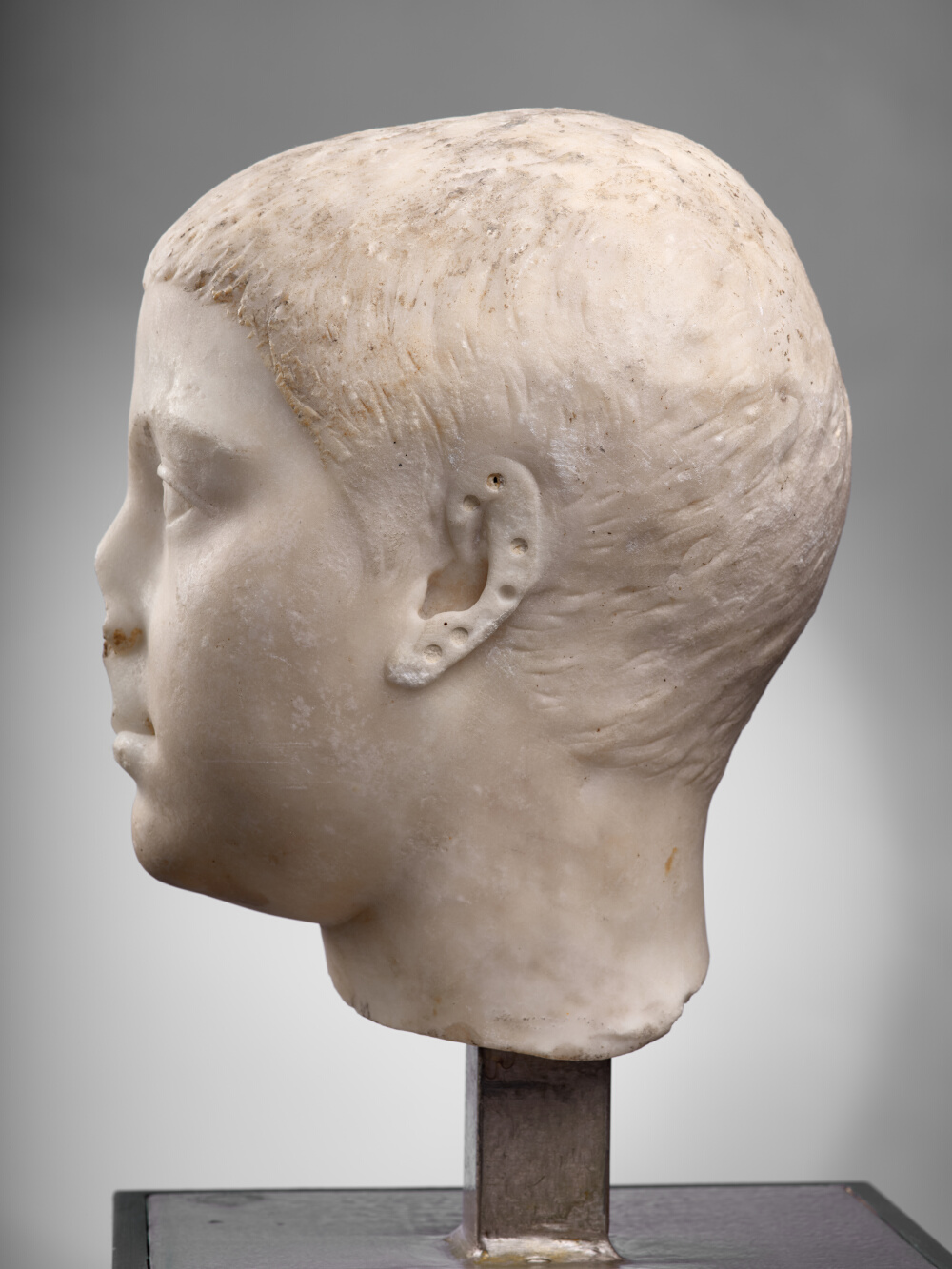
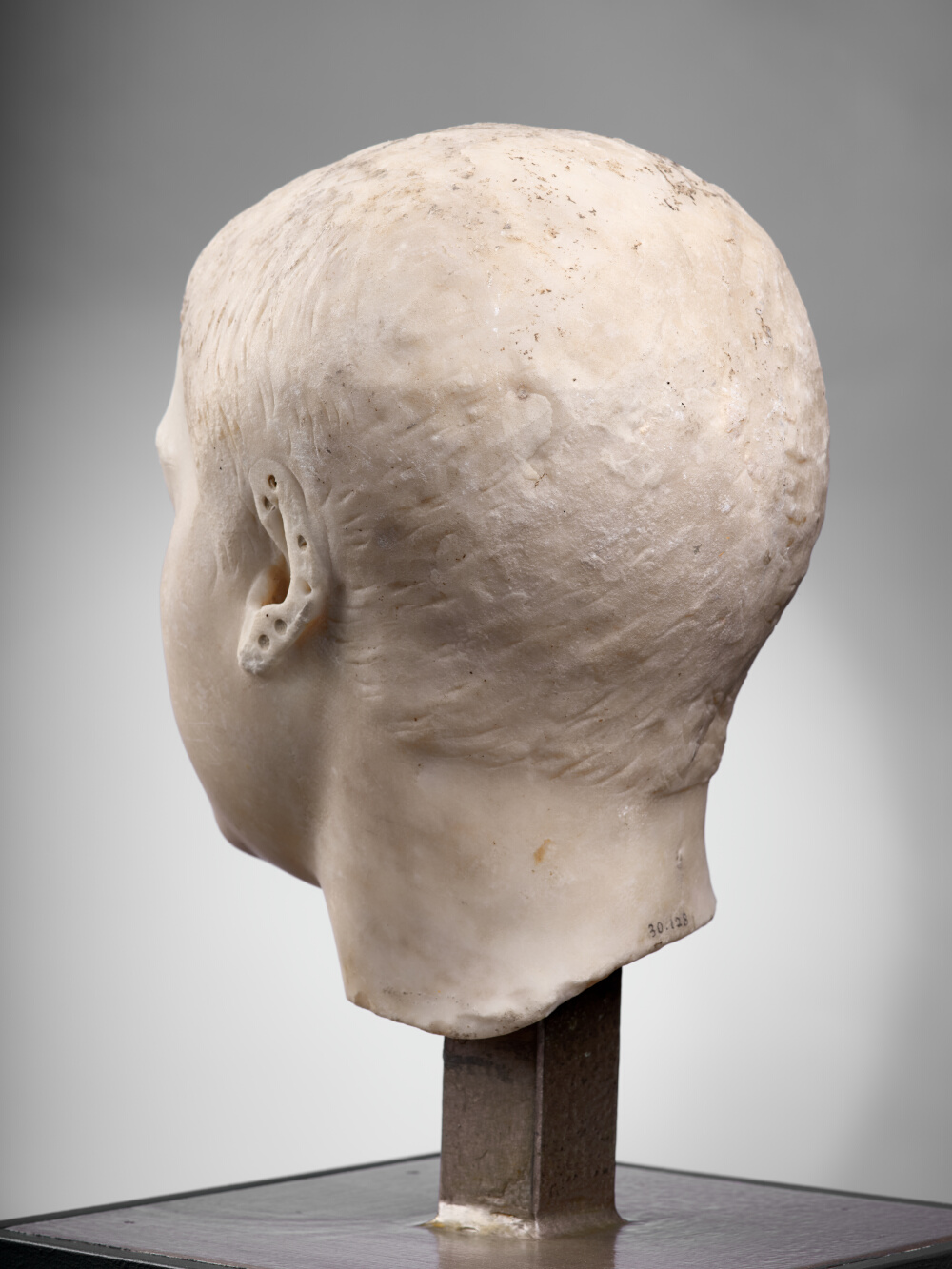
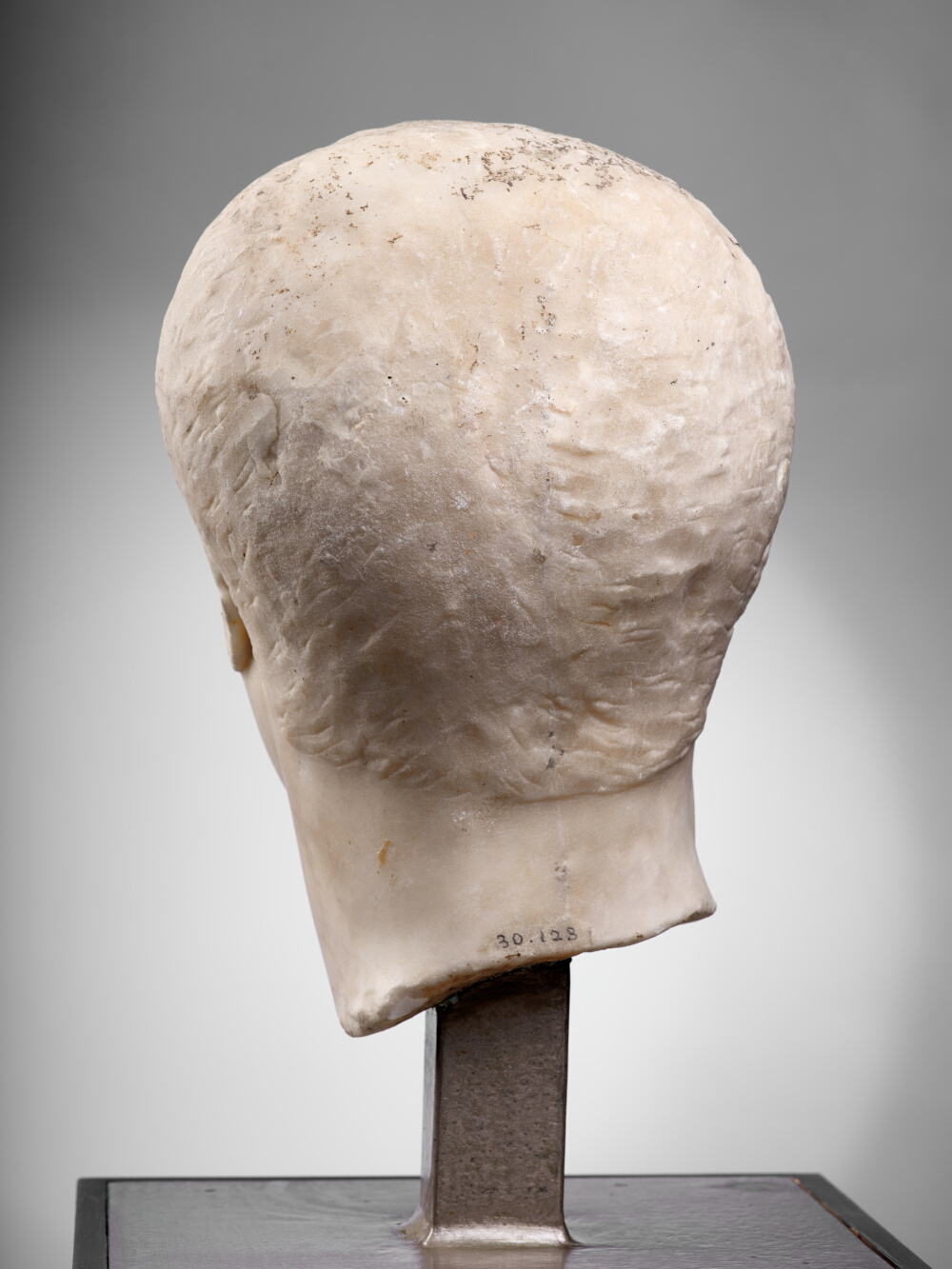
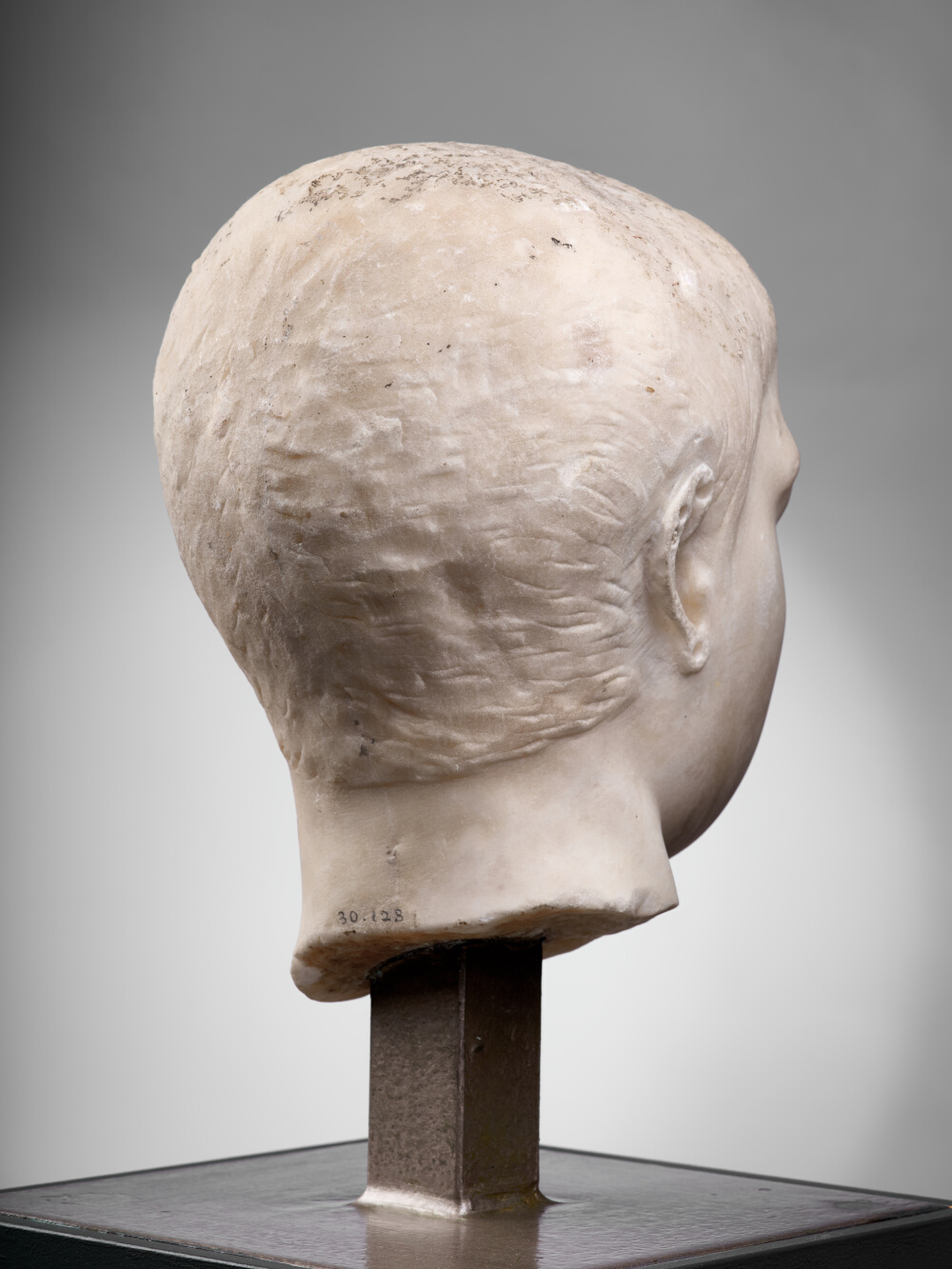
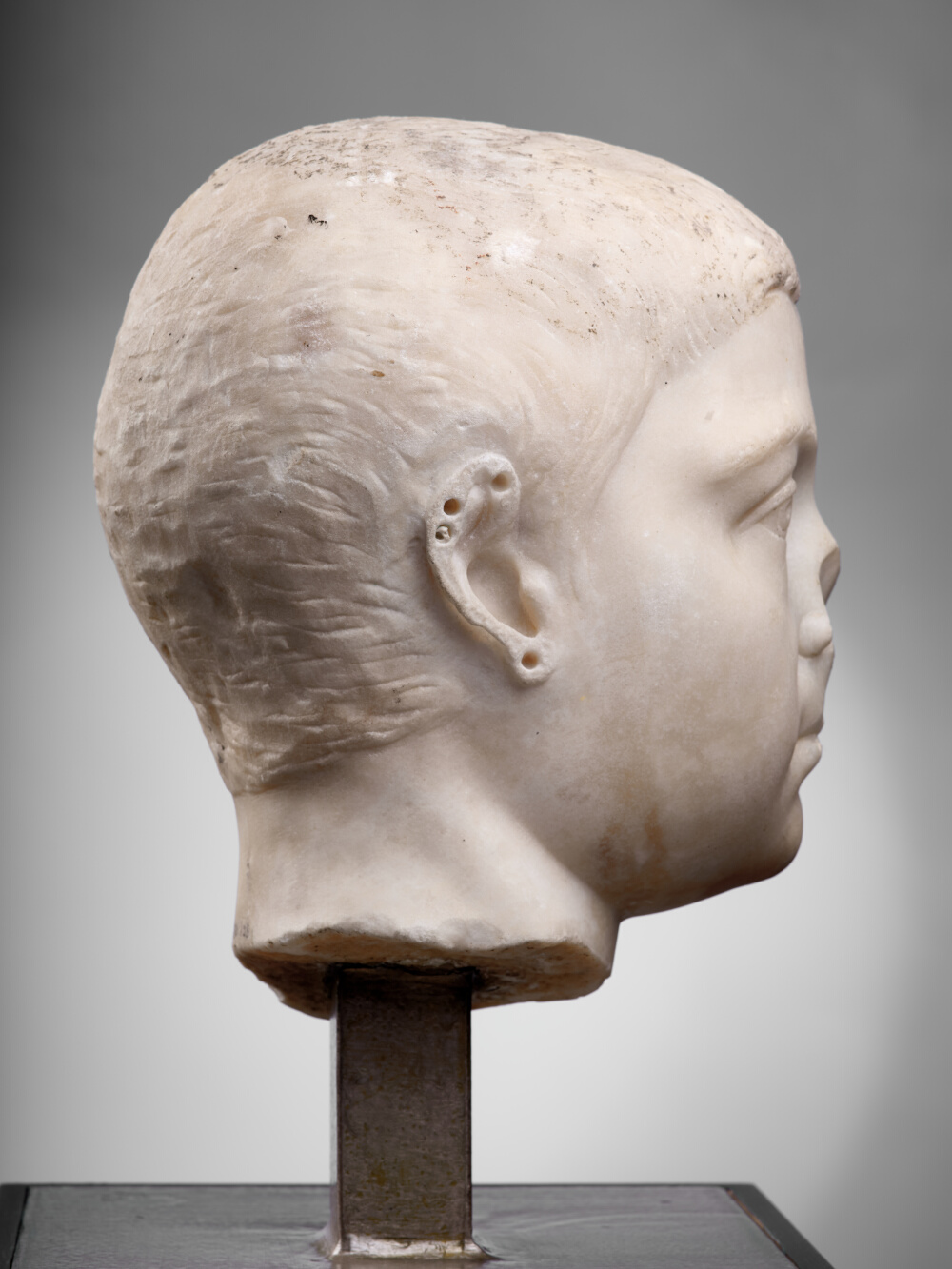
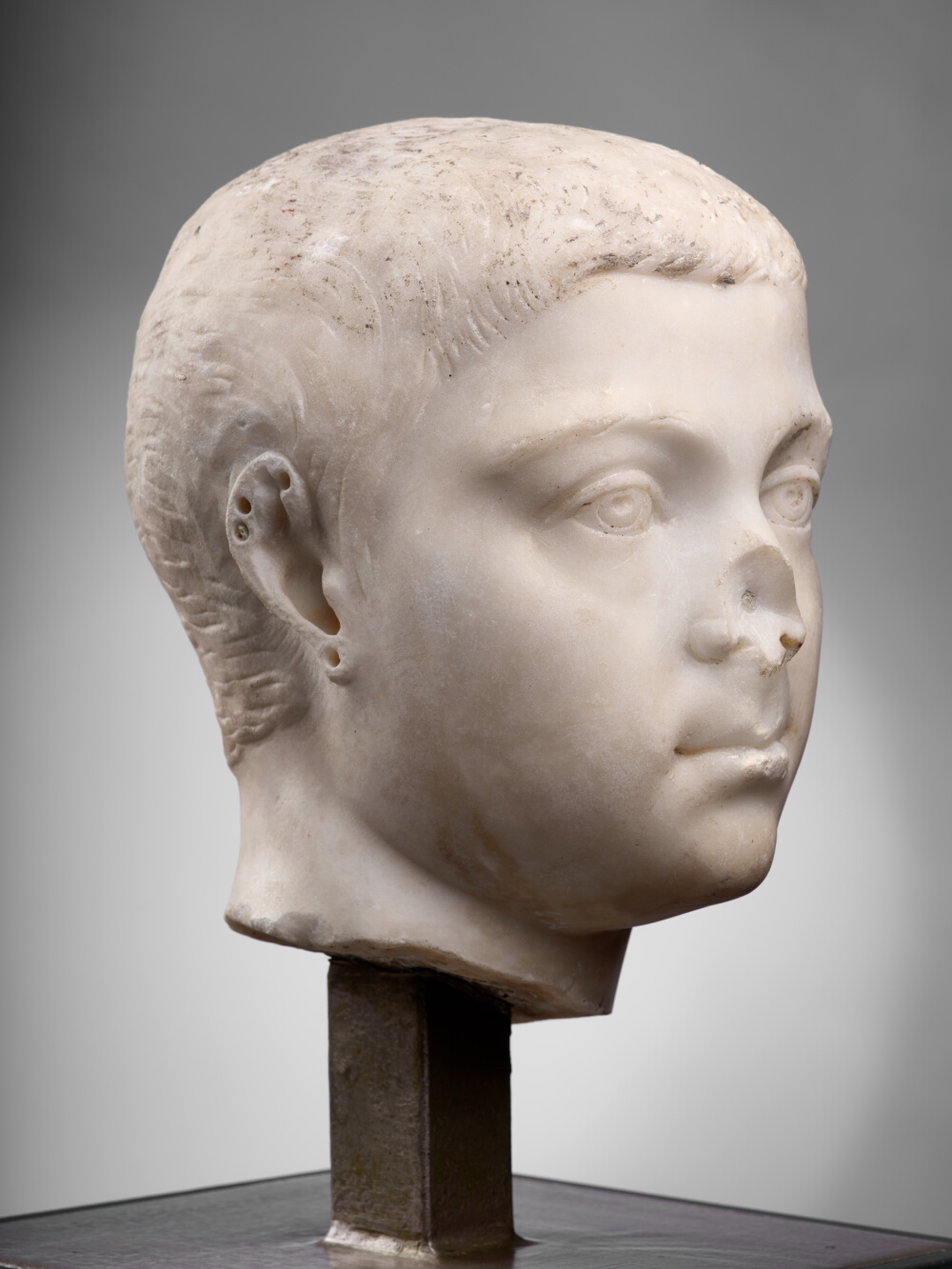
Portrait of Philip the Younger
- Biographic data
- 237 - 249
Co-emperor from 247 to 249. Son of Philip the Arab and Otacilia Severa - Date de création
- Between 247 and 249
- Material
- Göktepe marble, district 3 (Turkey)
- Dimensions
- H. 245 x l. 17 x P. 19 (cm)
- Inventory number
- Ra 73 h
- Photo credits
- Daniel Martin
The portrait is characterized by a deliberately classical style: a full face, a smooth forehead, almond-shaped eyes, and short hair inspired by earlier models, particularly those of the Julio-Claudian and Severan dynasties. This aesthetic, which contrasts with the often more pronounced realism of mid-3rd-century portraits, reflects a dynastic propaganda strategy aimed at presenting the young heirs as the successors to the great imperial dynasties.
Long a subject of debate, the identification of the head has evolved with each new discovery. Initially recognized by Du Mège as a portrait of Philip the Younger, it was subsequently attributed to Gordian III, Saloninus, or Severus Alexander before the work of Frédéric Braemer and Marianne Bergmann confirmed its identification through comparison with coin portraits and stylistic analysis. The Chiragan portrait is now considered one of the most reliable examples of the iconographic type of Philip the Younger, even though the corpus of his effigies remains limited and is still the subject of debate.
Despite Philip the Arab’s relatively long reign and the early elevation of his son to the rank of Caesar, and later Augustus, portraits of Philip the Younger are few in number. The Chiragan head, identified only in the mid-20th century, belongs to a limited body of work. This rarity, moreover, applies not only to the young prince but also to portraits of his father. It likely reflects a more general phenomenon of declining imperial statuary production after the Severan era, beyond the mere brevity of the reigns.
Portraits of Philip the Younger were likely intended to be part of dynastic statuary groups, as evidenced by coins, medallions, gemstones, and several statue bases. At Chiragan, where other portraits of young imperial princes have been discovered, the effigy of the young Caesar probably belonged to such a group. The quality of its craftsmanship, its likely Roman origin, and the use of Göktepe marble—the material of choice for official commissions—lead us to regard the Chiragan head as one of the principal examples of Philip the Younger’s iconography. It is undoubtedly among the earliest portraits of the prince, created shortly after his elevation to the rank of Caesar, when he was only about seven years old. The corpus of confirmed portraits must be limited to a small number of works: among these, our specimen and the one in Foligno (Museo Archeologico della città) appear to be the oldest.
The difficulties in identification stem largely from the strong resemblance between the portraits of Philip the Younger and those of Severus Alexander. This similarity stems from a deliberate policy of Angleichung: Philip the Arab, eager to establish a new dynasty after the death of Gordian III, intentionally had his son’s image made to resemble that of the young Severan princes in order to position his power as a continuation of that dynasty. This phenomenon is accompanied by a stylistic evolution characteristic of the mid-3rd century: the facial features become simpler and more geometric, while the strands of hair—inherited from the a penna technique—gradually lose their relief and are suggested only by chisel incisions.
Despite this formal simplification, the finest Roman workshops maintained a very high standard of craftsmanship, as evidenced, in particular, by the portrait in the Saint-Raymond Museum. The increase in official production following Philip the Younger’s elevation to the rank of Augustus and on the occasion of the Secular Games of 248 likely explains the spread of this iconographic type. However, the stylistic characteristics of the Chiragan portrait suggest that it still depicts Philip the Younger as Caesar, prior to his accession to the title of Augustus
According to J.-C. Balty 2024, Sculptures antiques de Chiragan (Martres-Tolosane). I. Les portraits romains I.4 Des Sévères à la Tétrarchie, Toulouse. Musée Saint-Raymond, Musée d’archéologie de Toulouse, 2024, p. 97-108.
Bibliography
- Andreae 1973 B. Andreae, L’Art de l’ancienne Rome (L’Art et les grandes civilisations), Paris. p. 294-295, fig. 126
- Attanasio, Bruno, Prochaska 2021 D. Attanasio, M. Bruno, W. Prochaska, Göktepe Marbles. White, Black and Two-Tone, L’Erma di Bretschneider, Roma, Bristol.
- Bergmann 1977 M. Bergmann, Studien zum römischen Porträt des 3. Jahrhunderts n. Chr. (Antiquitas), Bonn. p. 36-37, no 3, pl. 5.1-3
- Braemer 1952–1953 F. Braemer, « Les portraits antiques trouvés à Martres-Tolosane, » Bulletin de la Société Nationale des Antiquaires de France, pp. 143–148. p. 143-148, pl. III, fig. 4
- Braemer 1982 F. Braemer, « Le portrait romain, son rôle dans la propagande impériale et dans le maintien de la stabilité du gouvernement de l’Empire, » Wissenschaftliche Zeischrift der Humboldt - Universität zu Berlin, Ges.-Sprachw, 31, 2/3. p. 165, fig. 232
- Cazes et al. 1999 D. Cazes, E. Ugaglia, V. Geneviève, L. Mouysset, J.-C. Arramond, Q. Cazes, Le Musée Saint-Raymond : musée des Antiques de Toulouse, Toulouse-Paris. p. 141
- Du Mège 1835 A. Du Mège, Description du musée des Antiques de Toulouse, Toulouse. p. 124, no 222
- Du Mège 1844 A. Du Mège, Description du musée des Antiques de Toulouse (document manuscrit ). no 381
- Du Mège 1828 A. Du Mège, Notice des monumens antiques et des objets de sculpture moderne conservés dans le musée de Toulouse, Toulouse. p. 72-73, no 138
- Espérandieu 1908 É. Espérandieu, Recueil général des bas-reliefs de la Gaule romaine, 2. Aquitaine, Paris. p. 92, no 1003
- Felletti Maj 1958 B.M. Felletti Maj, Iconografia romana imperiale da Severo Alessandro a M. Aurelio Carino (222-285 d. C.) (Quaderni e guide di archeologia), Rome. p. 83
- Fittschen 1969 K. Fittschen, « Bemerkungen zu den Porträts des 3. Jahrhunderts nach Christus, » Jahrbuch des Deutschen Archäologischen Instituts, 84, pp. 198–236. p. 211, pl. 24
- Joulin 1901 L. Joulin, Les établissements gallo-romains de la plaine de Martres-Tolosane (Mémoires présentés par divers savants à l’Académie des inscriptions et belles-lettres",), Paris.
- Rachou 1912 H. Rachou, Catalogue des collections de sculpture et d’épigraphie du musée de Toulouse, Toulouse. no 73 h
- Roschach 1892 E. Roschach, Catalogue des musées archéologiques de la ville de Toulouse : Musée des Augustins, Musée Saint-Raymond, Toulouse. p. 37-38, no 73 h
- Roschach 1865 E. Roschach, Catalogue des antiquités et des objets d’art, Toulouse. no 73 h
- Rosso 2006 E. Rosso, L’image de l’empereur en Gaule romaine : portraits et inscriptions (Archéologie et histoire de l’art), Paris. p. 480-482, no 233
- Wegner, Unger 1979–1980 M. Wegner, R. Unger, « Verzeichnis der Kaiserbildnisse von Antoninus Pius bis Commodus, » Boreas. Münstersche Beiträge zur Archäologie, 2–3, pp. 87–181. p. 44, 50 pl. 15 a-b
- Wiggers, Wegner 1971 H.B. Wiggers, M. Wegner, Caracalla, Geta Plautilla (Das römische Herrscherbild. 3. Abt), Berlin. p. 199
- C.I.L. n.d. C.I.L., Corpus inscriptionum latinarum.
- C.I.L. 1888 C.I.L., Corpus inscriptionum latinarum, XII, Inscriptiones Galliae Narbonensis Latinae, Berlin. no 4227
- Musée Saint-Raymond 1990 Musée Saint-Raymond, Le cirque romain. Exhibition, Musée Saint-Raymond, Toulouse, 1990, Toulouse. no 14
- Musée Saint-Raymond 1995 Musée Saint-Raymond, Le regard de Rome : portraits romains des musées de Mérida, Toulouse et Tarragona. Exhibition, Mérida, Museo nacional de arte romano ; Toulouse, Musée Saint-Raymond ; Tarragone, Museu nacional arqueològic de Tarragona, 1995, Toulouse. p. 44, no 6
To cite this notice
Capus P., "Portrait of Philip the Younger", in The sculptures of the roman villa of Chiragan, Toulouse, 2019, online <https://villachiragan.saintraymond.toulouse.fr/en/ark:/87276/a_ra_73_h>.