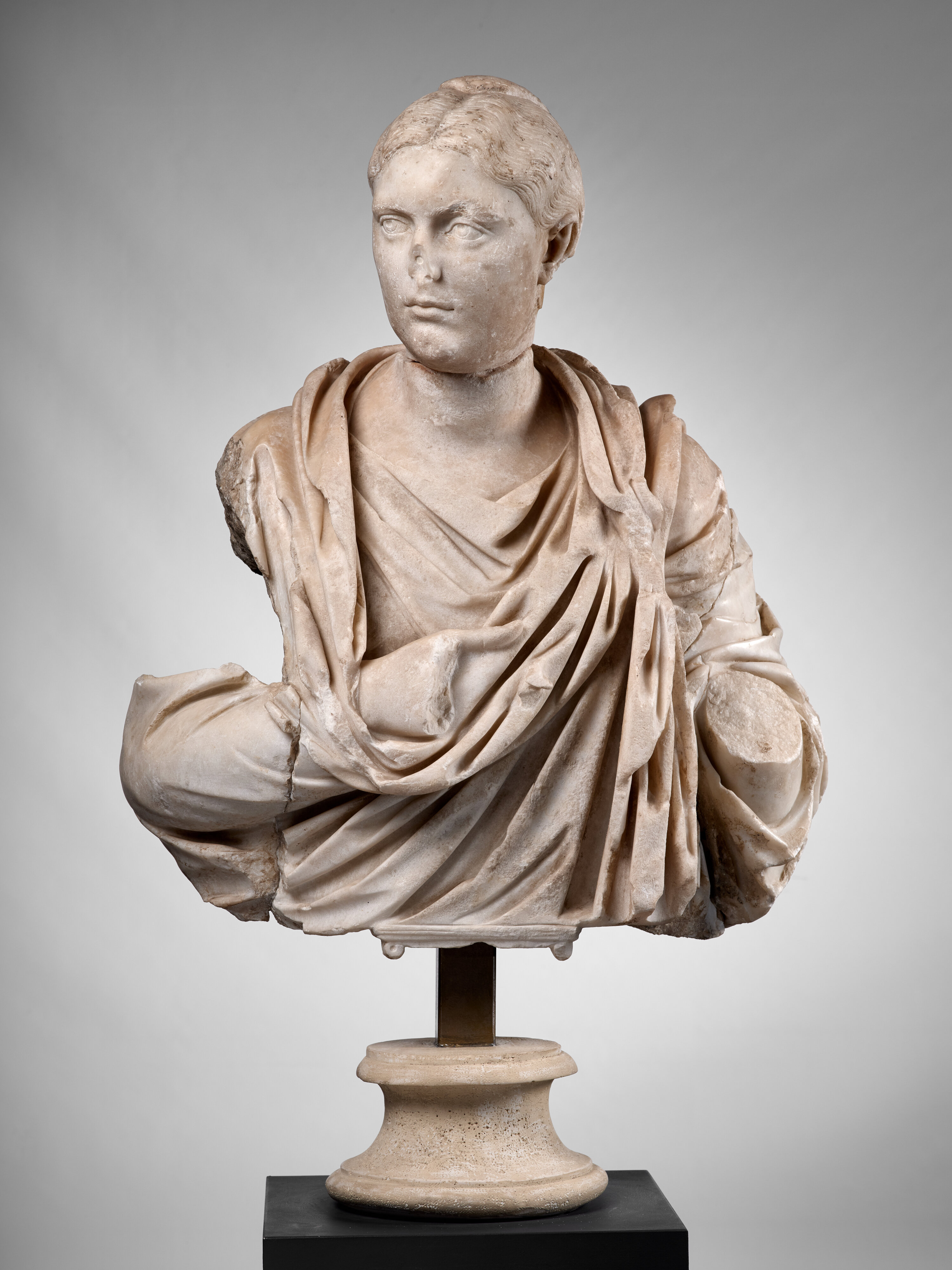
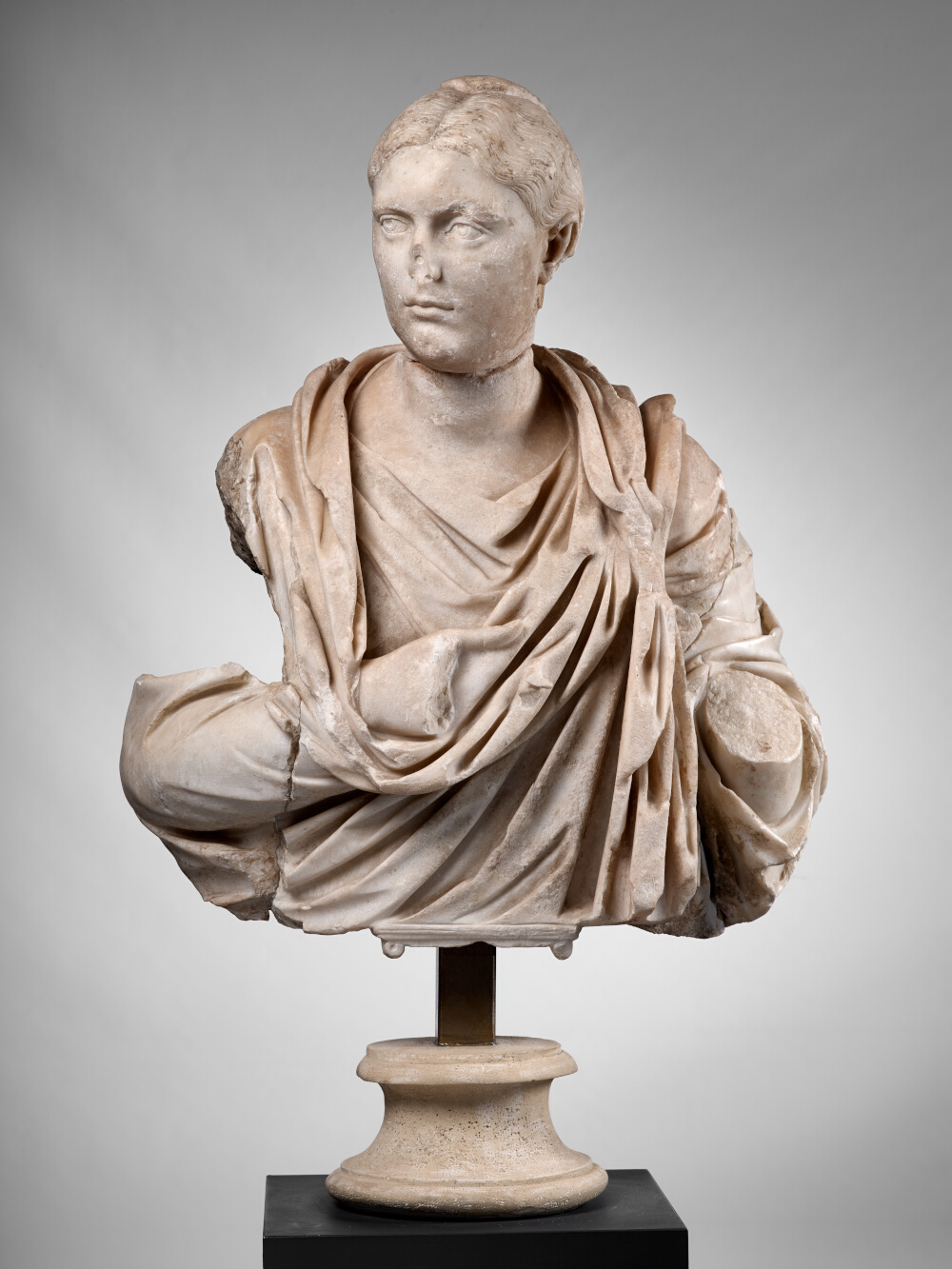
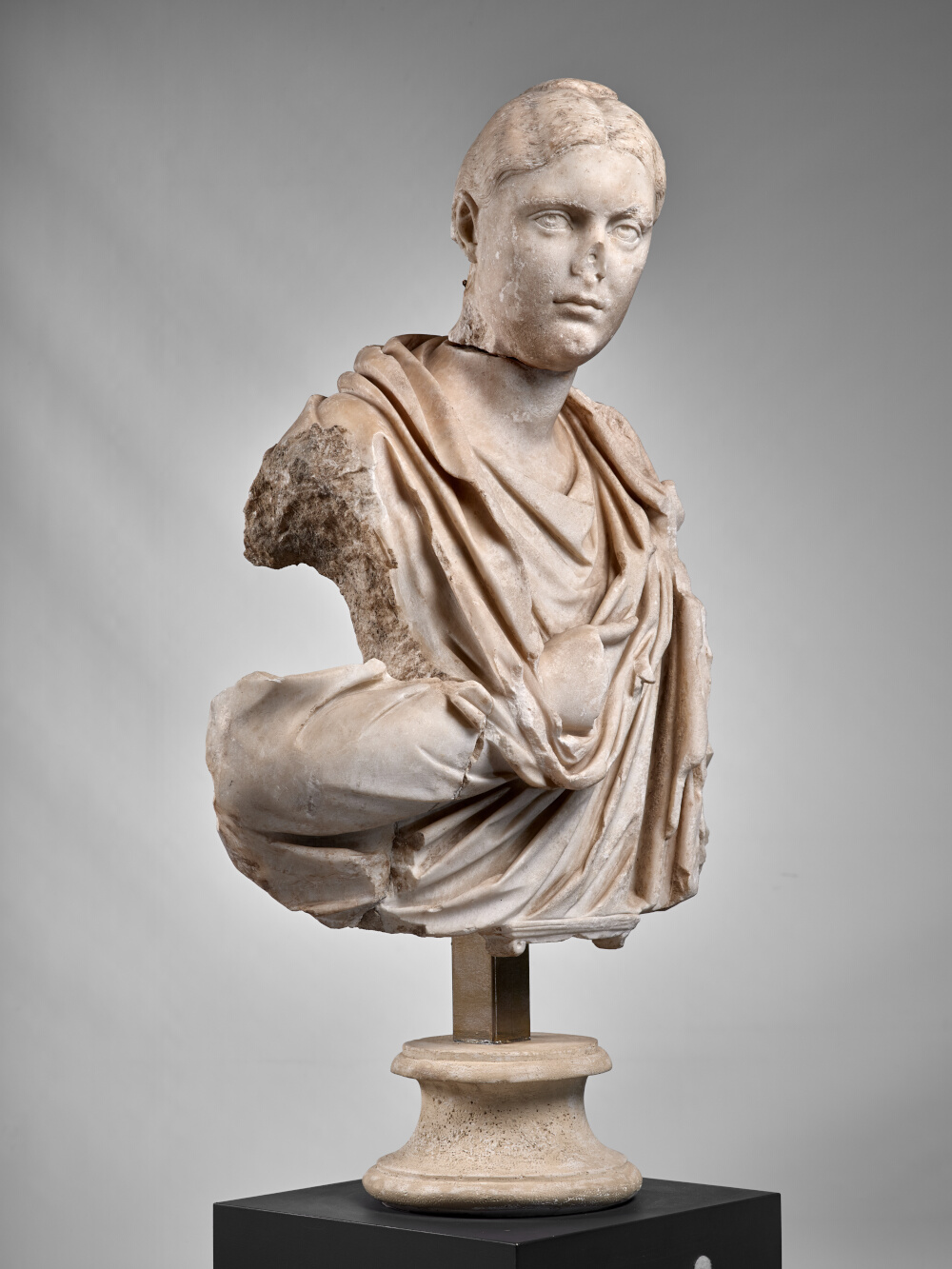
Portrait of Herennia Etruscilla (?)
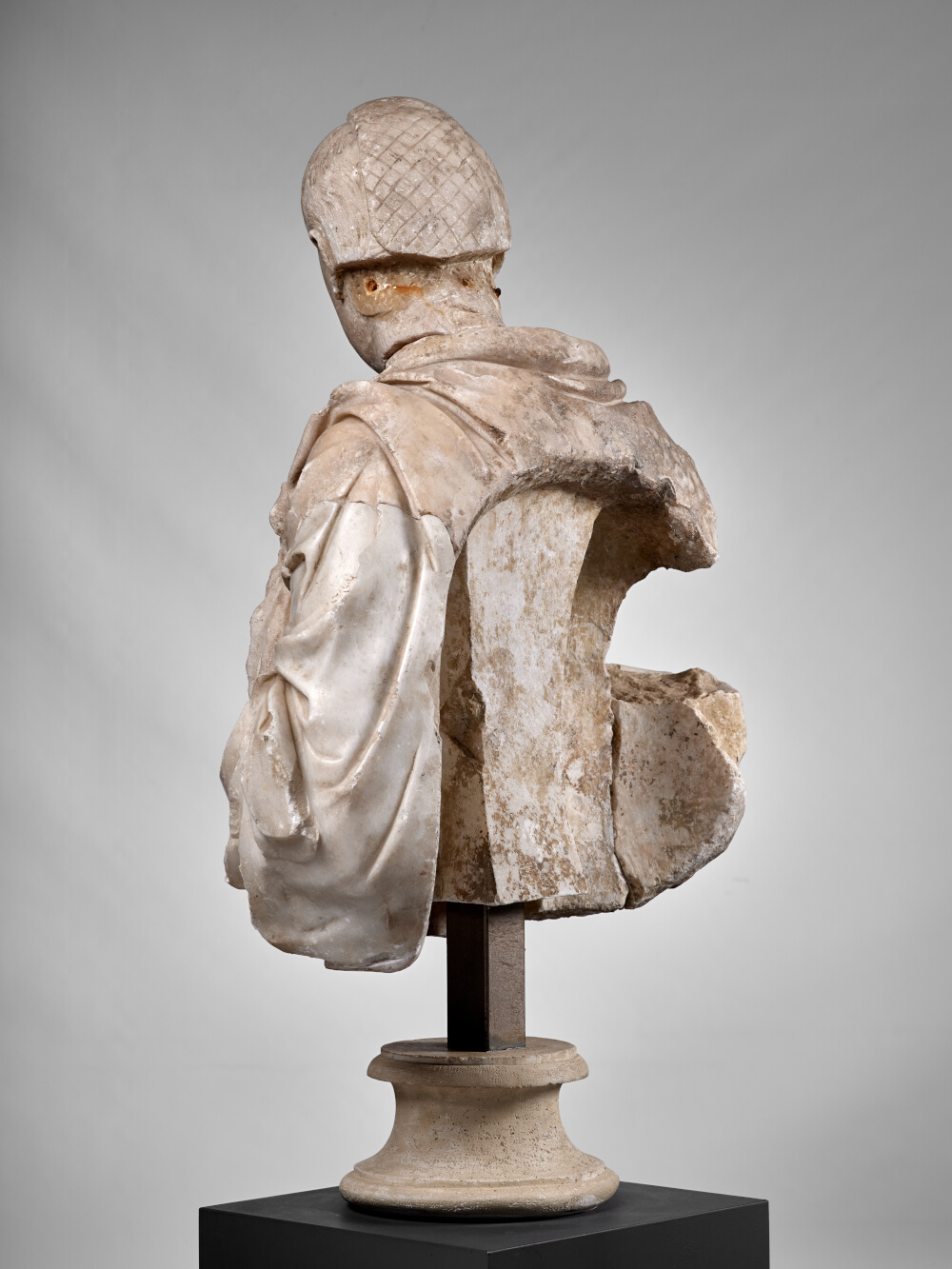
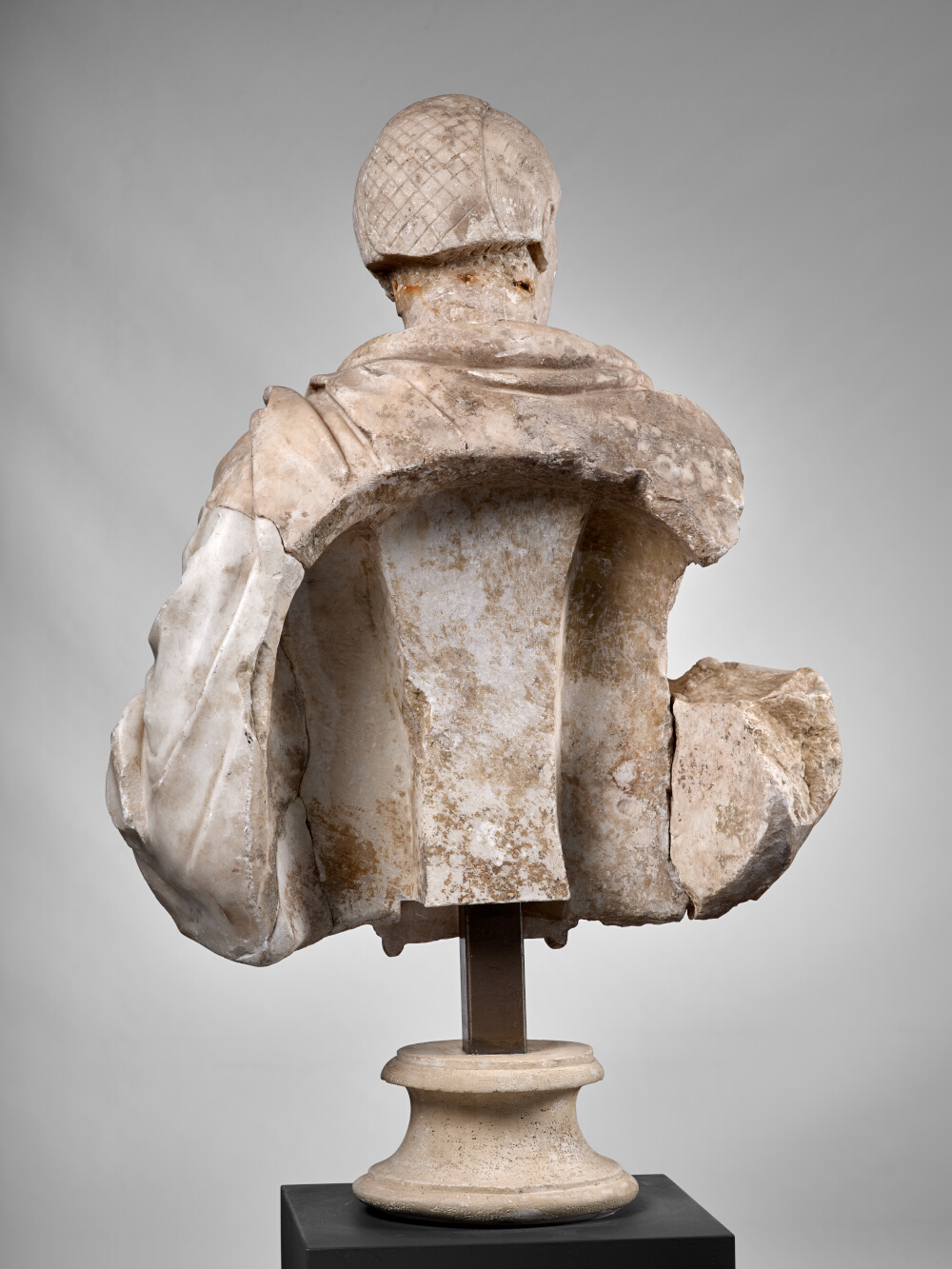
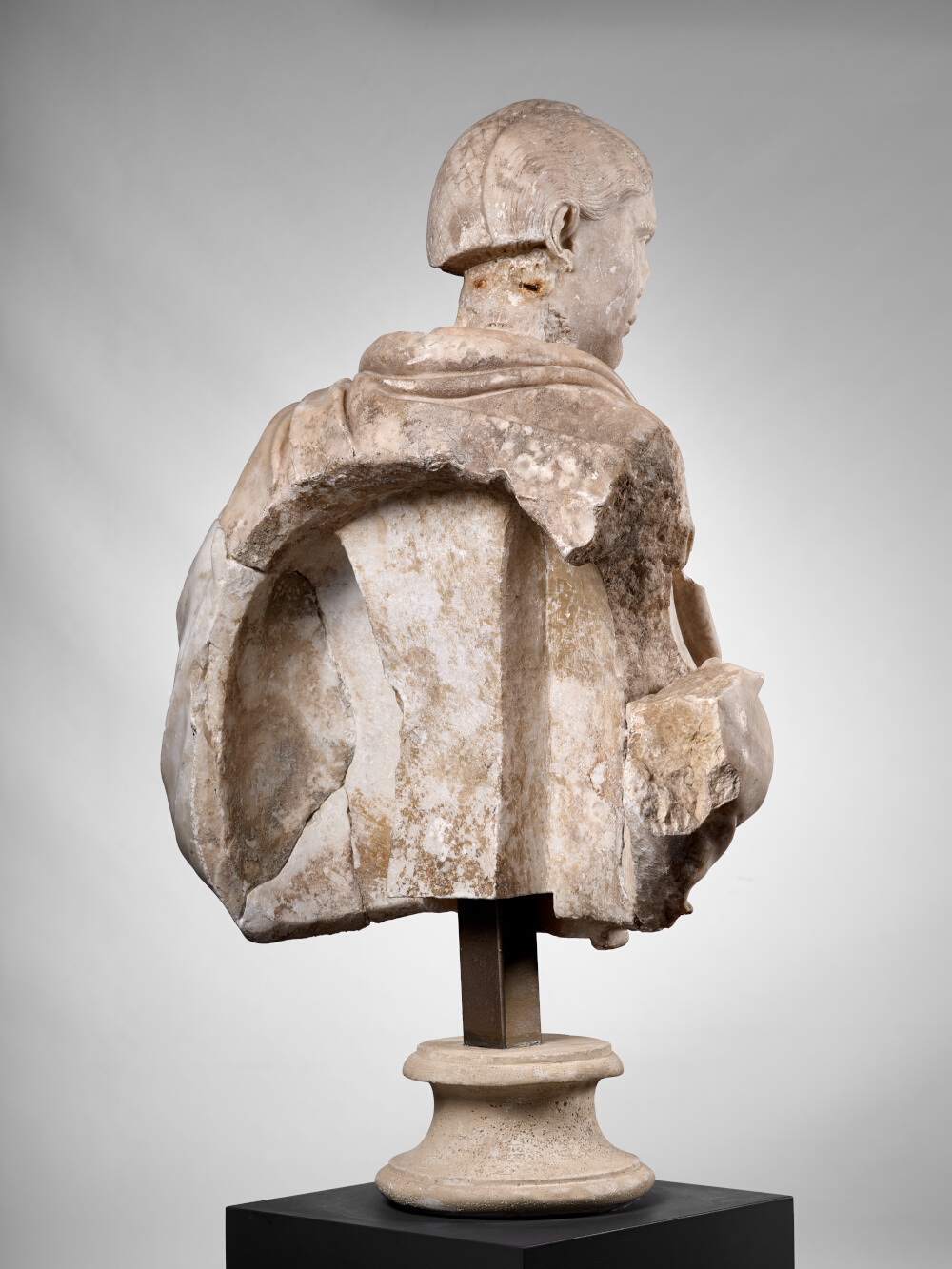
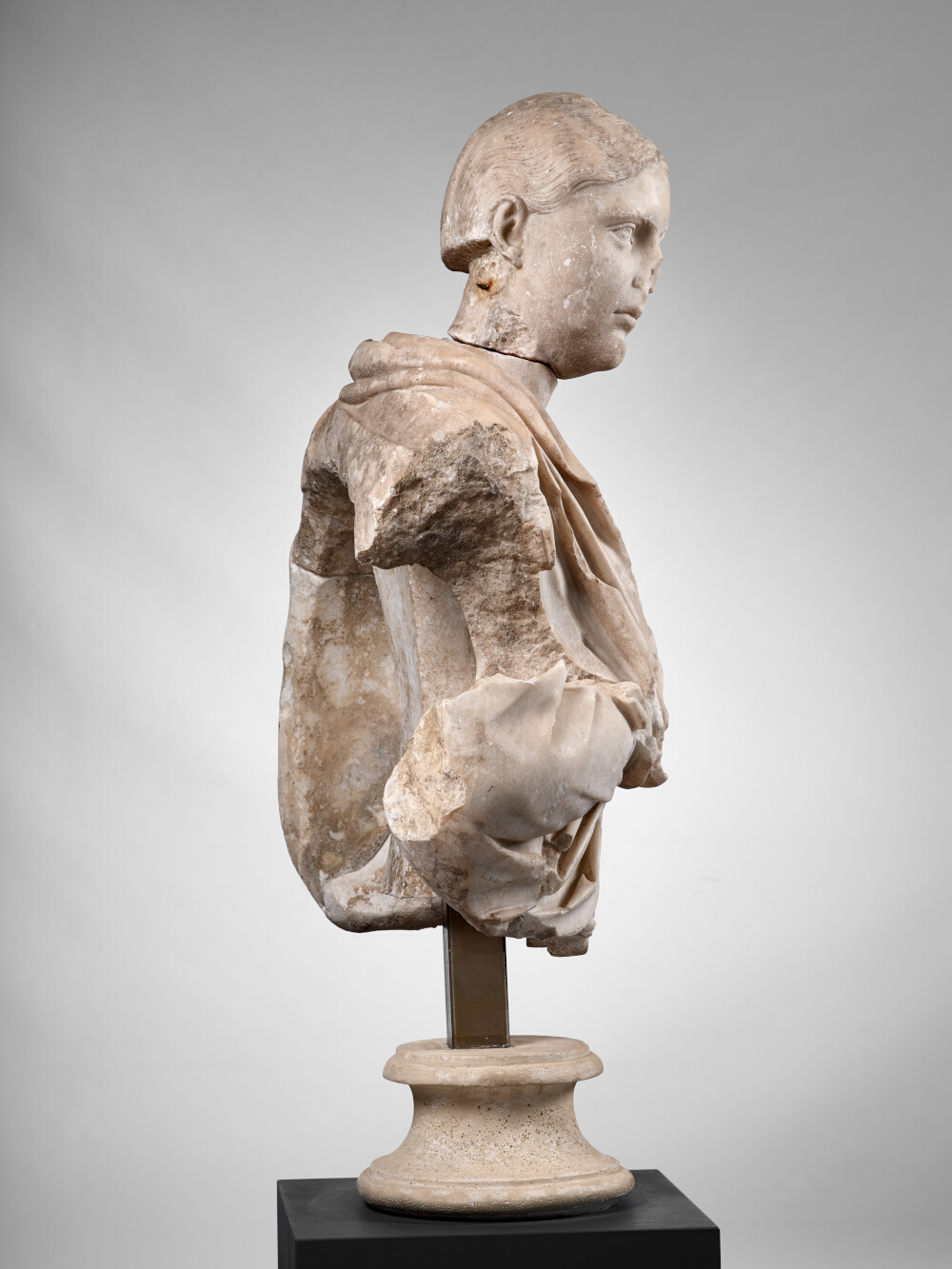
- Date de création
- Middle of the 3\rd\ century
- Material
- Göktepe marble, district 4 (Turkey)
- Dimensions
- H. 645 x l. 64 x P. 29 (cm)
- Inventory number
- Ra 74
- Photo credits
- Daniel Martin
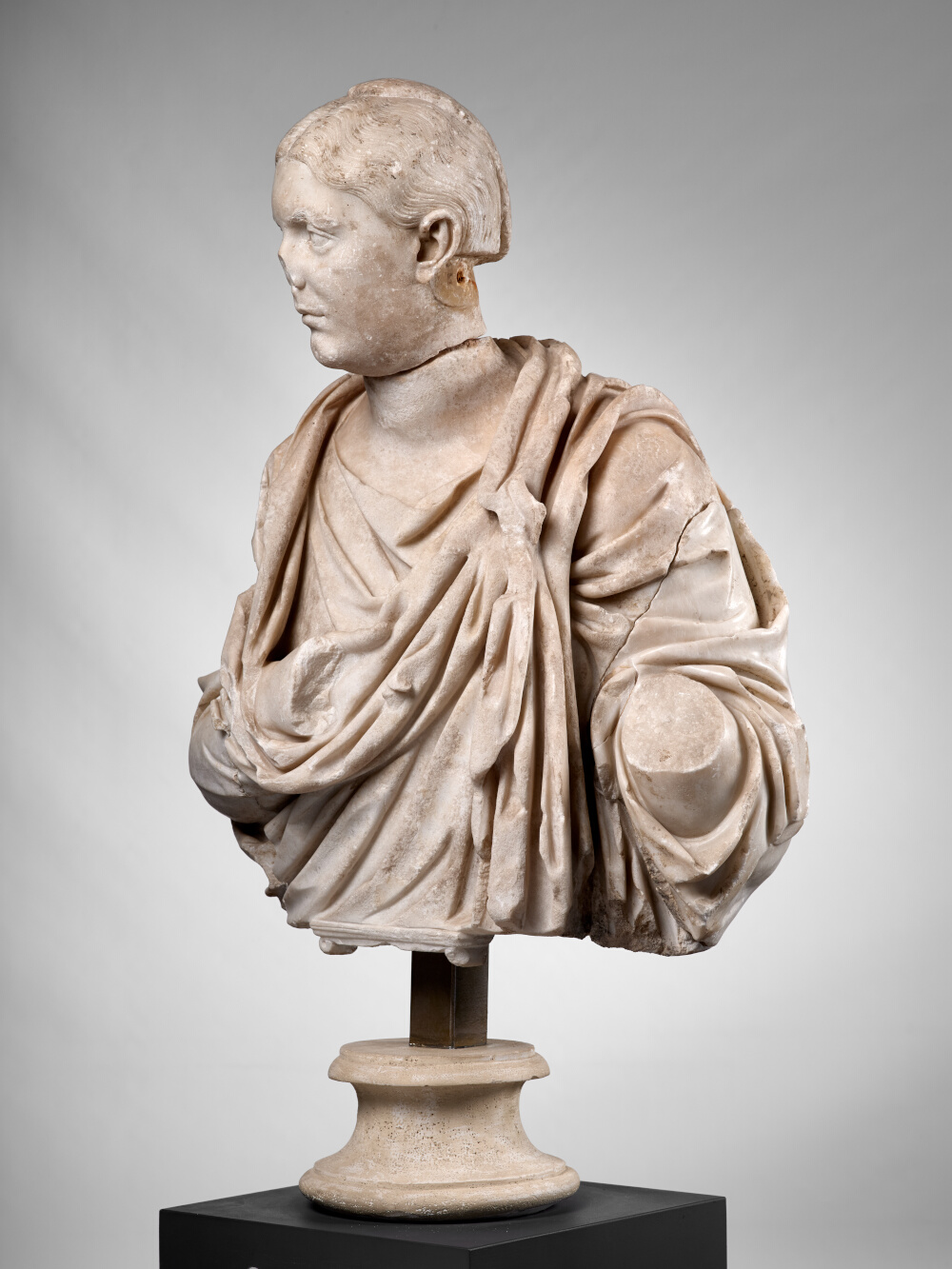
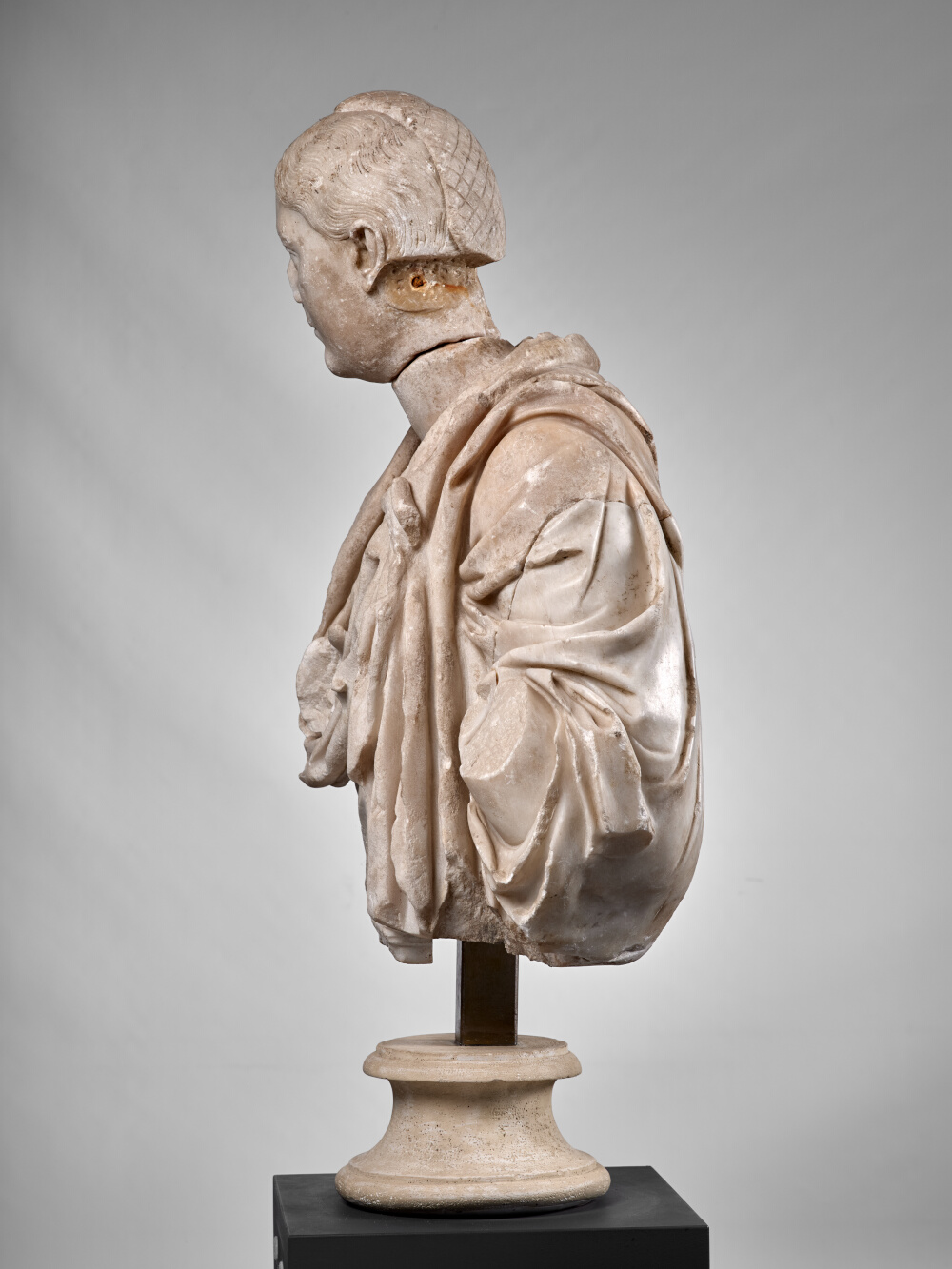
Long identified as Empress Herennia Etruscilla, wife of Trajan Decius, this portrait is one of the most important female effigies from the first half of the 3rd century preserved in Gaul. However, it is now thought necessary to distinguish the head from the bust; the connection between the two, accepted since the 19th century, can no longer be regarded as certain. Material analysis calls this traditional association into question. The fracture lines do not correspond exactly, the diameter of the neck differs slightly between the two elements, and earlier restorations had required the addition of plaster to secure their junction. Some modern retouching appears to have been carried out to conceal these discrepancies.
Examination of the fractures reveals that the nose had already been repaired in antiquity, as evidenced by a fixing mortise that is still visible. Despite these numerous interventions, the quality of the workmanship remains exceptional. The flesh is modelled with great subtlety, particularly around the eyes, where the faint dark circles accentuate a melancholic expression. The hair, eyebrows and eyelids are mainly carved with a chisel, whilst the trephine is used sparingly to highlight the nostrils, ears, pupils and the lacrimal caruncle. On the chin, a slight indentation corresponds to a marking made during the layout process, revealing that measurements were mechanically transferred from a preliminary model.
The head depicts a middle-aged woman with a full face, notably characterised by a pronounced double chin. The hairstyle is the key element for dating the work. The hair, parted in the middle, is drawn back into two gently wavy strands that fully expose the ears before being joined in a wide plait raised to the top of the head. This late variant of the Helmfrisur (a hairstyle that envelops the skull like a helmet), characteristic of the middle decades of the third century, allows the portrait to be dated to around the middle of the century.
The identification of the person depicted has been the subject of much debate. Earlier suggestions identifying her as Plautilla or Salonina now appear incompatible with the stylistic and iconographic characteristics of the work. On the other hand, several features link the portrait to the coin effigies of Herennia Etruscilla: the rounded forehead, thick eyelids, eyes with dark circles, round chin, as well as the combination of a wide plait at the back with naturally wavy hair bands. These similarities are reinforced by comparison with several sculpted portraits preserved in Rome, even though no genuine replica is known to exist today. The absence of a coherent series of copies nevertheless calls for a degree of caution, as imperial portraits from the 3rd century exhibited significant variation depending on the workshop. The archaeological context at Chiragan, however, supports this proposal. The villa’s portrait gallery already includes several representatives of the ruling dynasties of the 3rd century, notably a portrait of Tranquillina as well as other contemporary effigies. The probable use of Göktepe marble—the material of choice for official statuary of this period—along with the reproduction techniques employed, suggests a commission of the very highest calibre, consistent with the display of an imperial portrait in a grand aristocratic residence. If this identification is accepted, the work must be dated between Herennia Etruscilla’s elevation to the rank of Augusta in the autumn of 249 and the death of Trajan Decius in June 251.
Setting aside the head, the bust itself—enveloped in a heavy cloak whose folds powerfully structure the composition—is, in its own right, an exceptional work. Owing to its dimensions and the way it is cropped at the waist, it belongs to the very rare group of Halbkörperbüsten (‘half-length busts’), a monumental form that emerged during the second quarter of the third century. This iconographic style, attested in an extremely limited number of examples, marks the culmination of the evolution of the Roman bust by emphasising the figure’s physical presence whilst retaining the monumental character of the official portrait.
The tilt of the head, the restraint of the gestures and the richness of the drapery convey the virtues traditionally associated with Roman matrons: dignity, modesty and gravitas. Whether or not this is Herennia Etruscilla, this work remains one of the major examples of official sculpture from the years 240–250. It illustrates the profound renewal of the female portrait under the late Severan emperors and the early soldier-emperors.
According to E. Rosso 2024, Sculptures antiques de Chiragan (Martres-Tolosane). I. Les portraits romains I.4 Des Sévères à la Tétrarchie, Toulouse. Musée Saint-Raymond, Musée d’archéologie de Toulouse, 2024, p. 109-134.
Bibliography
- Attanasio, Bruno, Prochaska 2021 D. Attanasio, M. Bruno, W. Prochaska, Göktepe Marbles. White, Black and Two-Tone, L’Erma di Bretschneider, Roma, Bristol.
- Balty, Cazes 2021 J.-C. Balty, D. Cazes, Les portraits romains, 1 : L’époque des Sévères, 1.3 (Sculptures antiques de Chiragan (Martres-Tolosane), Toulouse.
- Braemer 1999 F. Braemer, « Le culte impérial en Narbonnaise et dans les Alpes au Haut-Empire : documents sculptés, » Revue archéologique de Narbonnaise, 32, pp. 49–55. p. 53
- Cazes et al. 1999 D. Cazes, E. Ugaglia, V. Geneviève, L. Mouysset, J.-C. Arramond, Q. Cazes, Le Musée Saint-Raymond : musée des Antiques de Toulouse, Toulouse-Paris. p. 142
- Du Mège 1828 A. Du Mège, Notice des monumens antiques et des objets de sculpture moderne conservés dans le musée de Toulouse, Toulouse. p. 69, no 133
- Espérandieu 1908 É. Espérandieu, Recueil général des bas-reliefs de la Gaule romaine, 2. Aquitaine, Paris. p. 86-87, no 993
- Felletti Maj 1958 B.M. Felletti Maj, Iconografia romana imperiale da Severo Alessandro a M. Aurelio Carino (222-285 d. C.) (Quaderni e guide di archeologia), Rome. no 328, p. 240
- Joulin 1901 L. Joulin, Les établissements gallo-romains de la plaine de Martres-Tolosane (Mémoires présentés par divers savants à l’Académie des inscriptions et belles-lettres",), Paris.
- Massendari 2006 J. Massendari, La Haute-Garonne : hormis le Comminges et Toulouse 31/1 (Carte archéologique de la Gaule), Paris. p. 246, fig 110
- Rosso 2006 E. Rosso, L’image de l’empereur en Gaule romaine : portraits et inscriptions (Archéologie et histoire de l’art), Paris. p. 484-486, no 235
- Saletti 1967 C. Saletti, Ritratti severiani, Rome. p. 39, no 29
- Wegner, Unger 1979–1980 M. Wegner, R. Unger, « Verzeichnis der Kaiserbildnisse von Antoninus Pius bis Commodus, » Boreas. Münstersche Beiträge zur Archäologie, 2–3, pp. 87–181. p. 134
- Wiggers, Wegner 1971 H.B. Wiggers, M. Wegner, Caracalla, Geta Plautilla (Das römische Herrscherbild. 3. Abt), Berlin. p. 129
- Musée Saint-Raymond 1995 Musée Saint-Raymond, Le regard de Rome : portraits romains des musées de Mérida, Toulouse et Tarragona. Exhibition, Mérida, Museo nacional de arte romano ; Toulouse, Musée Saint-Raymond ; Tarragone, Museu nacional arqueològic de Tarragona, 1995, Toulouse. p. 155, no 110
To cite this notice
Capus P., "Portrait of Herennia Etruscilla (?)", in The sculptures of the roman villa of Chiragan, Toulouse, 2019, online <https://villachiragan.saintraymond.toulouse.fr/en/ark:/87276/a_ra_74>.