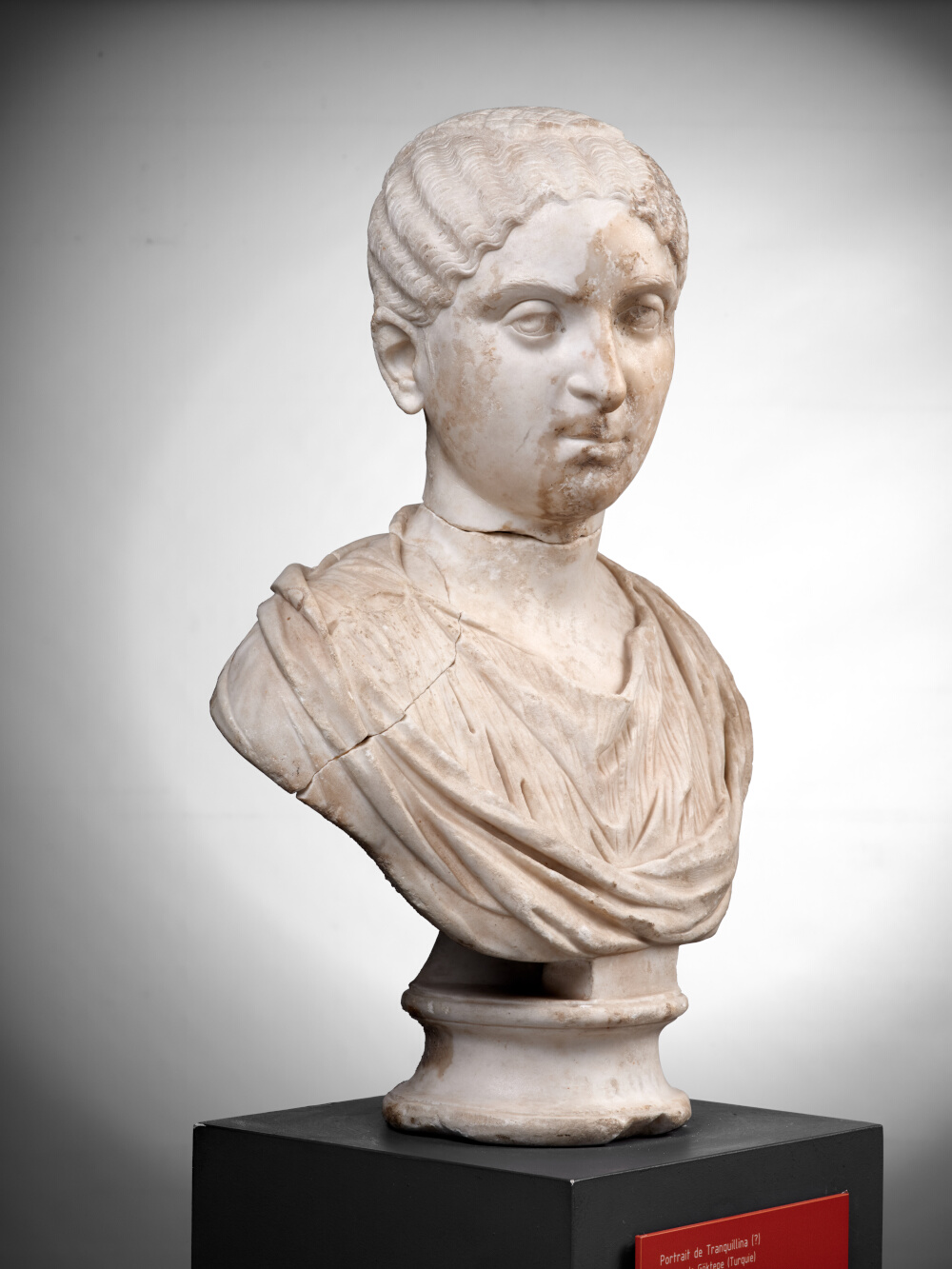
Portrait of Tranquillina (?)
- Date de création
- Approximately 241 - 244
- Material
- Göktepe marble, district 3 (Turkey)
- Dimensions
- H. 50 x l. 34 x P. 215 (cm)
- Inventory number
- Ra 166
- Photo credits
- Daniel Martin
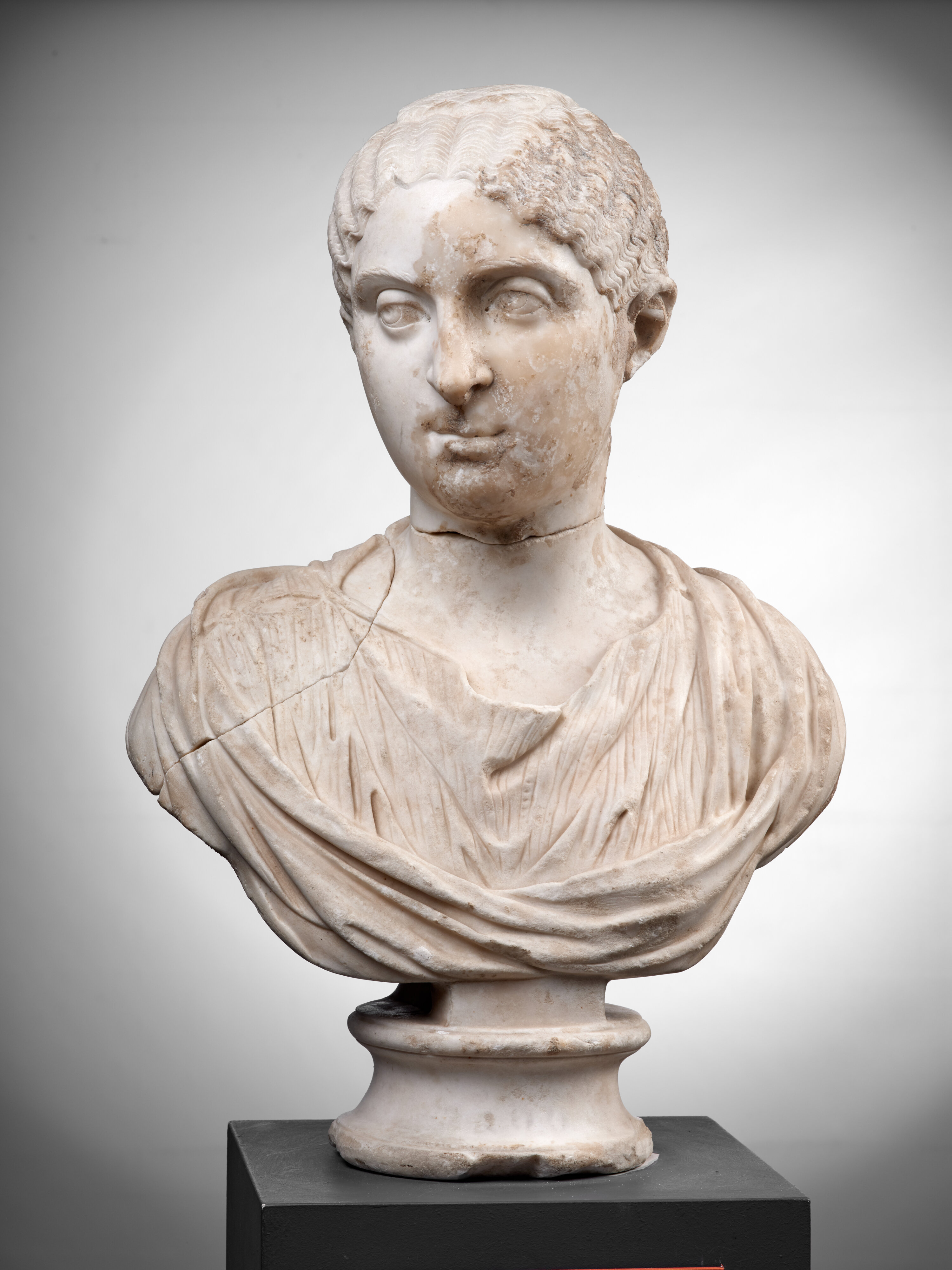
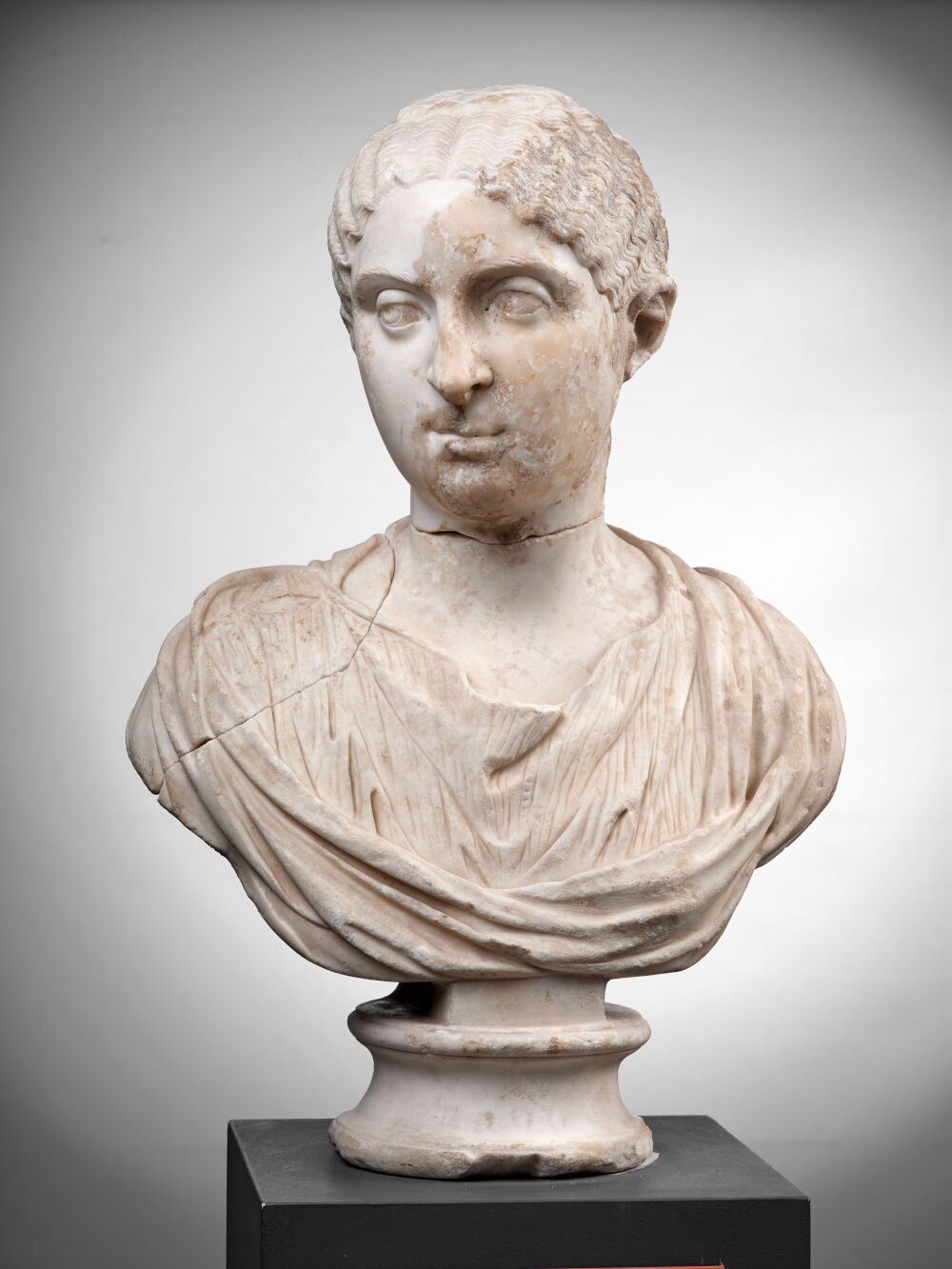
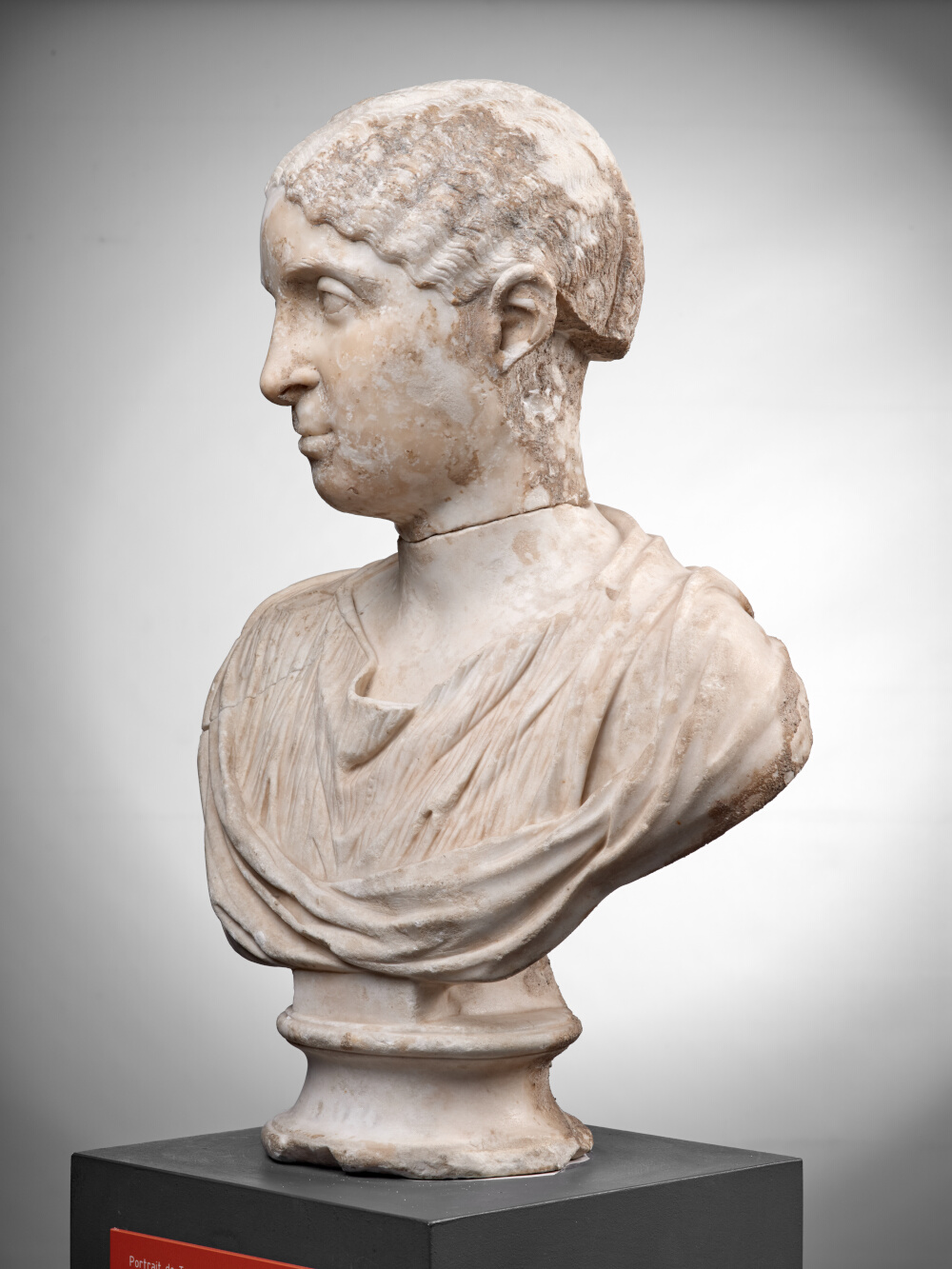
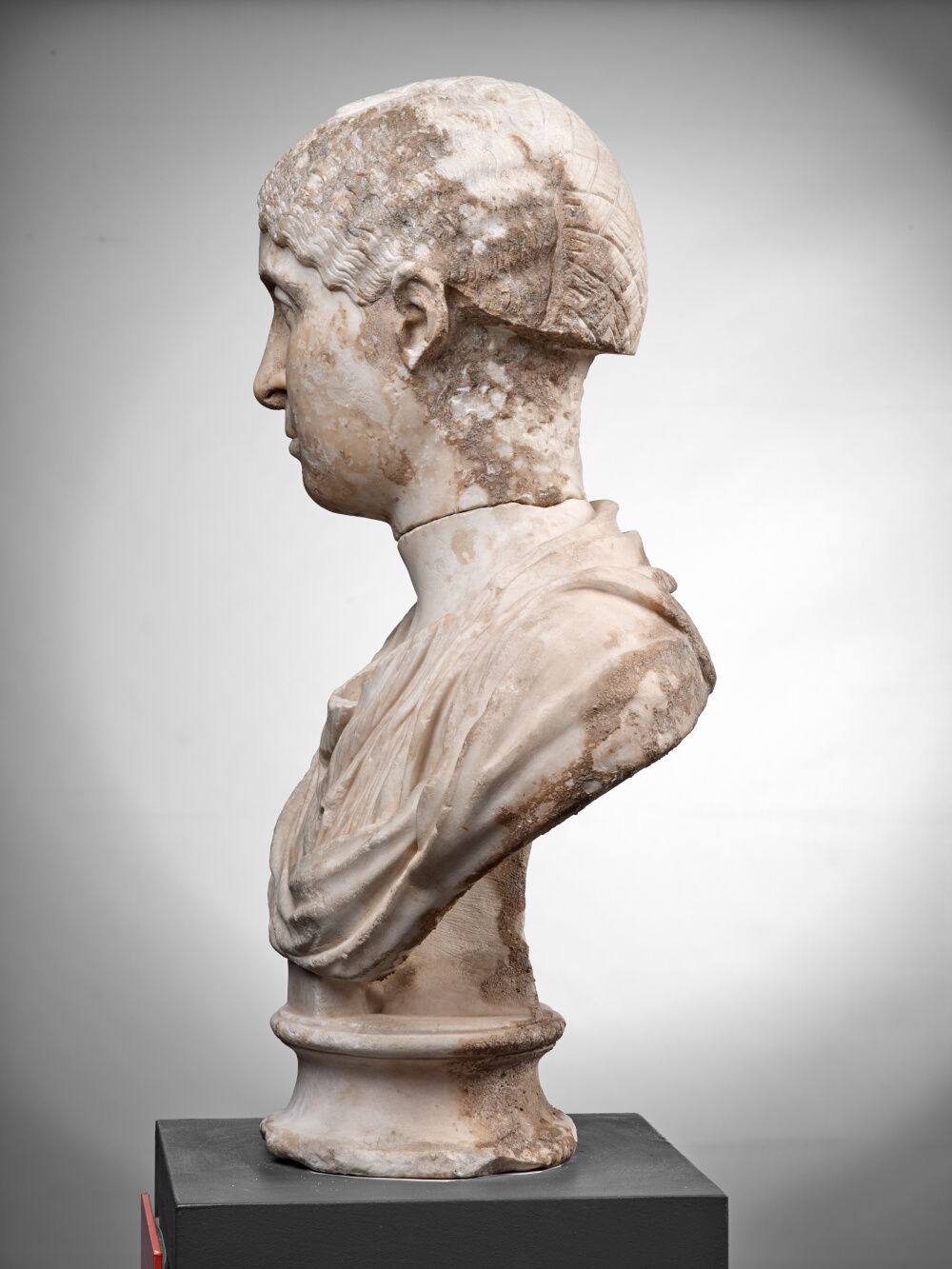
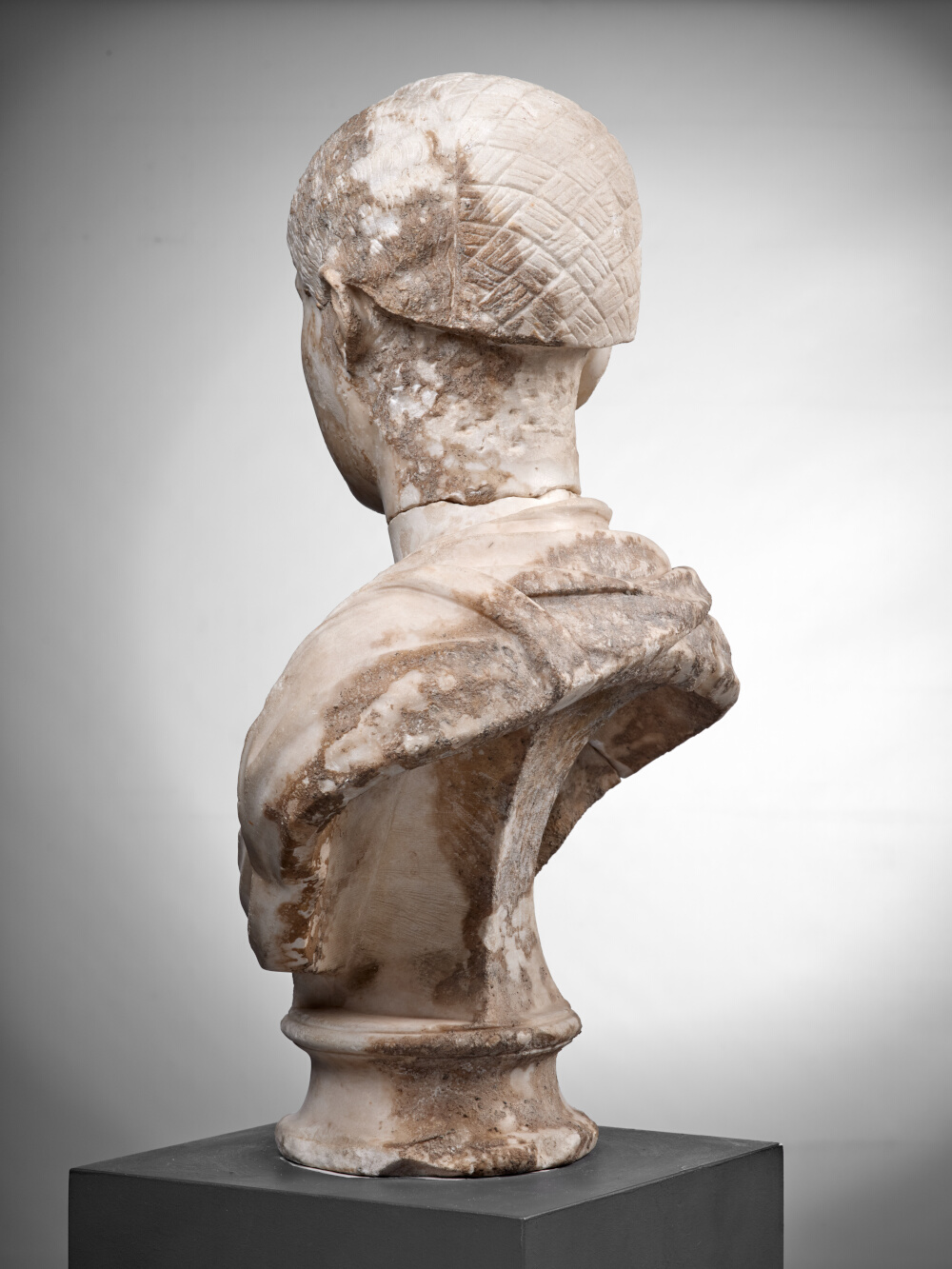
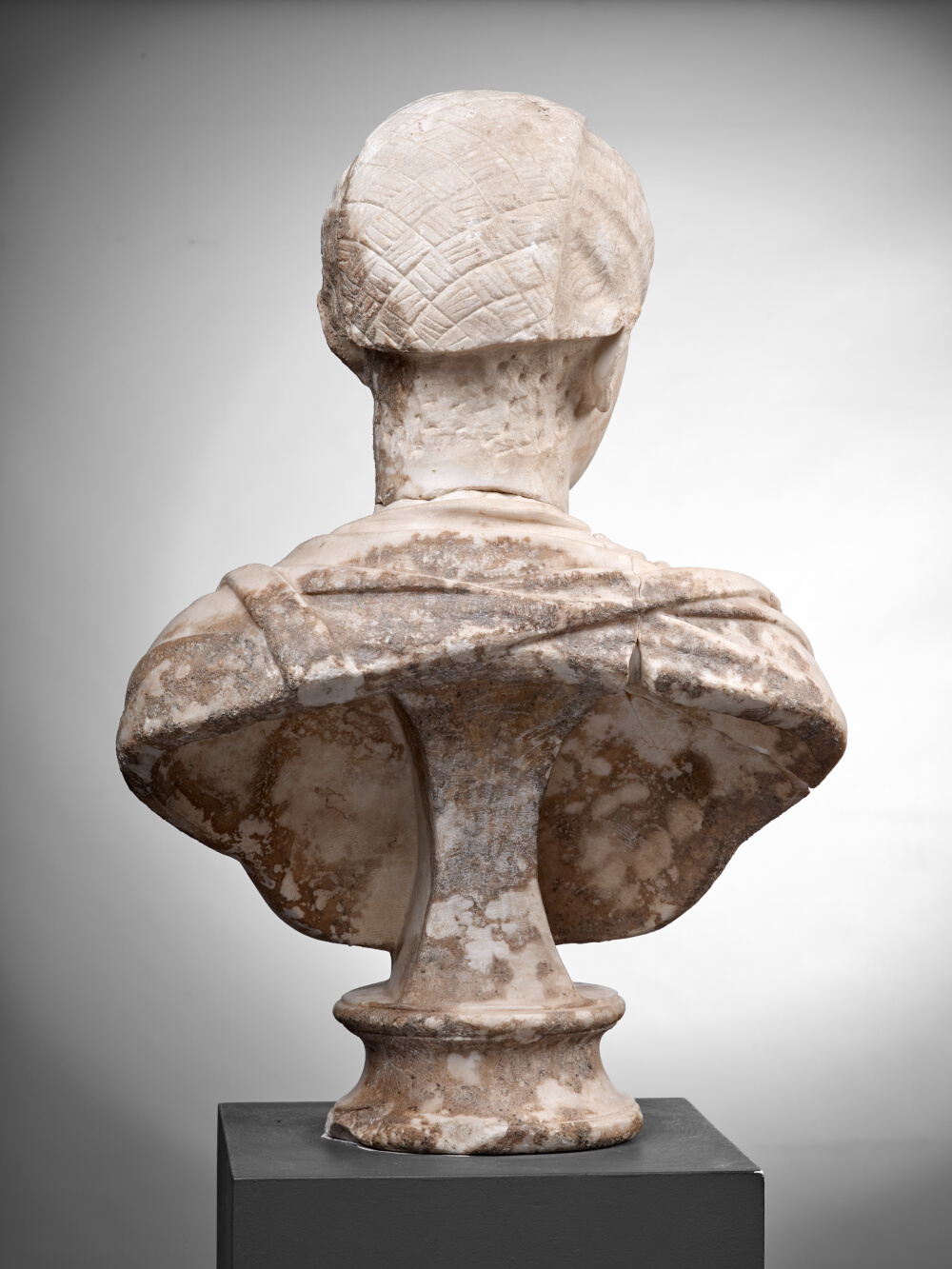
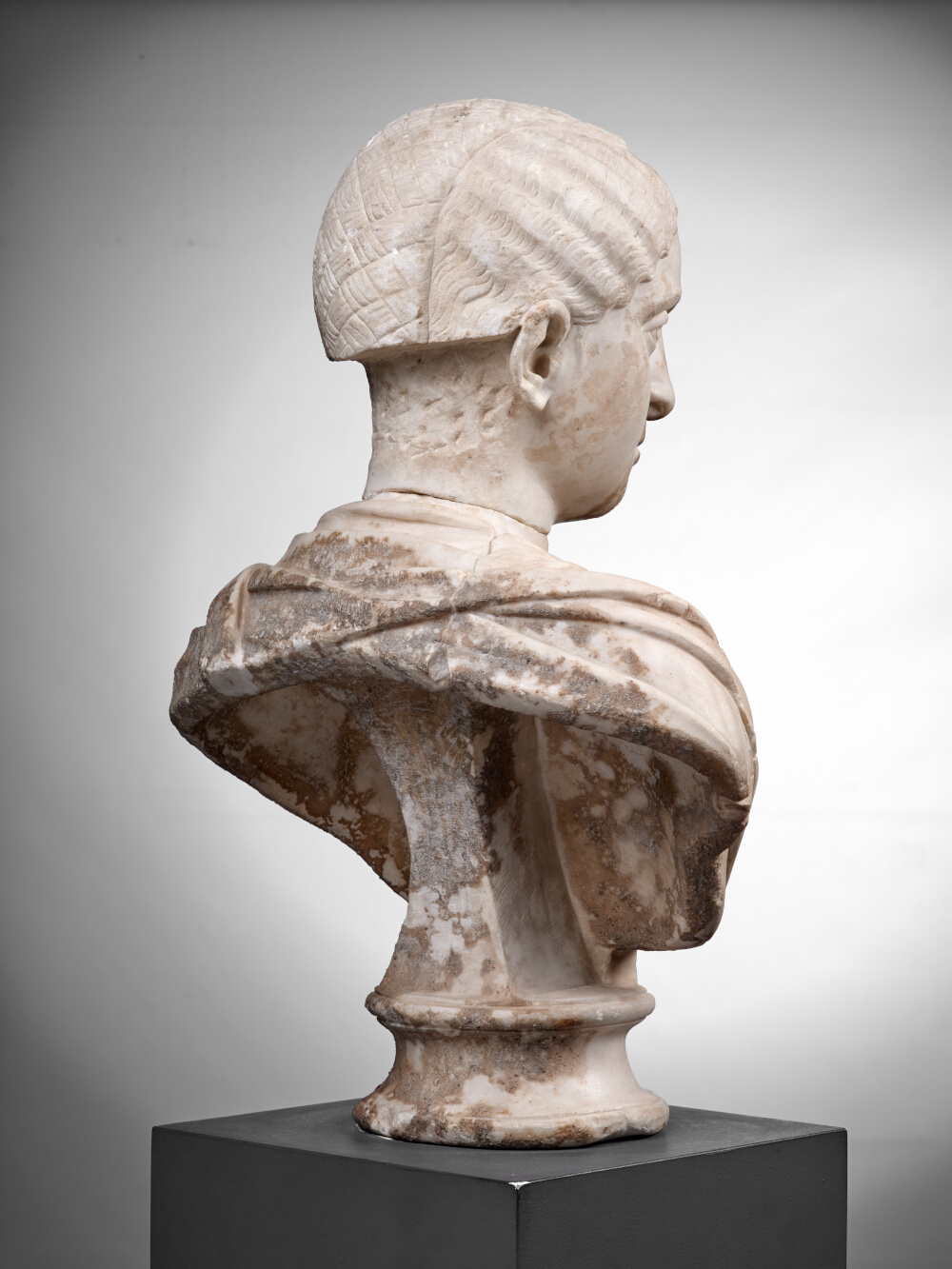
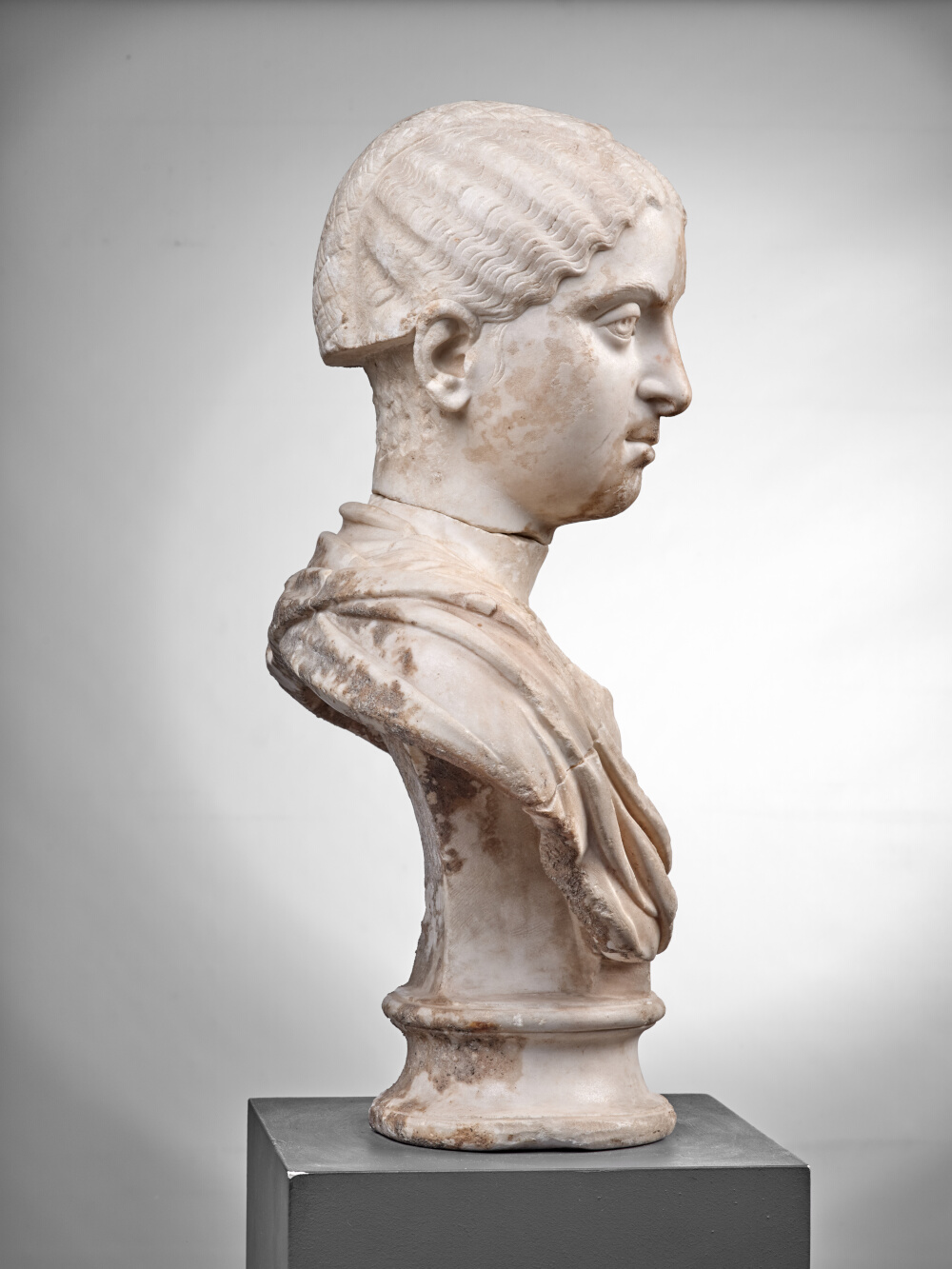
The portrait, in which the head is turned slightly to the right, depicts a young woman with features that are still adolescent : a regular oval face, full cheeks, a long, slender nose, almond-shaped eyes with heavy eyelids, and a subtly animated mouth, the lower lip of which—being fuller—protrudes slightly. Her hairstyle is the main identifying feature. The hair is parted in the middle and arranged in regular waves framing the forehead. At the back, the hair was complemented by an extension—now lost—forming a long, flat plait secured at the crown of the head in the style known as the Scheitelzopffrisur. First appearing in the early 240s, this hairstyle quickly became the standard for female portraiture throughout the second half of the third century.
The shape of the nose, the outline of the lips, the modelling of the eyelids and the very distinctive arrangement of this hairstyle allow us to link the Chiragan bust without hesitation to the official prototype of Tranquillina, known from several replicas preserved in Rome, London, Copenhagen, Florence, Dresden and Liverpool. The iconography was most likely created to mark the imperial wedding celebrated in 241, when Tranquillina was granted the title of Augusta. Despite the brevity of her reign, which was cut short by the death of Gordian III in 244, this image enjoyed remarkable circulation throughout the Empire. Contemporary coin issues constantly extolled the Concordia Augustorum, making the young imperial couple the symbol of the stability regained following the political crises of the 230s. The sculpted portraits played a full part in this dynastic propaganda and were widely distributed throughout the provinces, where they were displayed in sanctuaries of the imperial cult, public buildings or the residences of those in authority.
The Chiragan specimen stands out for the quality of its craftsmanship. The contrast between the delicately incised folds of the stola and the more powerful volumes of the palla, worked with a trephine, reveals a technical mastery characteristic of the finest Roman workshops. The particularly subtle modelling of the eyelids, mouth and braids, despite surface damage and the loss of the hairpiece, places this work amongst the finest surviving replicas of the official type. Carved from Göktepe marble, the bust most likely originates from a Roman workshop (stadtrömisch).
The possibility that it was recarved from an older bust has been considered, given the relatively archaic shape of the base and the presence of a repair piece at the nape of the neck. However, a detailed analysis of the work leads us to reject this hypothesis. It should be noted, for example, that the proportions of the head and the torso are perfectly consistent. As for the added hairpiece, this reflects a practice that was by no means unusual in the 3rd century, as evidenced in particular by the probable portrait of Julia Mamaea in the Louvre (Ma 3552) but also, at Chiragan, by the head of Etruscilla (?) (inv. Ra 74), associated with the half-bust (Halbkörperbüste). One might also consider the cargo of marble from the ‘Porticcio A’ shipwreck, off the coast of Ajaccio, which has preserved both a female bust and the added ‘veil of hair’—a sign that this addition was intended from the outset ; as at Chiragan, the latter was applied to a monolithic bust.
According to E. Rosso 2024, Sculptures antiques de Chiragan (Martres-Tolosane). I. Les portraits romains I.4 Des Sévères à la Tétrarchie, Toulouse. Musée Saint-Raymond, Musée d’archéologie de Toulouse, 2024, p. 81-96.
Bibliography
- Attanasio, Bruno, Prochaska 2021 D. Attanasio, M. Bruno, W. Prochaska, Göktepe Marbles. White, Black and Two-Tone, L’Erma di Bretschneider, Roma, Bristol.
- Bergmann 1977 M. Bergmann, Studien zum römischen Porträt des 3. Jahrhunderts n. Chr. (Antiquitas), Bonn. p. 39
- Braemer 1999 F. Braemer, « Le culte impérial en Narbonnaise et dans les Alpes au Haut-Empire : documents sculptés, » Revue archéologique de Narbonnaise, 32, pp. 49–55. p. 53, fig. 2
- Cazes et al. 1999 D. Cazes, E. Ugaglia, V. Geneviève, L. Mouysset, J.-C. Arramond, Q. Cazes, Le Musée Saint-Raymond : musée des Antiques de Toulouse, Toulouse-Paris. p. 141
- Espérandieu 1908 É. Espérandieu, Recueil général des bas-reliefs de la Gaule romaine, 2. Aquitaine, Paris. p. 90-91, no 1001
- Felletti Maj 1958 B.M. Felletti Maj, Iconografia romana imperiale da Severo Alessandro a M. Aurelio Carino (222-285 d. C.) (Quaderni e guide di archeologia), Rome. p. 179, no 220
- Joulin 1901 L. Joulin, Les établissements gallo-romains de la plaine de Martres-Tolosane (Mémoires présentés par divers savants à l’Académie des inscriptions et belles-lettres",), Paris.
- Poulsen 1951 F. Poulsen, Catalogue of Ancient Sculpture in the Ny Carlsberg Glyptotek, Copenhagen. p. 523, no 754
- Rachou 1912 H. Rachou, Catalogue des collections de sculpture et d’épigraphie du musée de Toulouse, Toulouse. no 166
- Rosso 2006 E. Rosso, L’image de l’empereur en Gaule romaine : portraits et inscriptions (Archéologie et histoire de l’art), Paris. p. 482-484, no 234
- Veyne 2005 P. Veyne, L’Empire gréco-romain (Des travaux), Paris. fig. 38
- Wegner, Unger 1979–1980 M. Wegner, R. Unger, « Verzeichnis der Kaiserbildnisse von Antoninus Pius bis Commodus, » Boreas. Münstersche Beiträge zur Archäologie, 2–3, pp. 87–181. p. 56
- Bulletin municipal Toulouse 1936 Bulletin municipal Toulouse, Bulletin municipal, Toulouse. p. 837
To cite this notice
Capus P., "Portrait of Tranquillina (?)", in The sculptures of the roman villa of Chiragan, Toulouse, 2019, online <https://villachiragan.saintraymond.toulouse.fr/en/ark:/87276/a_ra_166>.