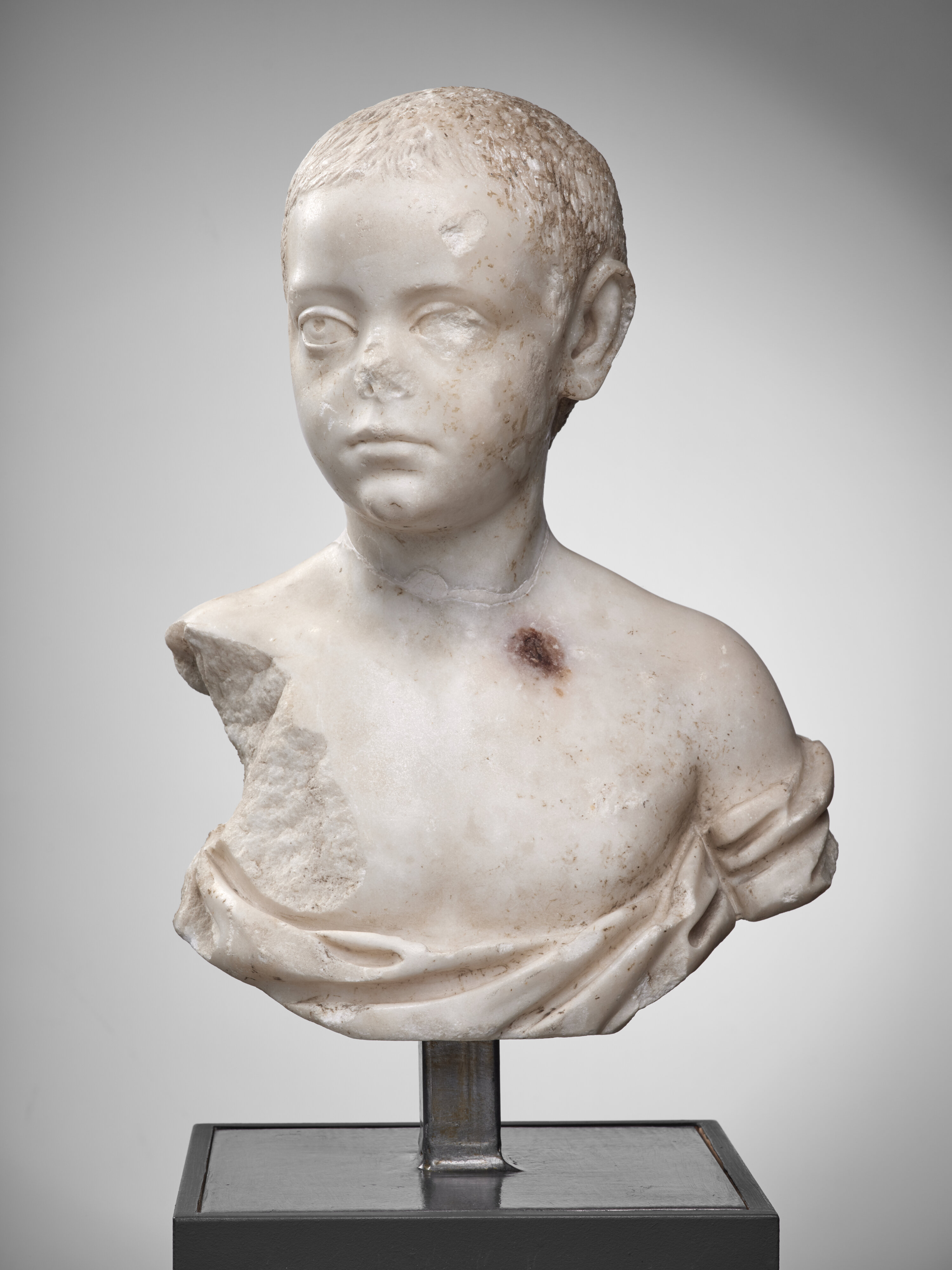
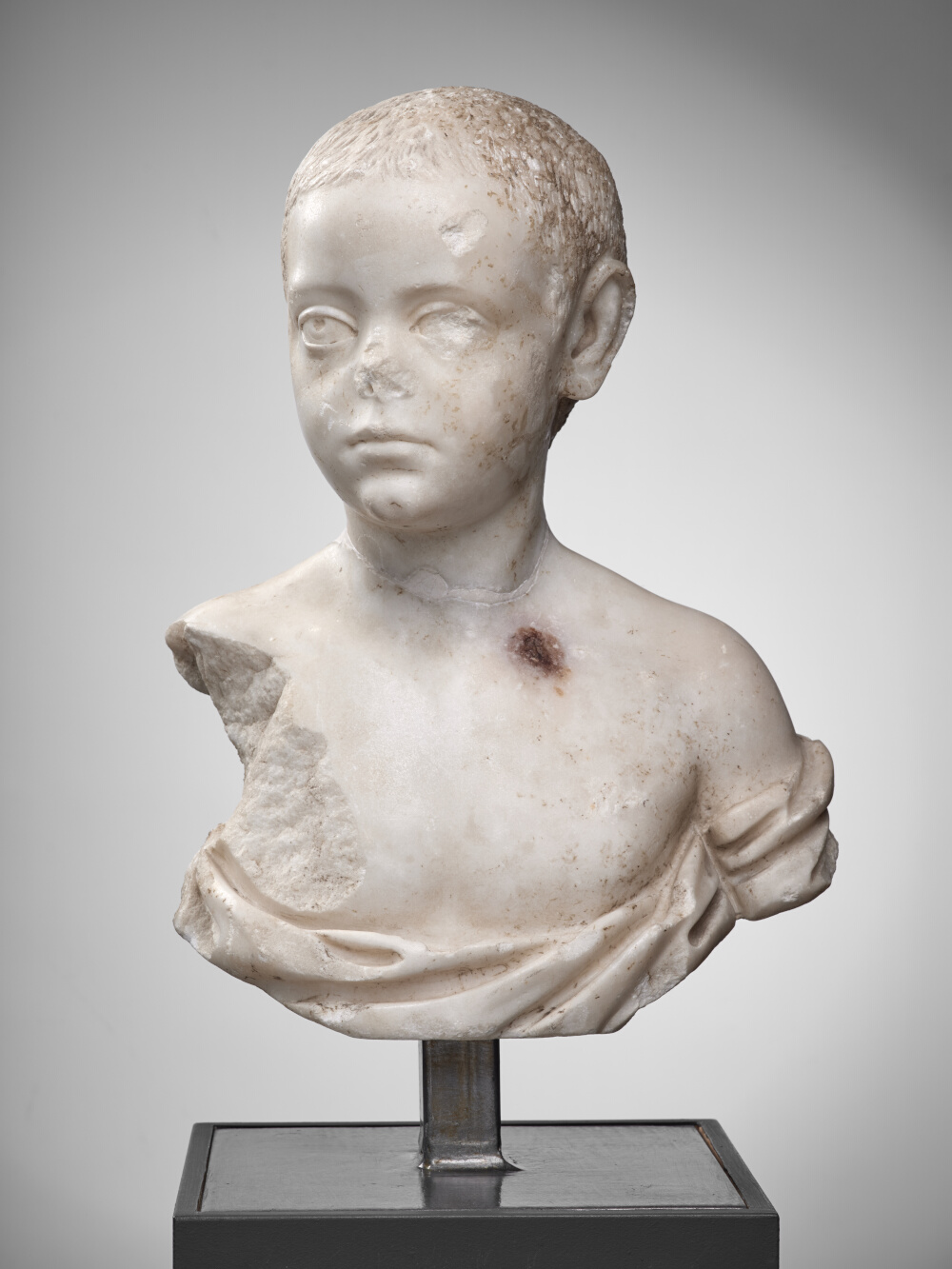
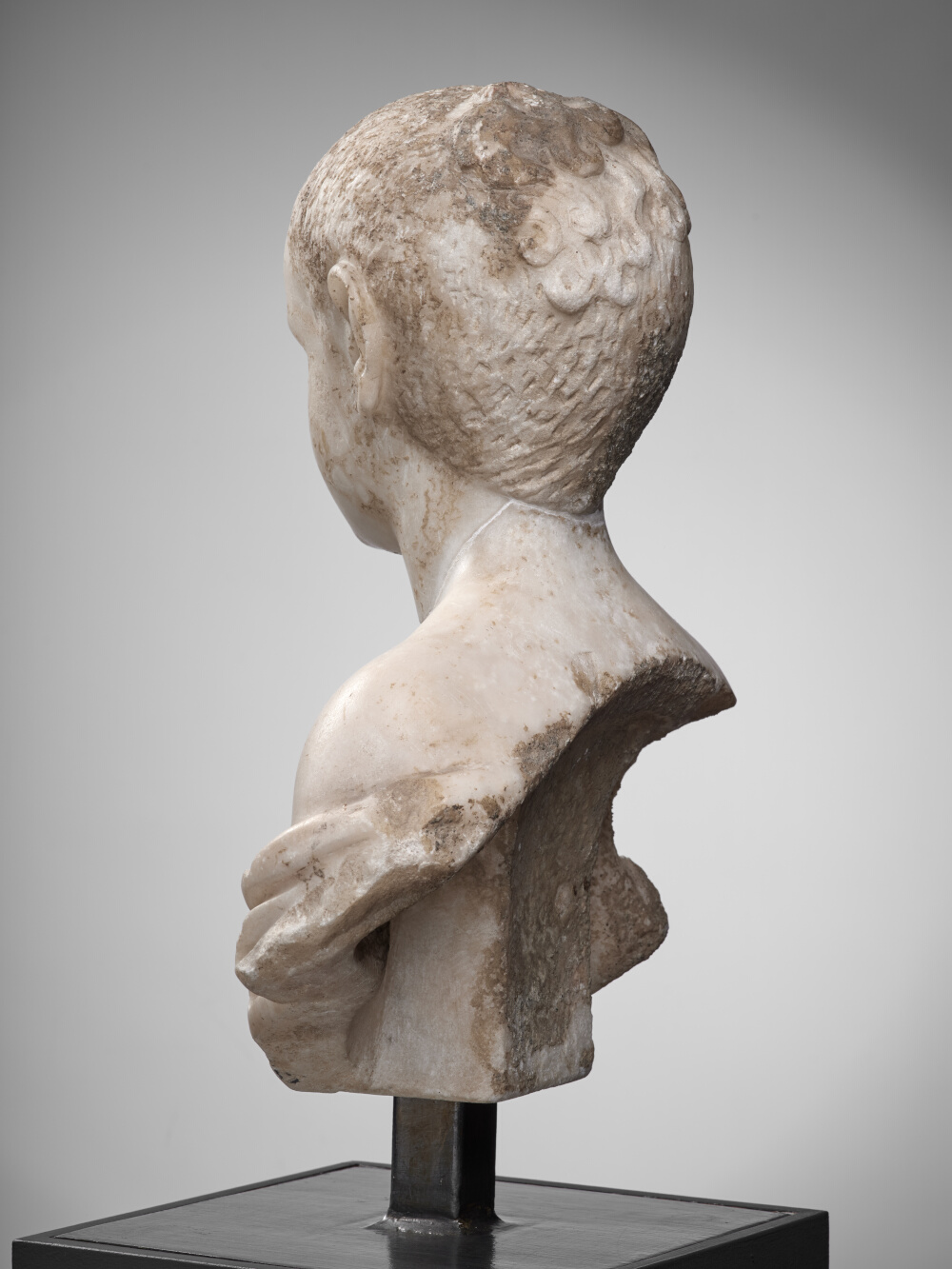
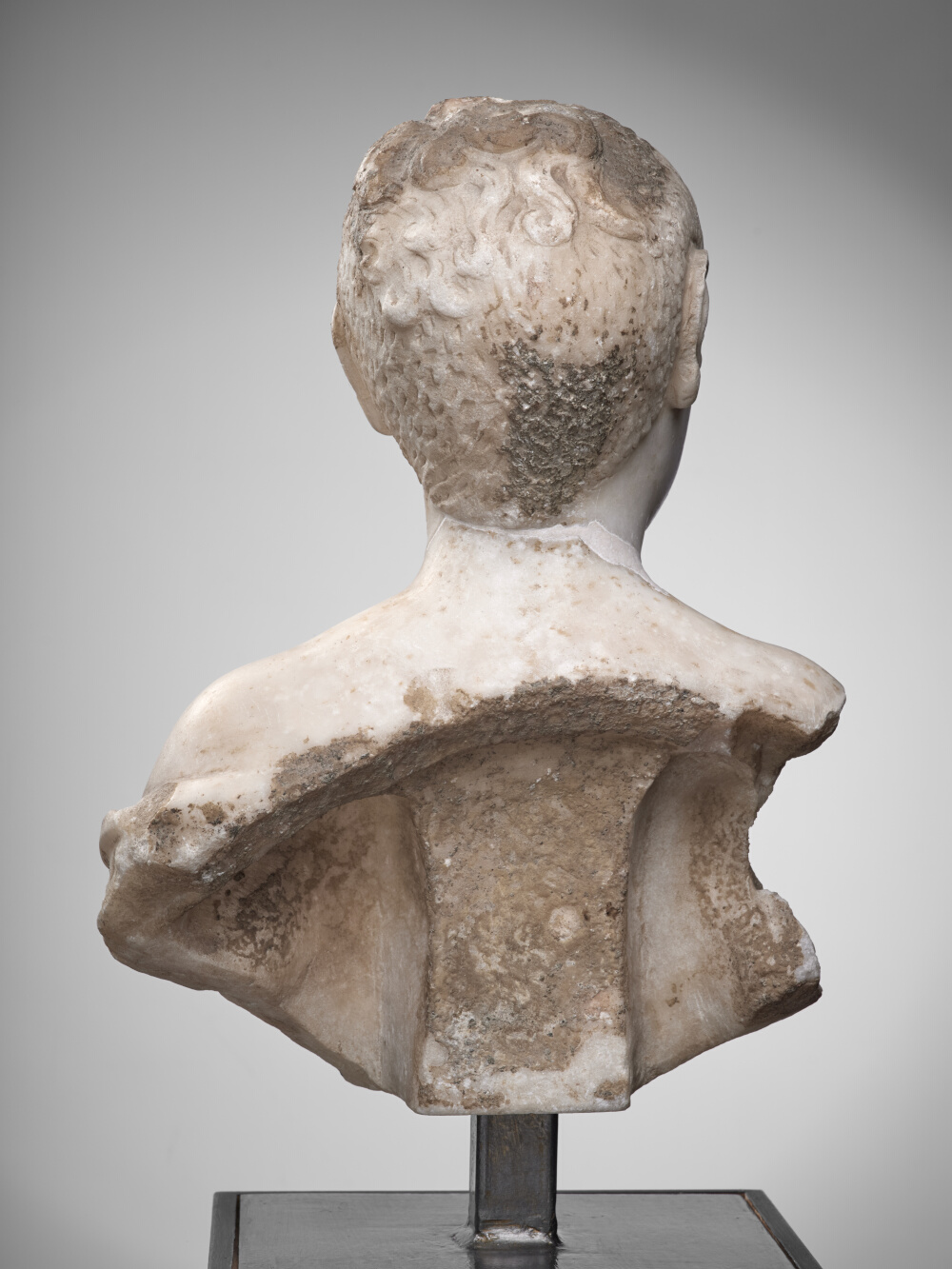
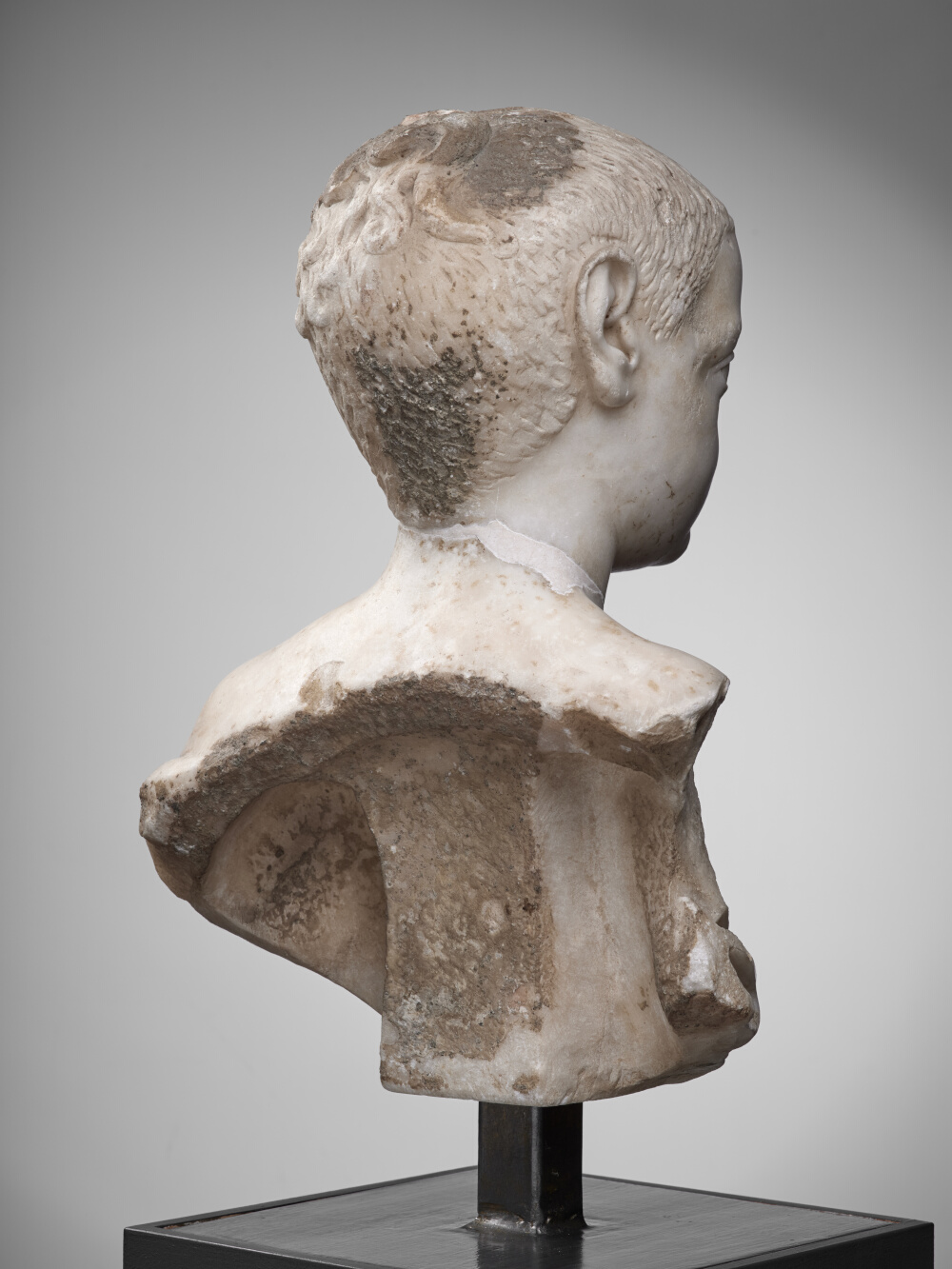
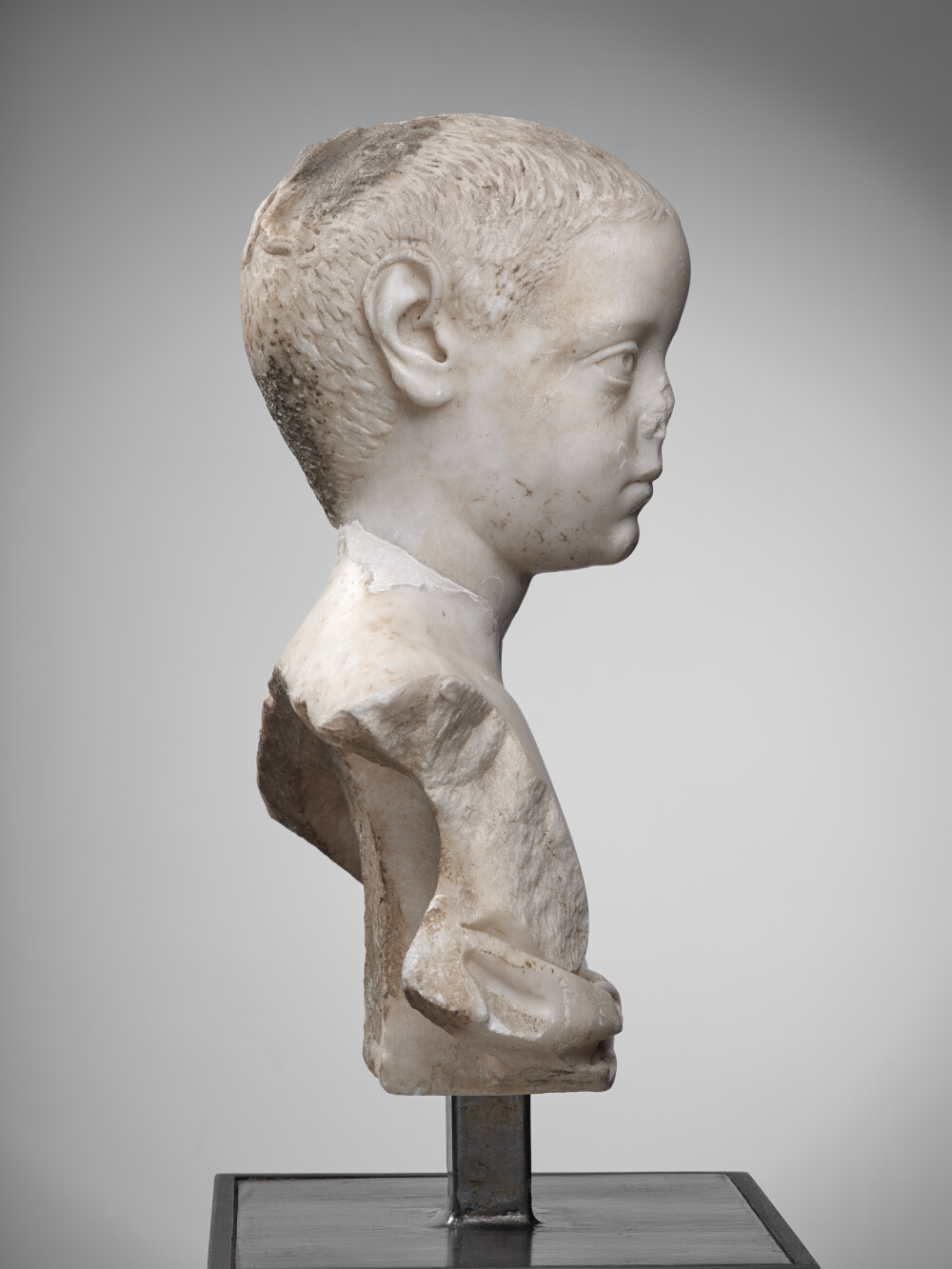
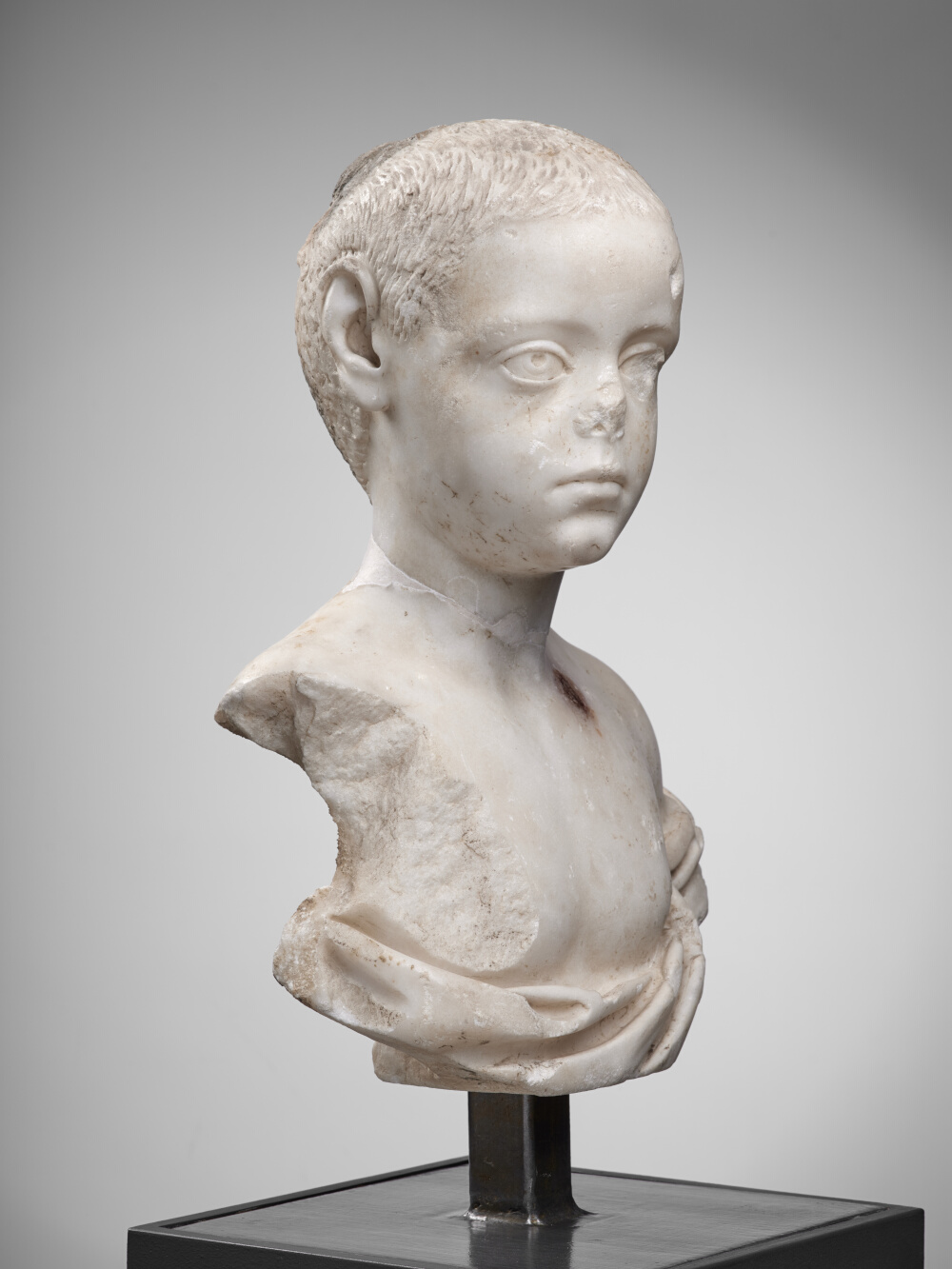
Bust of a young boy
- Date de création
- Second third of the 3\rd\ century
- Material
- Dokimium marble (Turkey)
- Dimensions
- H. 365 x l. 25 x P. 17 (cm)
- Inventory number
- Ra 125
- Photo credits
- Daniel Martin
This bust of a young boy is one of the most endearing portraits of children discovered in the Villa of Chiragan. With its naturalism and psychological subtlety, the work is in the finest tradition of Roman portraiture of children, which developed from the High Empire onwards.
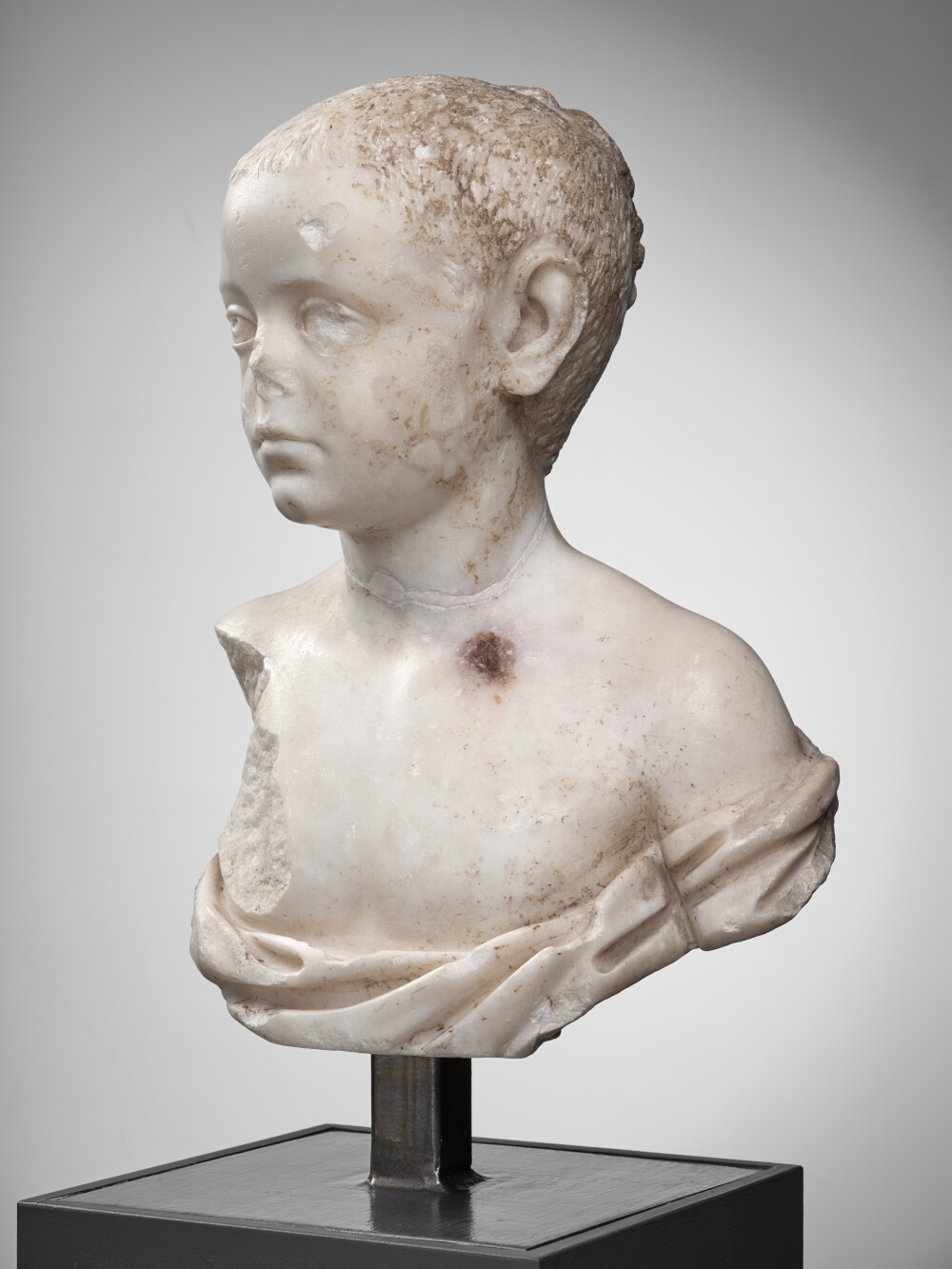
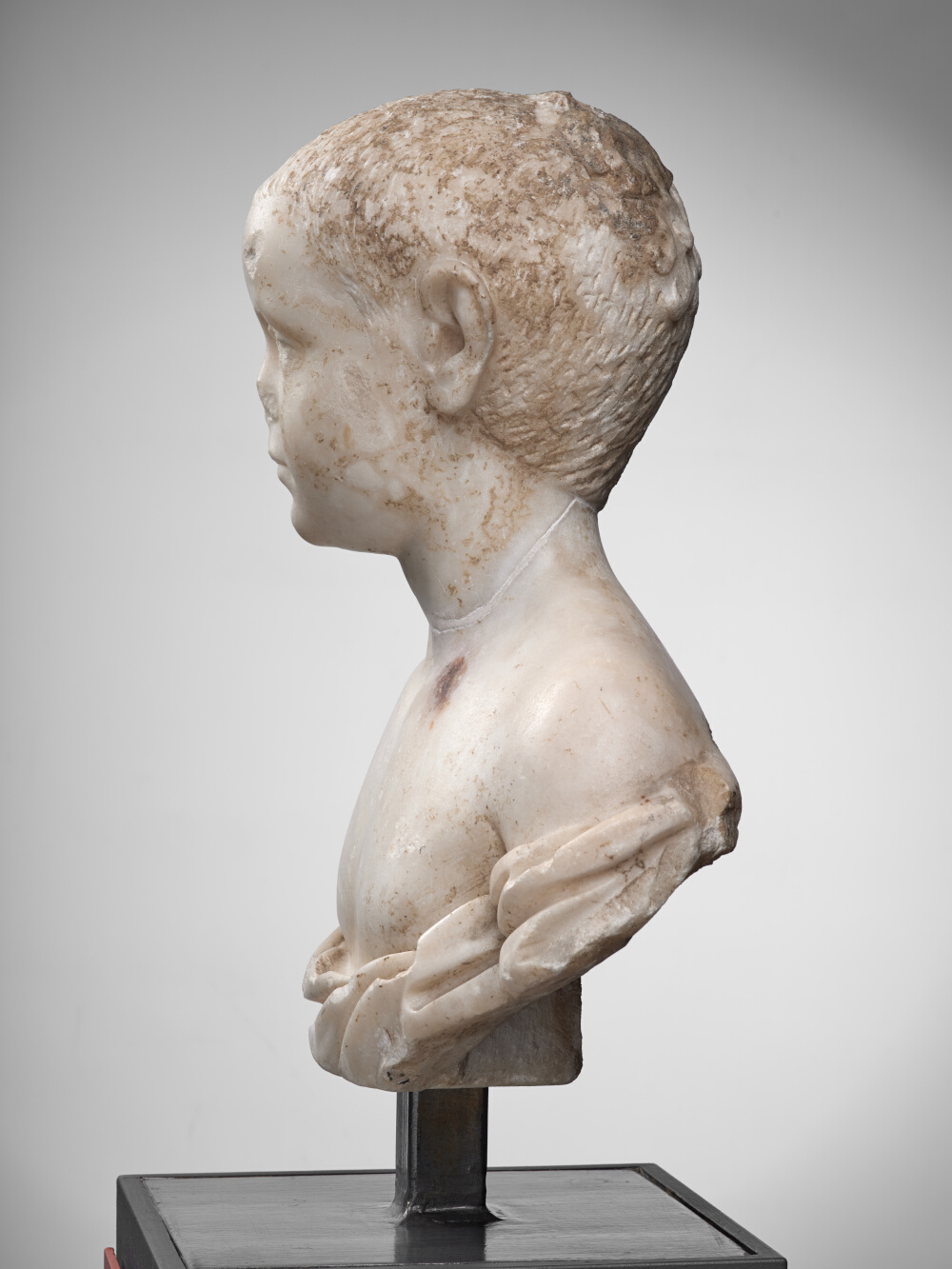
The portrait’s main point of interest lies in the treatment of the hair. The hair, cut very short, consists of small strands combed forwards, whilst longer strands emerge from the crown of the head. This distinctive feature has long led to the bust being associated with portraits of children wearing the famous
‘Horus lock’, traditionally interpreted as a sign of consecration to Isis intended to protect the child from premature death. Recent research, however, suggests that this interpretation should be abandoned. The true Horuslocke consists of a single long lock on the right side of the head, whereas the locks in the Chiragan portrait originate from the crown and belong to a different type of hairstyle.
The work thus forms part of a small group of portraits featuring locks confined to the crown of the head, distinct from examples where long locks cascade down the nape of the neck or onto the shoulders. Whilst the latter hairstyles have sometimes been interpreted as those of delicati — young slaves raised in large aristocratic residences who served as a symbol of the household’s luxury — this hypothesis seems unconvincing in the case of the Chiragan portrait. The child’s very young age, his still childlike face and his partially bare torso suggest more strongly that this is the likeness of a boy who died in infancy rather than that of a teenager belonging to the household staff.
The clothing contributes to this interpretation. The shoulders are bare, but a relatively thick cloak envelops the body in a manner rarely seen in Roman portraiture. This type of drapery finds a few parallels in funerary monuments from the early 3rd century and emphasises the private nature of the commission rather than any official dimension.
The dating is based primarily on a stylistic analysis of the hairstyle. The small locks still display the characteristics of the a penna style, which was widespread in the early 3rd century, but their rendering becomes freer and less rigorous, foreshadowing the stylistic developments of the second half of the century. The rendering of the pupils, achieved with two drill strokes, also links the work to several portraits of Gordian III. Taken together, these factors suggest that the bust was created between 235 and 245.
Careful examination of the right ear suggests the possibility of an earlier reworking or retouching (Umarbeitung), comparable to those observed on other portraits from Chiragan. Certain irregularities in the modelling may be remnants of this, but the evidence remains insufficient to confirm this hypothesis with certainty.
Unlike several juvenile portraits from the site, which are generally associated with members of the imperial family, there is nothing here to identify a young prince. Comparisons with the coin effigies of Valerian II reveal significant differences in both hairstyle and facial features. The largely exposed torso is also at odds with the official iconography of the Empire’s princes.
Finally, an analysis of the material provides a decisive argument. Crafted from Dokimeion (Afyon) marble, rather than Göktepe marble—which was generally reserved for imperial commissions—the bust appears to be a private commission, probably executed in a Roman workshop. It may depict the son of a high-ranking official or one of the administrators of the vast Chiragan estate, who died prematurely. Through this work of great artistic quality, the sensitivity of Roman funerary portraiture towards early childhood finds one of its most moving expressions here
According to J.-C. Balty 2024, Sculptures antiques de Chiragan (Martres-Tolosane). I.Les portraits romains I.4 Des Sévères à la Tétrarchie,Toulouse. Musée Saint-Raymond, Musée d’archéologie de Toulouse,2024, p. 57-70.
Bibliography
- Baratte 1993 F. Baratte, « Deux portraits d’enfants isiaques, » Revue Archéologique, 1, pp. 101–110. fasc. 1, p. 101-110
- Cazes et al. 1999 D. Cazes, E. Ugaglia, V. Geneviève, L. Mouysset, J.-C. Arramond, Q. Cazes, Le Musée Saint-Raymond : musée des Antiques de Toulouse, Toulouse-Paris. p. 141
- Derriks 1998 C. Derriks, « Une tête d’enfant isiaque. Hypothèse ou certitude, » W. Clarysse, A. Schoors, H. Willems (eds.), Egyptian religion, the last thousand years : studies dedicated to the Memory of Jan Quagebeur I, Leuven, pp. 91–103. p. 91-103
- Espérandieu, Lantier 1907 É. Espérandieu, R. Lantier, Recueil général des bas-reliefs, statues et bustes de la Gaule romaine, 1 (Collection de documents inédits sur l’histoire de France), Paris. p. 93, no 1006
- Goette 1989 H.R. Goette, « Römische Kinderbildnisse mit Jugend-Locken, » Mitteilungen des Deutschen Archäologischen Instituts. Athenische Abteilung, 104, pp. 203–217. p. 203-217
- Joulin 1901 L. Joulin, Les établissements gallo-romains de la plaine de Martres-Tolosane (Mémoires présentés par divers savants à l’Académie des inscriptions et belles-lettres",), Paris.
- Rachou 1912 H. Rachou, Catalogue des collections de sculpture et d’épigraphie du musée de Toulouse, Toulouse. no 125
- Vonderstein 2011 M. Vonderstein, « Cirrus, mallos oder Horuslocke-Uberlegungen zu einem romischen Knabenportrat in der Berliner Antikensammlun, » O. Pilz (ed.), "Keraunia": Beiträge zu Mythos, Kult und Heiligtum in der Antike, Berlin, Boston, pp. 161–176. p. 161-176
- von Gonzenbach 1957 V. von Gonzenbach, Untersuchungen zu den Knabenweihen im Isiskult der römischen Kaiserzeit, Bonn.
- Backe-Dahmen 2008 A. Backe-Dahmen, Die Welt der Kinder in der Antike, Mainz.
- Musée Saint-Raymond 1995 Musée Saint-Raymond, Le regard de Rome : portraits romains des musées de Mérida, Toulouse et Tarragona. Exhibition, Mérida, Museo nacional de arte romano ; Toulouse, Musée Saint-Raymond ; Tarragone, Museu nacional arqueològic de Tarragona, 1995, Toulouse. p. 53, no 13
To cite this notice
Capus P., "Bust of a young boy", in The sculptures of the roman villa of Chiragan, Toulouse, 2019, online <https://villachiragan.saintraymond.toulouse.fr/en/ark:/87276/a_ra_125>.