Portrait of a man
- Date de création
- Approximately 225 - 250
- Material
- Göktepe marble, district 3 (Turkey)
- Dimensions
- H. 345 x l. 185 x P. 23 (cm)
- Inventory number
- Ra 73 i
- Photo credits
- Daniel Martin
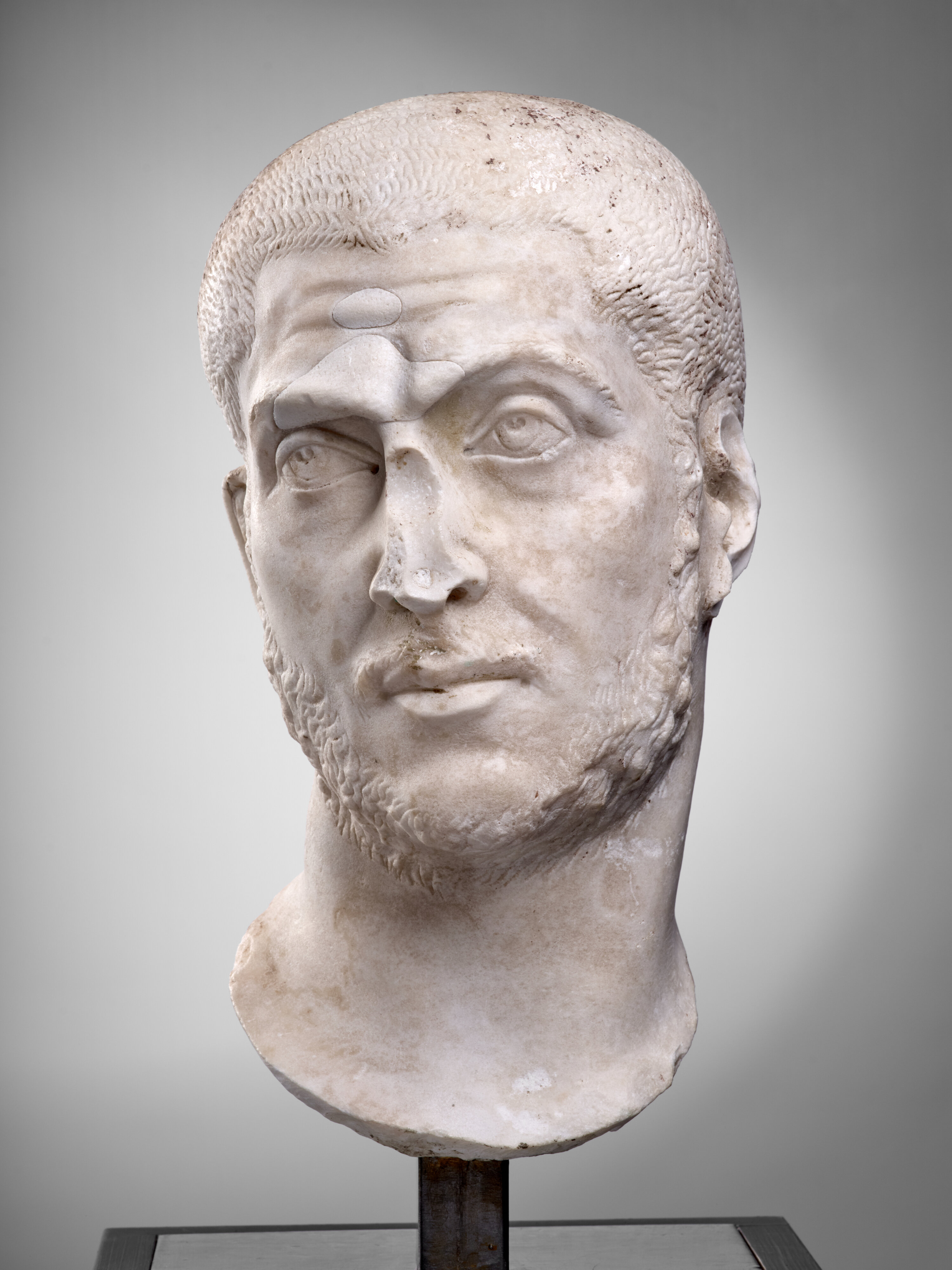
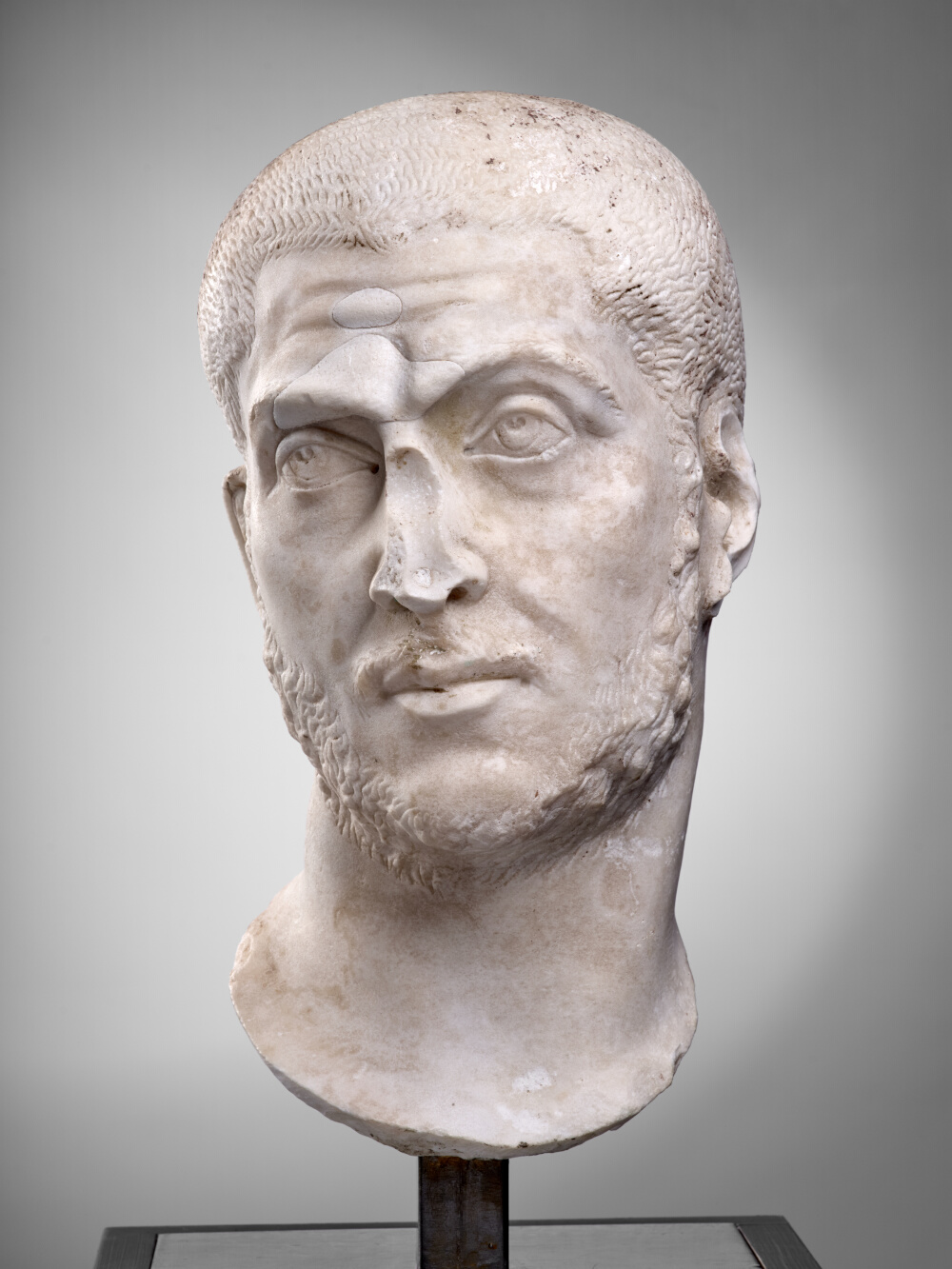
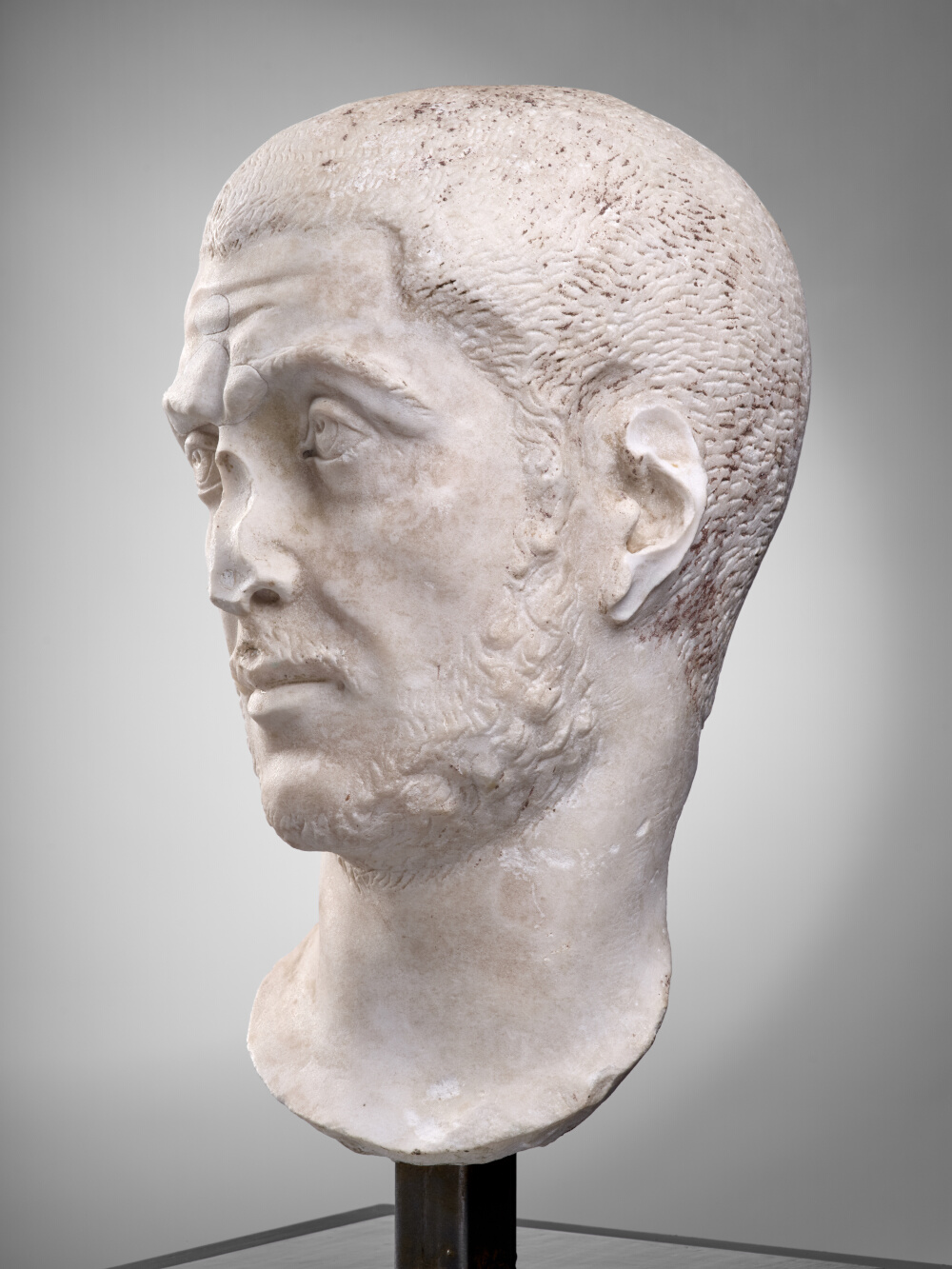
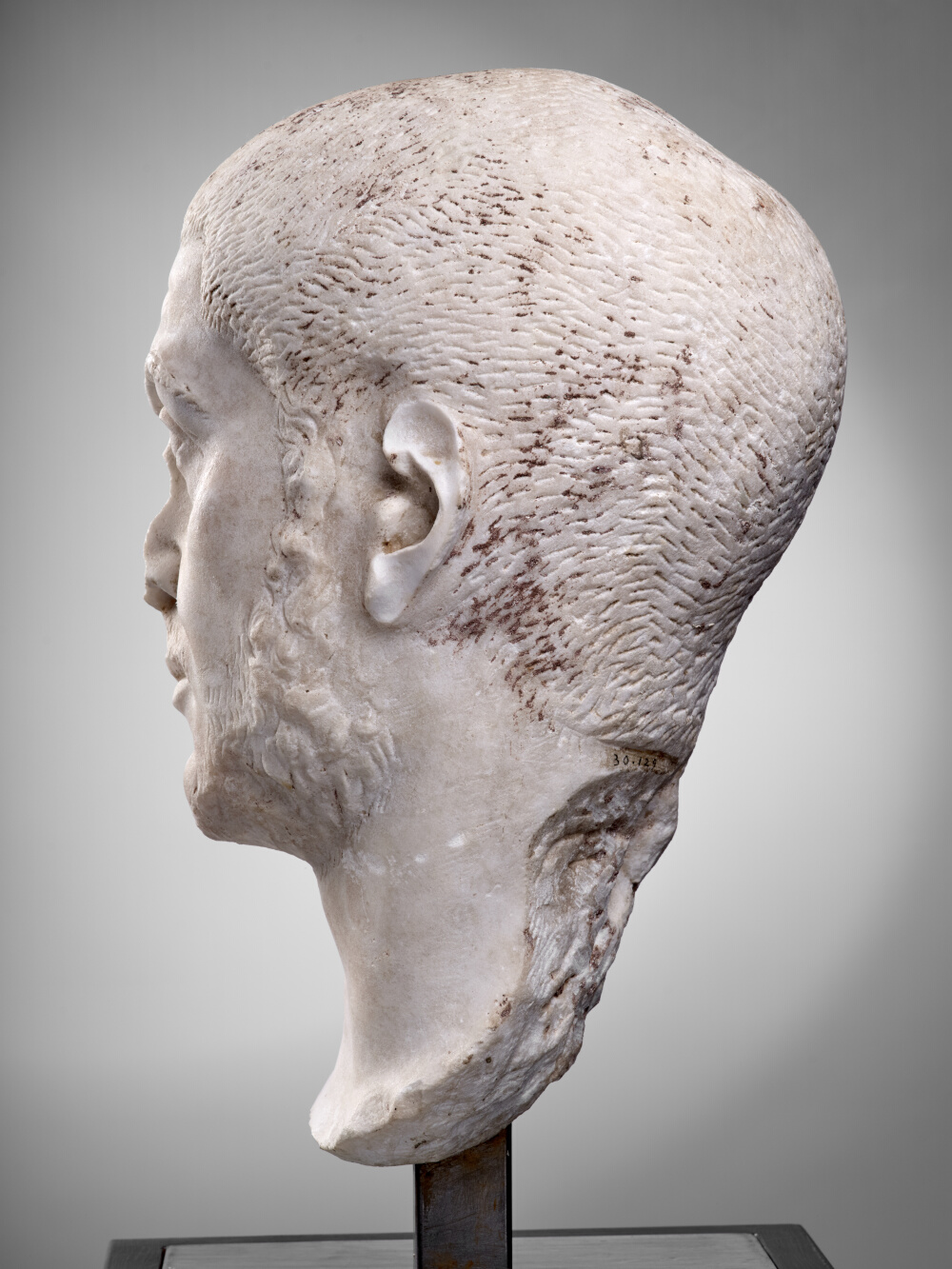
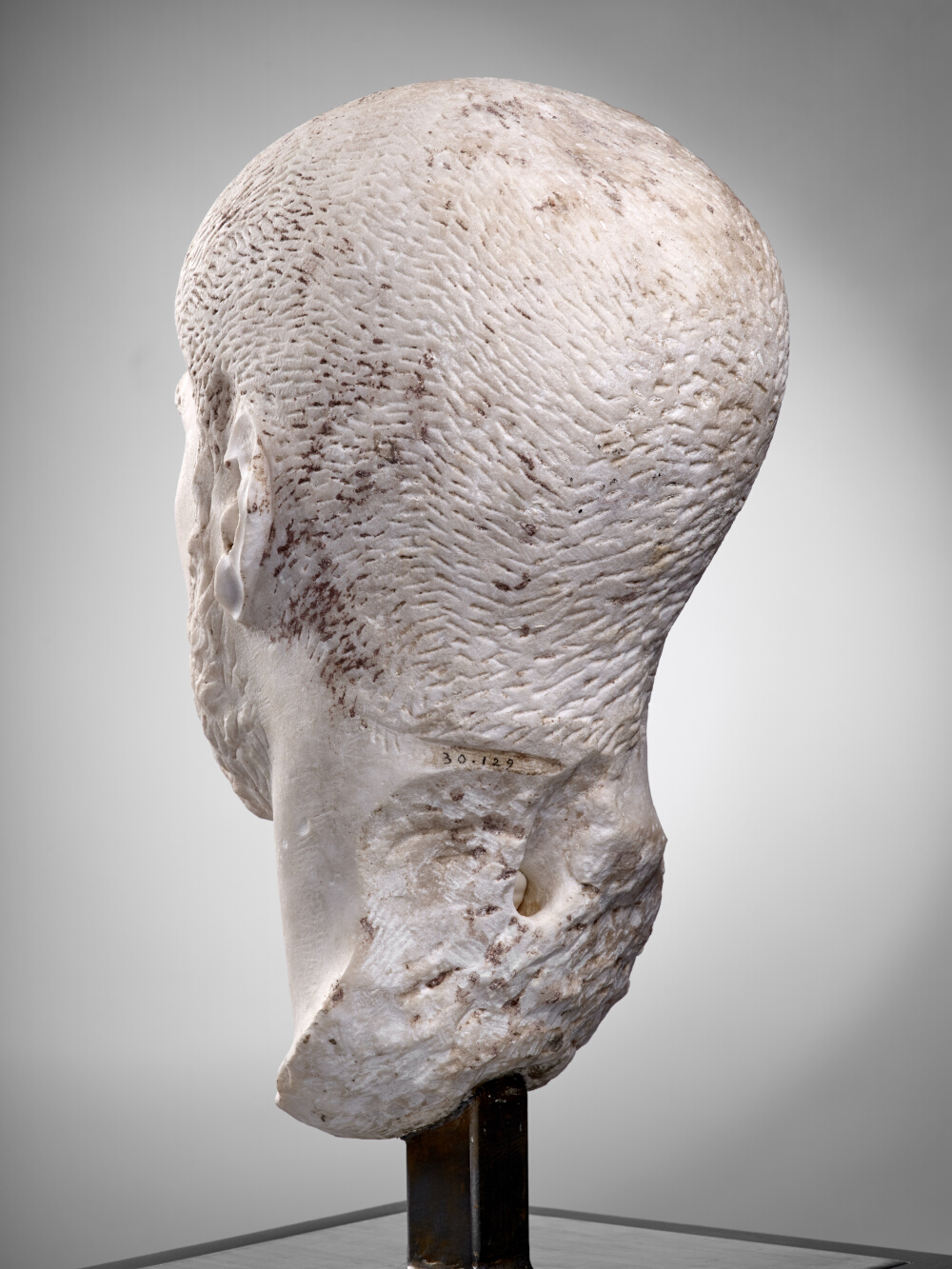
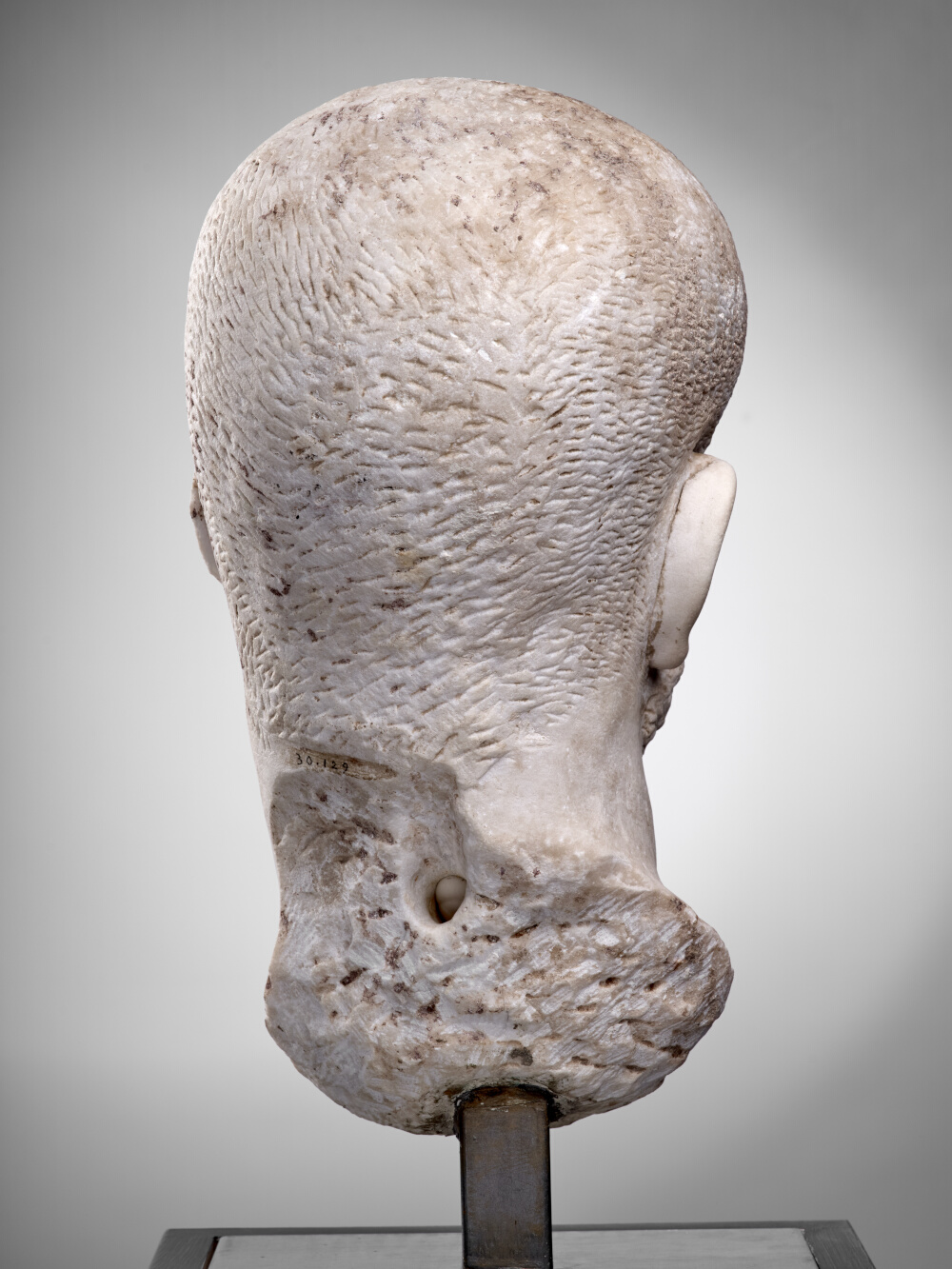
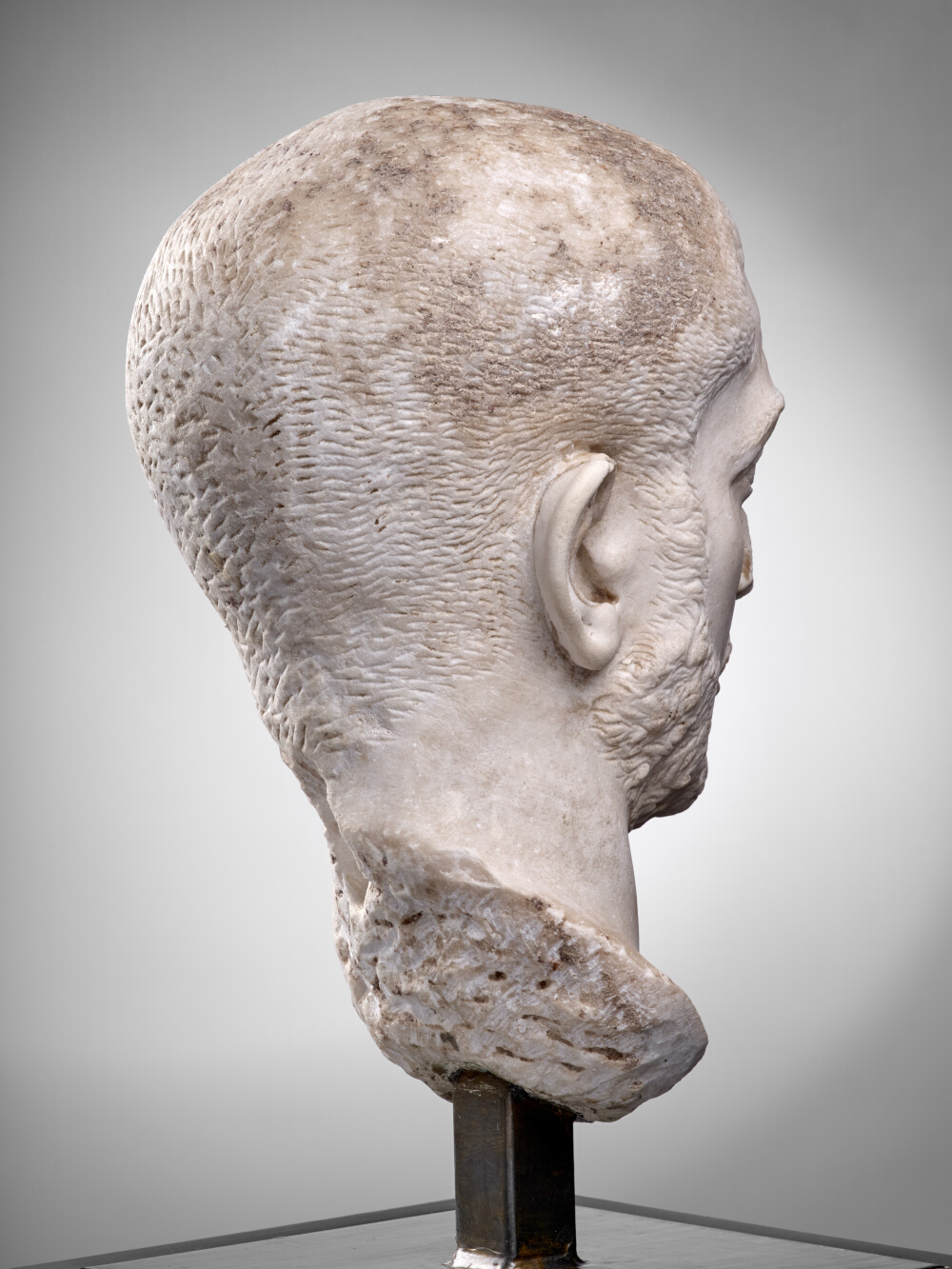
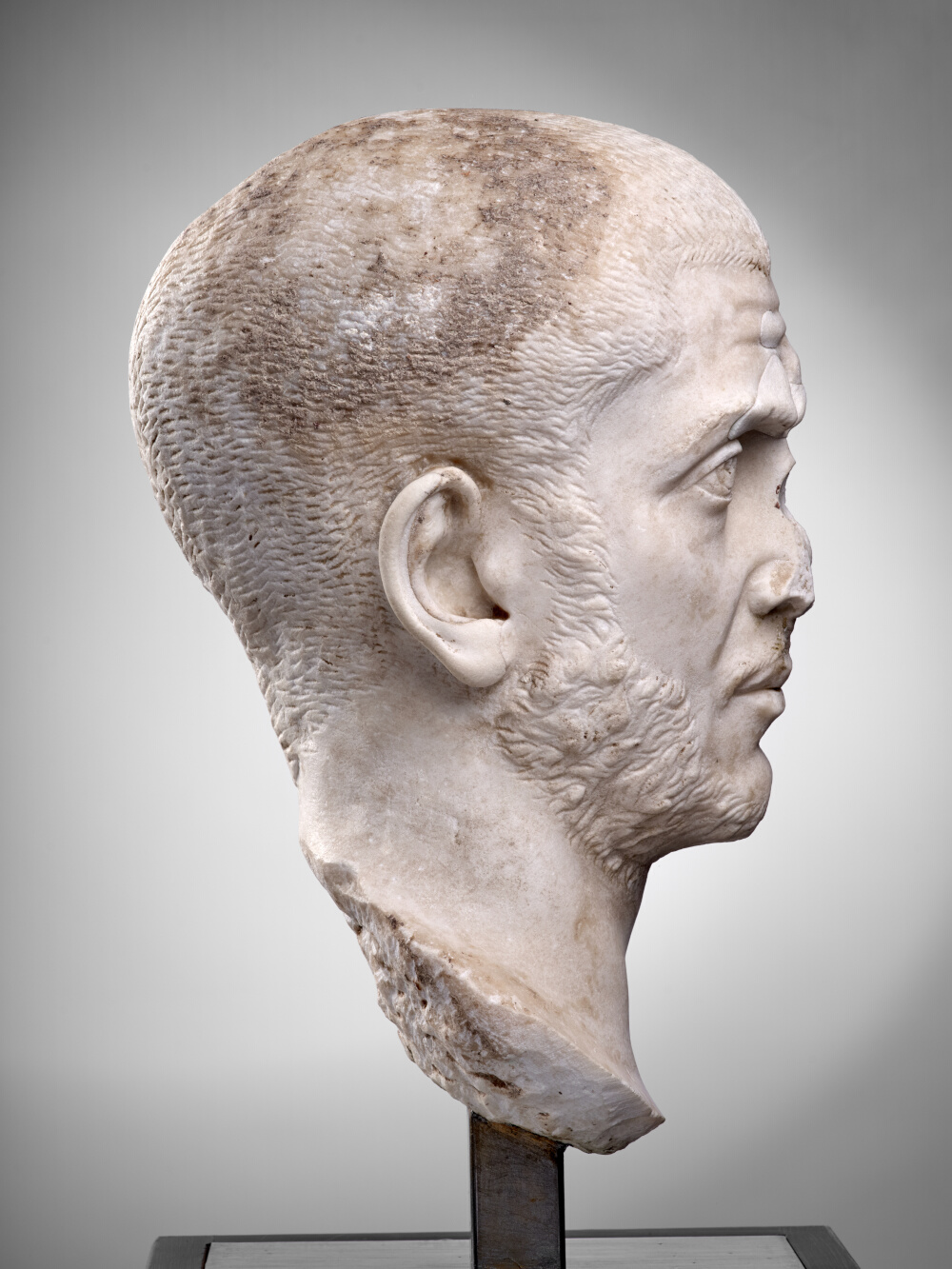
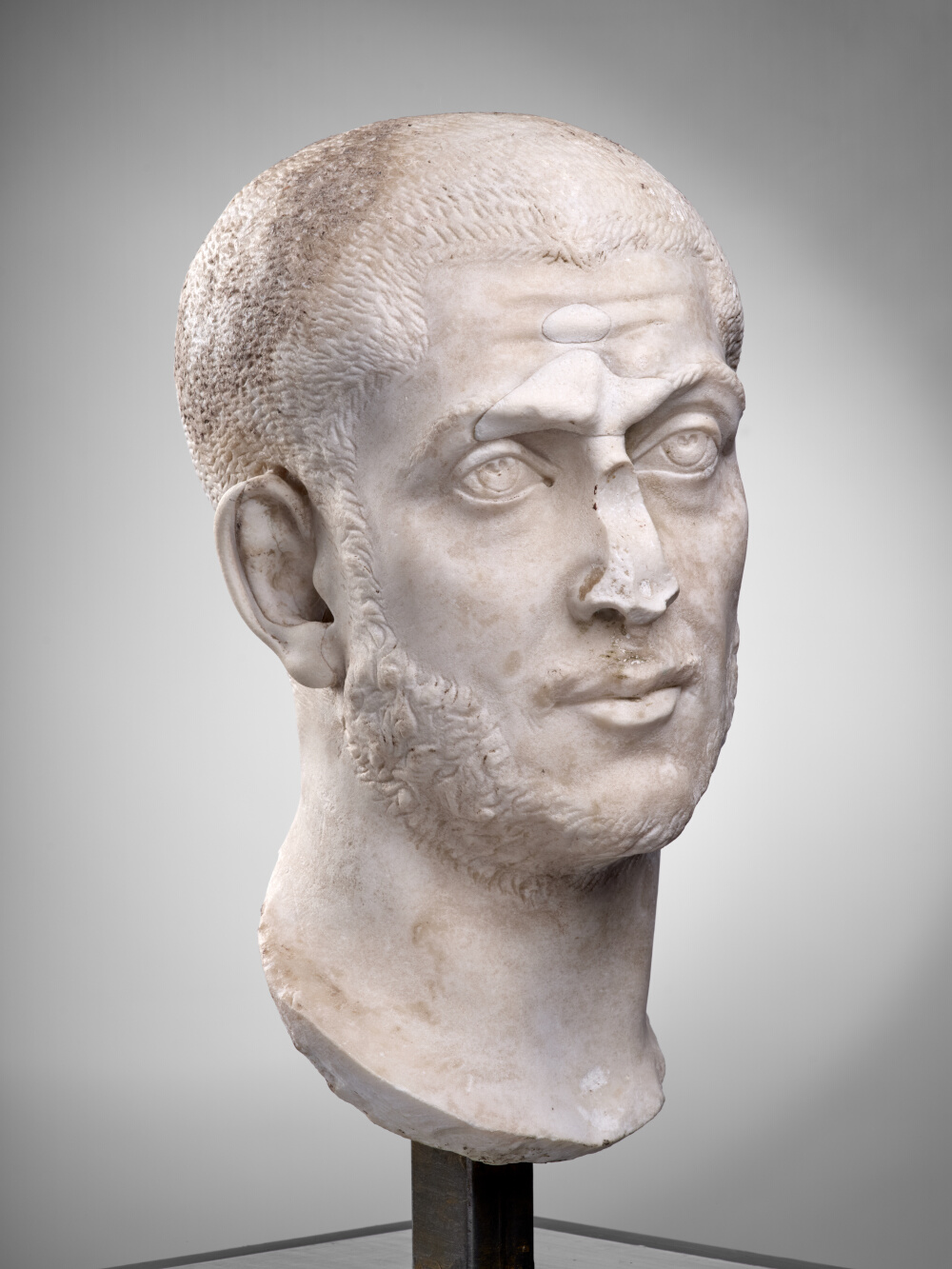
This male head was significantly altered even during Antiquity itself. The only parts that have retained their original delicacy are the rendering of the sideburns and, above all, the beard, whose supple modeling contrasts with the deep retouching affecting the hair. The unusual appearance of the hair—rendered with broad, angular strokes on the temples, the sides of the skull, and the top of the head—clearly reveals the reuse of an earlier portrait. This reworking is confirmed by the lack of care taken in the hatching of the shortened hair, by the disproportionate volume at the back of the skull, by the deepening of the forehead—which strongly accentuates the brow ridges—as well as by the unusual ratio between the width of the head and the diameter of the neck. The marked tilt of the head relative to the neck is also an indication of this transformation.
Despite these modifications, the portrait’s original state remains identifiable thanks to the treatment of the beard, whose short strands bear a strong stylistic resemblance to certain portraits of Gallienus. This comparison leads to dating the original effigy to around 260. The earlier identification of the portrait as Volusien was therefore not entirely without foundation, since it already recognized a work dating from the mid-3rd century.
The second version of the portrait is more difficult to date. However, several stylistic characteristics help to place it chronologically. The broad brow ridges, which reveal a large area around the eyes, the pronounced modeling of the forehead and eyelids, as well as the rendering of the beard and mustache, link this work to a group of portraits created between the end of Gallienus’s reign and the beginning of the Tetrarchy. Among these comparisons, the portrait on the famous sarcophagus known as the « Sarcophagus of Plotinus » » (Vatican, Museo Gregoriano Profano, inv. 9504) is the most convincing parallel. Both works share the same hairstyle, a deeply furrowed brow, highly developed brow ridges, angularly modeled lips, a finely incised mustache, and a still-abundant beard. We can therefore date this second phase of the portrait to around 280.
The head’s pronounced tilt to the right is also part of this stylistic evolution. More broadly, this work illustrates the transformations in official portraiture during the second half of the third century. The features become more expressive: the forehead wrinkles deepen, the eyes widen beneath thick brow ridges, the eyelids take on greater volume, while the iris, pupil, and lacrimal gland are rendered with renewed emphasis. Taken as a whole, this reflects a shift toward a more dramatic and expressive visual language, characteristic of the end of the century.
In its second stage, the head may have been mounted on a bust, as portraits intended to be incorporated into a statue remain quite rare—if not exceptional—at Chiragan. The cut of the mounting socket and the shape of the collar, which flares out more toward the right shoulder, seem to indicate that this was an armored bust, draped with a military cloak (paludamentum) over the left shoulder; this is, in fact, how most imperial busts from the 3rde century are depicted.
This observation naturally raises questions about the figure’s identity. An imperial origin cannot be ruled out, as the practice of reworking a portrait does not necessarily result from a damnatio memoriae, but may also stem from the reuse of portraits that remained unused in the workshops. However, the iconography of the emperors from the years 270–285 is too poorly understood to allow for a definitive identification. The proposed comparisons with Claudius II, Aurelian, or other rulers of this period are not convincing.
Whether it ultimately depicts an emperor or a high-ranking imperial official, this bust provides valuable evidence of the continued flow of official commissions intended for the Chiragan villa around 280. It demonstrates that the workshops in Rome continued at that time to supply the great aristocratic estates with prestigious portraits. Despite a certain decline in artistic production, no real break appears before the Tetrarchic period, and this effigy fully illustrates the continuity of official Roman portraiture on the eve of the profound transformations of the late third century.
Based on J.-C. Balty, Sculptures antiques de Chiragan (Martres-Tolosane) I. Les portraits romains I.4 Des Sévères à la Tétrarchie, Toulouse, Musée Saint-Raymond, 2024, p. 151-163.
Bibliography
- Attanasio, Bruno, Prochaska 2021 D. Attanasio, M. Bruno, W. Prochaska, Göktepe Marbles. White, Black and Two-Tone, L’Erma di Bretschneider, Roma, Bristol.
- Cazes et al. 1999 D. Cazes, E. Ugaglia, V. Geneviève, L. Mouysset, J.-C. Arramond, Q. Cazes, Le Musée Saint-Raymond : musée des Antiques de Toulouse, Toulouse-Paris. p. 140
- Du Mège 1835 A. Du Mège, Description du musée des Antiques de Toulouse, Toulouse. no 224
- Du Mège 1828 A. Du Mège, Notice des monumens antiques et des objets de sculpture moderne conservés dans le musée de Toulouse, Toulouse. no 139
- Espérandieu 1908 É. Espérandieu, Recueil général des bas-reliefs de la Gaule romaine, 2. Aquitaine, Paris. no 994
- Joulin 1901 L. Joulin, Les établissements gallo-romains de la plaine de Martres-Tolosane (Mémoires présentés par divers savants à l’Académie des inscriptions et belles-lettres",), Paris.
- Massendari 2006 J. Massendari, La Haute-Garonne : hormis le Comminges et Toulouse 31/1 (Carte archéologique de la Gaule), Paris. p. 247, fig 111
- Rachou 1912 H. Rachou, Catalogue des collections de sculpture et d’épigraphie du musée de Toulouse, Toulouse. no 73
- Roschach 1892 E. Roschach, Catalogue des musées archéologiques de la ville de Toulouse : Musée des Augustins, Musée Saint-Raymond, Toulouse. no 73 i
To cite this notice
Capus P., "Portrait of a man", in The sculptures of the roman villa of Chiragan, Toulouse, 2019, online <https://villachiragan.saintraymond.toulouse.fr/en/ark:/87276/a_ra_73_i>.